Festival Special
We celebrate so many festivals across India in so many ways. In this section, let me throw some light upon how Tamil Brahmins(Iyer) celebrate festivals and what do we cook special. Please find below the recipes & DOs for all the festivals, I have penned down whatever I have seen and have been doing as our family tradition.
Item-wise Menu
Thiruvaadhirai Kootu
Thiruvadhirai Kali
Paruppu Payasam
Sakkarai Pongal/Sweet Pongal
Ven Pongal
Kaaradai (Uppu Kuzhakattai)
Velladai (Vellam Kuzhakattai)
Vella Cheedai
Appam
Plain Murukku
Mullu Murukku
Uppu Cheedai
Sweet Kozhukattai
Uppu Kozhukattai
Mani Kozhukattai
Panakam
Kosamalli
Sundal
Festival-wise Menu
Vaikunth Ekadasi
Aarudhra Dharisanam
Pongal
MahaShivaratri
Kaaradaiyaan Nombu
Rama Navami
Janmashtami/Gokulashtami
Ganesh Chaturthi
Navaratri
Vaikunth Ekadasi:
Elders would advise to take head bath (without oil). As per person's will power, fasting is observed either by fasting whole day or just eating once in a day. Some prefer eating idlis and some say idli is a form of rice, so some prefer chappathis. But both should be prepared without salt. For side dish, you can cook plain dhal without salt or can just have sugar. Or you can have just some fruits. It is completely as per the person's will power and bhakti.
The significance is that by oberving fasting on this day, we attain moksha and get place in the vaikuntham.
Thiruvaadhirai/Aarudhra Dharisanam
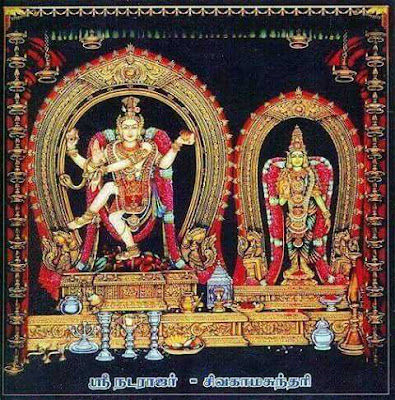
It is celebrated in the Tamil month of Margazhi and falls in December-January. The significance is celebration of Shiva's cosmic dance.
Thiruvaadhirai Kootu
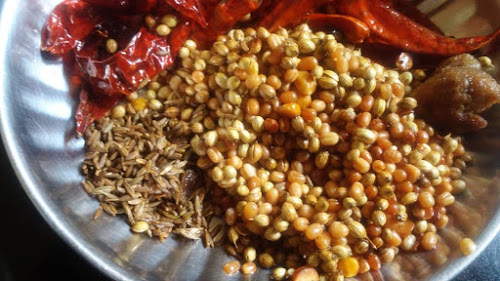
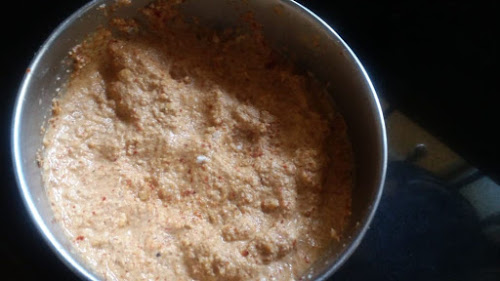
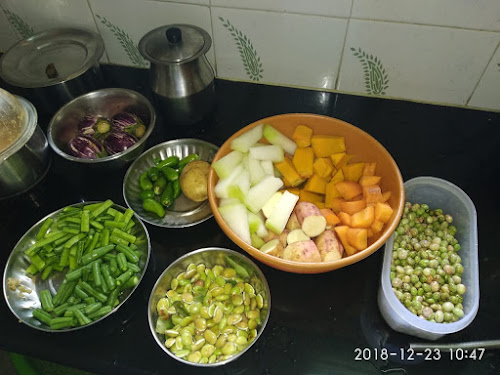
Ingredients: (serves 4-5)
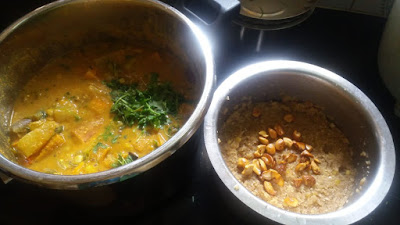
You need 7 variety of vegetables. That is why it is also named as yezhu-curry-kootu. (yezhu means 7 in Tamil, curry means vegetable). You can select any seven of these, or can also use all.
White pumpkin 250g
Yellow pumpkin 175g
sweet potato 2 (medium size)
avarakkai/flat beans : 15
kothavaranga/cluster beans: 20
katrika/brinjal : 5-6 medium size
Sena kazhangu/yam/suran: 150g
raw banana (optional) 1/2
You also need to add 1 cup lima beans ('moccha kottai' in tamil) along with the above. Chop above vegetables into big pieces.
Tamarind: Big lemon size (Make tamarind juice out of the raw tamarind.)
For masala paste:
urad dal : 2 tbsp (note: no kadala paruppu)
Dhaniya seeds : 2tbsp
Red chillies : 15-20
Jeera: 1/2 tspoon
Asafoetida/Perungayam: tamarind seed size
Fresh Grated coconut: 1 cup (or more as per quantity of vegetables)
green chillies : 6-7
curry leaves/cilantro leaves
Cooked Tuwar dal : 2 cups
1/4 tsp turmeric
salt 2 tsp
methi seeds 1/2 tsp
Method:
For masala:
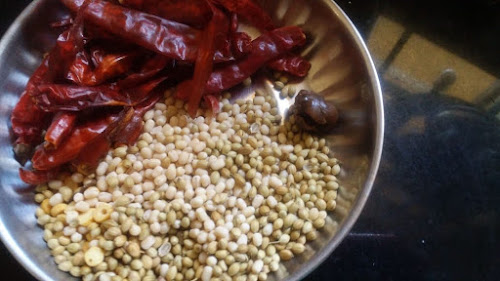
Fry urad dal, red chilli,dhaniya seeds with 1tsp oil till golden brwon. Add jeera, saute for 10 sec, then add coconut and saute for 2 min in low flame. Switch off flame , let it cool , then grind it (neither coarse, nor fine). Add little water. But not too much. You need to make a thick masala paste.
For gravy:
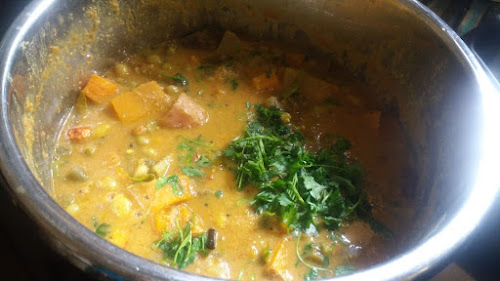
1. Take a big thick bottom vessel. Add 1.5 to 2 tumbler water. Once it boils, Add these veggies in order as given: chopped white pumkin, sweet potato, avarakkai, kothavaranga,sena kazhanug.. Then on top add yellow pumpkin, katrika, mocha kottai, slit green chillies. salt, turmeric.
2. Let it boild for 5-7 min with closed lid.
3. If u r using metal spoon, pls reverse it and use the pointed side to mix the vegetables, so that vegetables dont get mashed. Mix well. Close it again and let it boil for 3 min with closed lid.
4. Once veggies are half cooked, add tamarind juice. Again close with lid and let it boil for 4-5 min.
5. Now once vegetables are cooked, add tuwar dal. Now let it boil on medium flame for 3 min without lid.
6. Now add ground masala paste. Stir well.Add water as per consistency.
7. Bring to boil for another 4-5 min and switch off flame.
8. Now in a small pan, heat oil, add mustard seeds, let it crackle..then add methi seeds,red chilli, curry leaves. Switch off flame. Add the tadka to the gravy.
Thiruvadhirai Kali:
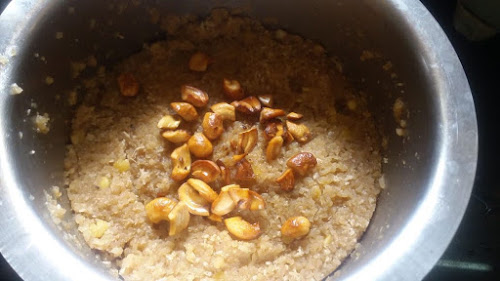
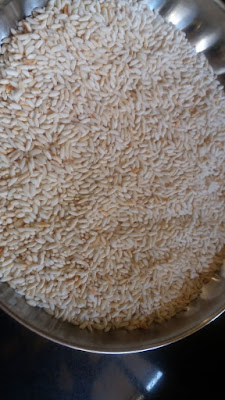
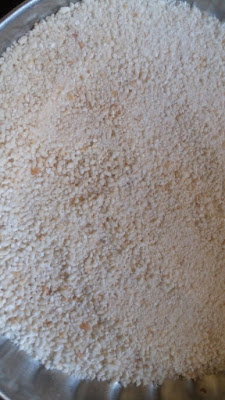
Ingredients:
1 tumbler raw rice
3/4 tumbler jaggery
Cardamom 4-5
ghee 4 tbsp
1.5 cup fresh grated coconut
Method:
Take kadhai and dry roast the raw rice till it becomes light reddish.
Once done, let it cool and grind it in mixer coarsely.
Take a pan, add 2 tbsp water and once it boils, put the broken jaggery. Jaggery will start melting and once done..let it cool and then using siever/filter, clean the melted jaggery. This is to be done since jaggery has sand and dirt particles.
Take 2-3 tumblers of water in a pan, once it boils, add grated coconut.
Add broken rice and stir well on low flame. Make sure that the rice doesnt get burnt.
Once rice is half cooked, add melted jaggery. Mix well.
While stirring, add few drops of ghee, mix well, again add few drops of ghee, mix well. Repeat this for 4 tbsp of ghee. Make sure that the rice doesnt get burnt.
Now add powdered cardomom, mix well. Switch off flame.
Pongal
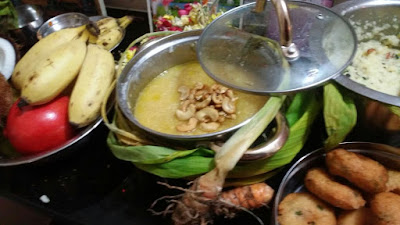
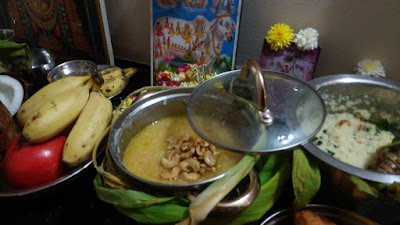
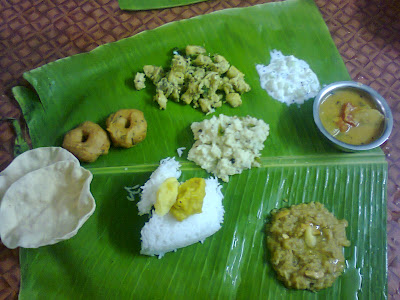
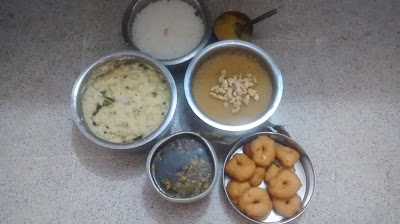
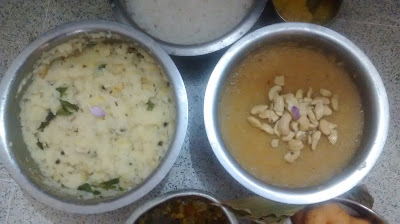
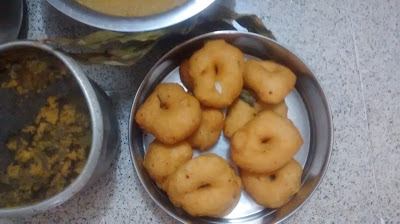
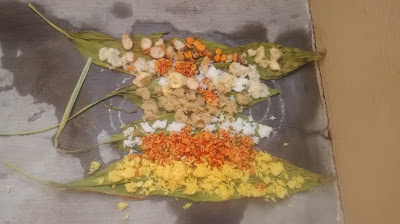
Pongal is festival of feast. Its a harvest festival which is a great celebration for farmers. Its a ThanksGiving to the Sun (nature) and the cattle which help us in agriculture and animal husbandry.
People in Tamilnadu celebrate it for four days as:
1. Bhogi Pongal
2. Surya Pongal
3. Maatu Pongal
4. Jallikattu (only in villages)
People make colourful rangolis, tie mango leaves thoran at the doors, clean house and decorate it.
Also kaapu kattu (bunch of pungam flowers and neem leaves) is tied at the doors/gate which stops negative power from entering the house.
Bhogi pongal feast:
Avial, Poriyal, Thuvaiyal, Paruppu Payasam (kadala paruppu), Pachadi, Sweet Pongal, Paruppu/Ulundu Vadai, Sambhar, Rasam, Appalam.
All the above items are first offered to God as neivedhiyam along with sugar canes.
Surya Pongal :
Take a new pot or used vengala pot (bell metal pot). Traditionally, we prepare pongal in vengala pots.
Take head bath in the morning (without oil). Surya Pongal is related to the Sun. We do not take oil bath on the days related to Sun. (That's why elders advise not to take oil bath on sundays too), wear new clothes. Its good to cook in open space under the sun.
Menu : Venpongal, Sakkarai Pongal, Vegetables Kootu, Vadai(ulundu vadai).
Tie turmeric along with its leaves around the pot. Draw surya and chandra pirai with chalk (sunnaambu). Prepare VenPongal and Sakkarai Pongal in those pots in open space under the Sun. While making Sweet pongal, when the milk boils, we have to joyfully shout 'pongal o pongal' which means 'wishing things to be in abundance'. 'Pongal' means 'overflow'. So we say it when the milk overflows. Offer the cooked items first to God as neivedhiyam (Do special offerings to SuryaDev and thank him for giving everything). Evening people go to temple with all family members.
Maatu pongal:
Its a thanks giving occasion to the cattle.
Villagers bathe the bulls, sharpen the horns and paint it with colours and decorate them. Bathe the cows, apply kumkum/turmeric to it, offer garlands. People take no work from cattle this day. Sweet pongal is prepared and fed to the bulls/cows/cattle.
Menu: Puli kootu with vegetables, Sweet coconut/tamarind/lemon rice.
In brahmin family, we perform offering to the birds(crows). Wake up early morning and before taking bath, we perform this offering called 'kanu pidi'. This is considered to be performed for the well being of brothers and is performed by girls/ladies. Go to an open space/terrace, clean turmeric leaves, make rangoli and place the leaves over them and take handful of venpongal,sweet pongal, turmeric rice, kumkum rice and place them over the leaves. Also place banana, elandha pazham, turmeric. (all these are generally preserved from the previous day i.e. surya pongal). Do aarthi and say 'kaka pidi vechen, kanu pidi vechen, kakaellam kalyanam, kurvikellam kondaatam". Then younger ones(only for girls/ladies) go to elders and get some turmeric applied on the forehead by the elders, then take bath(without oil). Avoid touching things before taking bath.
Jallikattu: The last day of celebration wherein bull fight is held in villages and people show off bravery. Then they let those bulls mate with cows.
Now lets have a look at the Pongal recipes.
VenPongal:
Ingredients:
3/4 cup of rice, 1/4 cup moog dal, few curry leaves, ginger (1 inch), 1 pinch hing, salt 1 sp, 1 tsp pepper and 1 tsp cumin seeds. Ghee 2-3 tbsp
Method:
Take rice and moog dal , wash it and pressure cook it with salt for 5-6 whisteles with 1:4 water.
Take ghee in pan, add ginger, pepper, cumin seeds one by one turn off after they crackle.
Add hing and curry leaves and mix it with the pressure cooked rice-dal mixture. Add ghee on top as desired.
Sakkarai Pongal (Sweet Pongal)
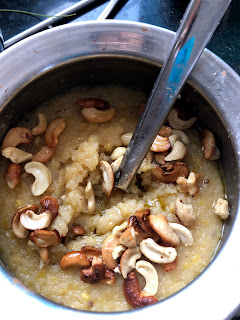
Ingredients:
3/4 cup rice, 1/4 cup moog dal.
jaggery : 1 cup
elaichi :4-5
ghee : 5-6 tbsp
Method:
Saute rice and moog dal on a pan, dry without oil, just for 1-2 min.
Add 2.5 cup water and 0.5 cup milk, pressure cook it for 5-6 whistels ( or boil it in pot till milk boils and till rice/dal become soft)
Add 2tbsp water to jaggery and allow it to melt. Filter it to remove impurities if any and add it to rice dal mixture and mix it. Let the jaggery bind and blend well with the mixture.
After 3-5 min, add ghee and stir well and allow it to boil for another 3-4 min till mixture reaches thick consistency. Add elaichi powder, Kaju & kishmish(roasted in ghee). Add more ghee if required/desired.
MahaShivaratri
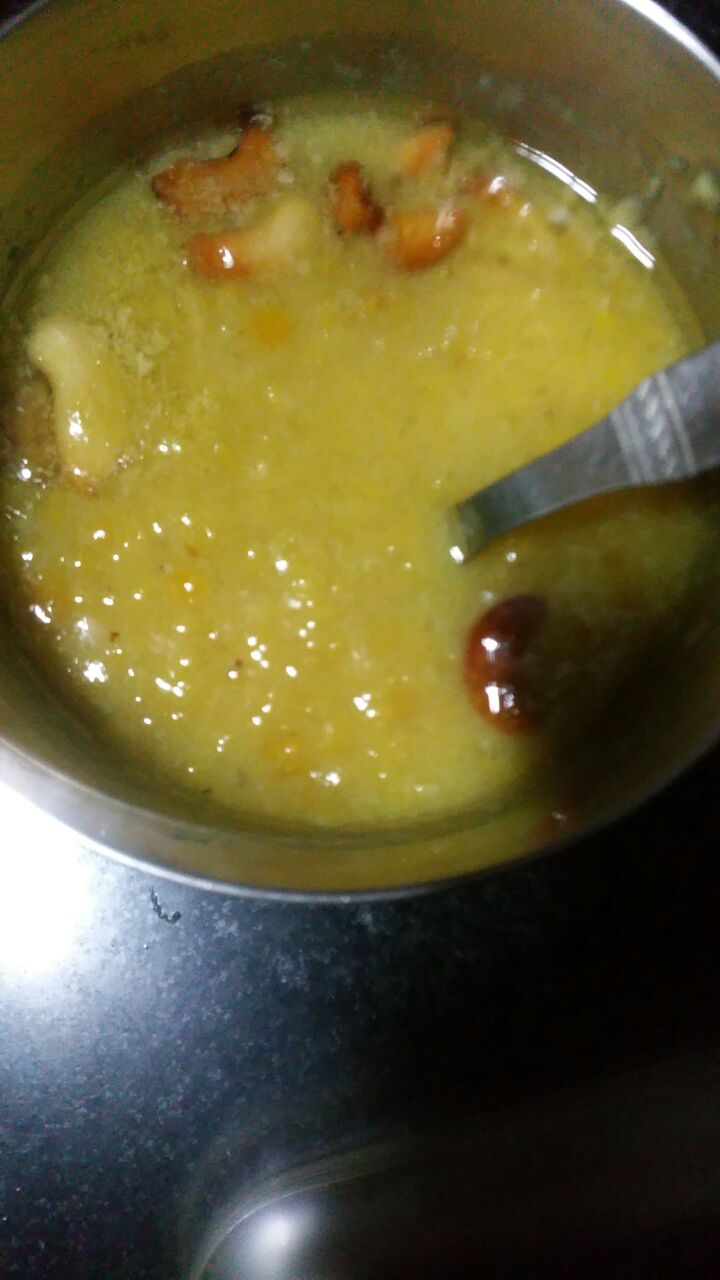
paruppu payasam and boiled sweet potatoes
Paruppu Payasam
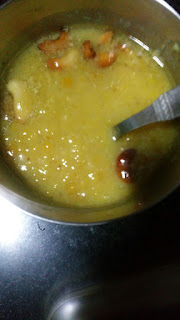 Ingredients:
Moong dal : 1 small cup
Chana dal : 1 tbsp
Jaggery : 1 small cup
Milk : 1/2 tumbler
Elaichi : 4-5
Ghee : 2 tbsp
Kaju : 7-8
Method :
Take 1 cup moog dal, 1 tbsp chana dal. Dry roast lightly till colour slightly changes.
Boil it in enough water.
Melt 1 cup jaggery and filter it (to remove mipurities if any). Mix it with dal and allow it to boil till raw flavour goes off and consistency is little thick.
Add 1/2 tumbler boiled milk, add elaichi (4-5) powder
Add ghee as required and roast the kaju in it till golden brown. Add it to the payasam.
Kaaradaiyaan nombu
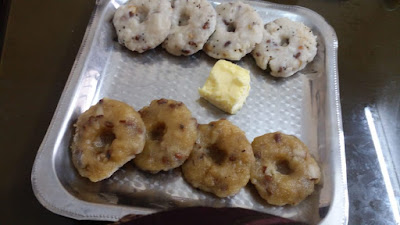
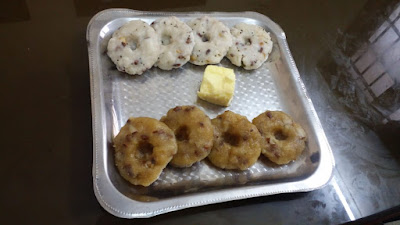
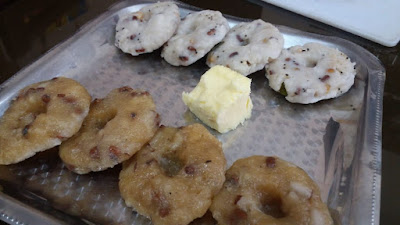
You might have heard the story of Satyavaan Saavitri. She brought back her husband from the clasps of Yamraj (Yamadharmar). Once Satyavaan was cutting woods in the forest that Yamraj comes to take him away as per his time rules. When Saavitri comes to know this, she pleads him to leave her husband. Since she keeps on following him, Yamraj tells her to ask for a boon, anything other than asking for her husband. She pleads that she needs hundred children through Satyavaan and in a hurry Yamraj says 'ok'. And on realizing what had happened, he is forced to leave Satyavaan and go. Hence we mark this day as 'Kaaradaiyan nombu' and ask for a boon of never getting separated from husband. As per our traditions, we don't worship or ask something from God without offering anything. Saavitri had prepared kuzhakattai/adai with sand(she could not get hold of anything but sand that time) and offered them to Yamraj for asking the boon. Hence to follow the same we prepare kuzhakattai and add karamani, chopped coconut to it to imitate the sand/stone particles.While praying and asking the boon, we tie 'saradu' - the sacred thread.
The time for tying the sacred thread (called 'saradu') is predicted before maasi month (in Tamil calendar) ends and before panguni month starts. If the predicted time falls in the morning, get up 3 hours before for the preparations. If the time falls in the evening, do the preparation in the morning itself.
(But if time is odd like 2 a.m., it is ok to get up at 4 or 5 a.m. and do the rituals.)
The rituals should be performed with empty stomach, hence pls do fasting that day. If the auspicious time falls in the evening, and if it is difficult to fast since morning due to health conditions, then try to finish lunch before 12 p.m. For lunch generally elders advise to eat 'pathu illa palagaaram' like aval upma or chappathi.
For Poojai, we need the below:
saradu (Buy nombu saradu from shop, else if not possible/not available, take a cotton thread and dip it once in turmeric water and take it out. )
flowers
banana leaf with corner/edge
vethalai, paaku (betel leaves & betel nuts)
fruits
coconut
malli poo or turmeric (manjal kazhangu).
(note : So always save fresh turmeric kazhangu which we get during pongal time. Pongal falls in month of Jan and this nombu falls in March).
The number of members participating in the Pooja should be even(i.e. 2 or 4) or can be 5 or more. If there are only 1 or 3 members participating, then add swami(God) as one member and make it 2 or 4 and put one banana leaf for swami too.
All should take bath and then only tie the saradu (if it is in the evening, take bath again before preparations), else if you are working professional and have no time after office, atleast clean your face,hands,legs and change clothes.
Clean the place for the members to sit and draw 'padi kolam' (rangoli) or simple star or square kolam with a center cross. (note : dont draw pulli kolam). Draw the rangoli for each member and place the banana leaf on every kolam/rangoli with leaf corner on the left hand side. Make sure that the sitting direction is east-west.
Tie malli poo(jasmine) or turmeric(small piece of manjal kazhangu) to the saradu.
Kongu region practice:
On a plate or tray, place vethalai(betel leaves 2 or 4 or >=5) ,two fruits (banana preferrably), manjal kazhangu (fresh turmeric),paaku (betel nuts),one whole coconut, saradu. Sprinkle water on banana leaf and clean it, place two sweet kuzhakattai on each leaf, 1 spoon of cooking butter (w/o salt). Now sit at the designated place, keep the prepared plate/tray in lap, first take the saradu and tie it round your neck. (if any elderly lady is there, they will offer the plate and tie the saradu for you, and also apply manjal(turmeric) kumkum to you). Pass the plate to others and each member will follow the same. After tying saradu, do namaskaaram to husband. Then come back, sit, take little water in hand and do neivedhiyam (move your hand circularly around the leaf and allow the water to drip simultaneously) and say
'urugaadha vennaiyum ore adaiyum naan tharen, oru naalum en kanavanai vittu piriyaadha irukkanum.'
(Meaning - Oh God, I'm offering you butter and adai, please grant me the boon of not getting separated from my husband even for a single day.)
Then keep aside one adai with some butter (for God) and then eat and enjoy the adai which you prepared with all hard work :) .
Thanjavur region practice:
Place vethalai (betel leaves 2 or 4 or >=5) ,two fruits (banana preferrably), manjal kazhangu (fresh turmeric), paaku (betel nuts) and saradu on the corner of the banana leaf. Then place two sweet kuzhakattai on each leaf, 1 spoon of cooking butter (w/o salt). Do neivedhiyam (move your hand circularly around the leaf and allow the water to drip simultaneously) and say
'urugaadha vennaiyum ore adaiyum naan tharen, oru naalum en kanavanai vittu piriyaadha irukkanum.'
(Meaning - Oh God, I'm offering you butter and adai, please grant me the boon of not getting separated from my husband even for a single day.)
Then take and tie the saradu, keep aside one adai with some butter and eat and enjoy the adai which you prepared with all hard work :) . Do namaskaaram to husband.
Do namaskaaram to elders.
This may be the only festival/pandigai wherein ladies eat first then serve to gents. :)
Next day give the adais (which were kept aside on the leaves) to cow.
In addition to sweet kuzhakattai (velladai), kaaradai (salted version) is also prepared, but that is for us to eat, neivedhiyam is not performed for the kaaradai.
Now let's see how to prepare the 'Adai's.
Vella Kuzhakattai (velladai)
Ingredients (for 12 kuzhakaattai apprx)
Rice : 1 tumbler (1 tumbler =~ 200ml)
Jagggery : 1/2 to 3/4 tumbler
Elaichi : 4
Coconut (chopped into baby milk teeth size) : 1/4 coconut
Thatta payir (karamani/lobia): 1 handful (one pidi)
Method:
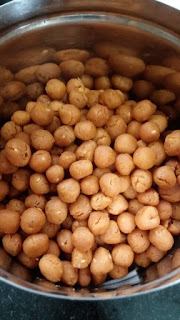
Dry saute the karamani without oil and then pressure cook for 5-6 whistles.
Soak rice in water for min 1/2 hr.
Drain the water well. Rice can be light wet but no water should remain. So strain well.
Grind the rice nicely and sieve it.(Dont use rava salladai, use maavu salladai - the one with the most minute pores.)
Now dry saute the ground rice flour till rose colour i.e. colour change. check if u can draw straight line (rangoli) without gaps.
Again sieve the roasted rice flour. Whatever remains in siever can be ground and added again.
Now take 1:2 water (here 2 tumblers) and boil it. Add vellam(jaggery). Filter it to remove impurities.
Again add vellam water and add chopped coconut,drain the water from thatta payir (karamani) and add 2-3 tbsp of it. Add powdered elaichi.
When jaggery mixture starts boiling, add rice flour slowly. Keep flame to sim and mix well. It will become thick paste like (like kali). Switch off the flame.
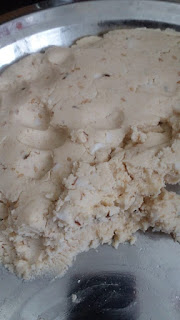
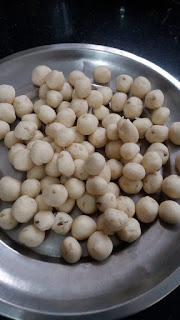
Now take a small portion of it, flatten it like vada/patty and make one thumb impression in centre (do not make hole) and steam it like idlis in idli cooker for 8-10 min.
Uppu kuzhakattai (kaaradai)
Ingredients:
Rice : 1 tumbler (1 tumbler =~ 200ml)
Rai/Mustard : 1/2 tsp
Urad dal : 1.5 tsp
Kadala Paruppu (chana dal): 1.5 tsp
Thatta payir (karamani/lobia): 1 handful (one pidi)
Green chilly : 2 chopped
Red chilly : 1
Coconut (chopped into baby milk teeth size) : 1/4 coconut or 2 tbsp apprx
Oil : 2 tbsp
Asafoetida : pinch
ginger
curry leaves : few
Salt : 1 tsp or as per taste
(Note: Kaaradai is not for neivedhiyam. It is only for us to eat)
Method:
Dry saute the karamani without oil and then pressure cook for 5-6 whistles.
Soak rice in water for min 1/2 hr.
Drain the water well. Rice can be light wet but no water should remain. So strain well.
Grind the rice nicely and sieve it.(Dont use rava salladai, use maavu salladai - the one with the most minute pores.)
Note : No need to roast the ground rice flour.
Heat oil in a pan, add rai, red chilly halved, urad dal, kadala paruppu (chana dal), curry leaves, green chilly, saute for a min, add 1:2 water, salt and bring it to boil. Drain the water from thatta payir (karamani) and add 2 tbsp of it.,chopped coconut, pinch hing. Once boiling, add rice maavu, mix well, it will become thick dough absorbing all water. switch off and close with lid for 10min. Knead it well with hands and again take ball, flatten like vadai, make finger impression in centre and steam it like dilis for 8-10 min in idli cooker.
Janmashtami/Gokulashtami
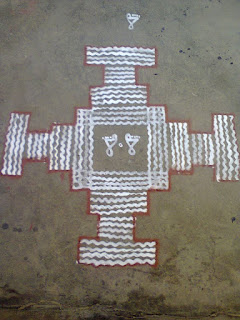
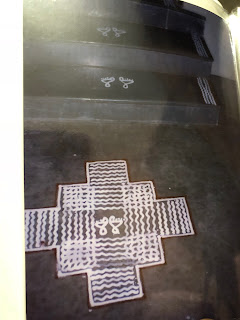
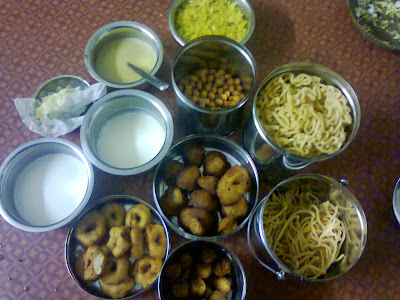
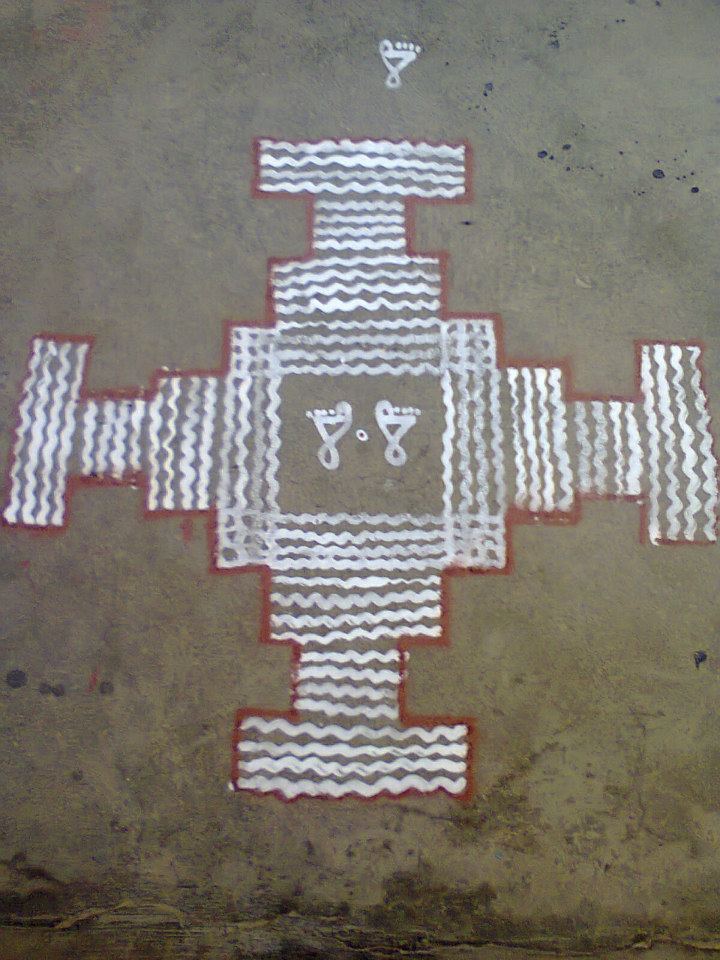
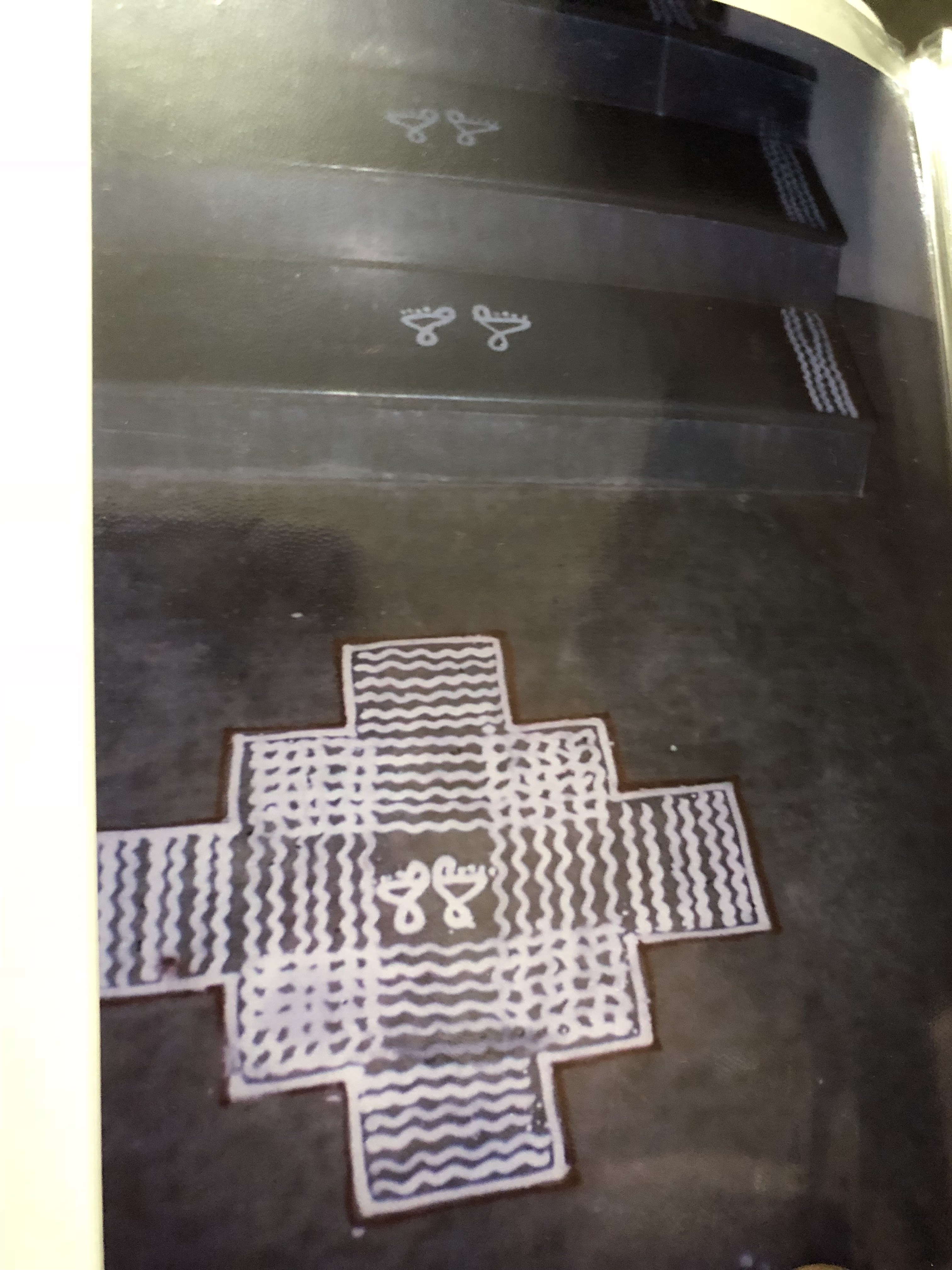
Janmashtami is celebrated across India, rejoicing the birth of Lard Krishna. If we see or hear stories of Krishna, we can note that Krishna also is a foodie. So we celebrate preparing varieties of dishes specially made of rice flour. Clean the house, draw the big traditional rangoli (maav padi kolam as shown in photo), draw cute little legs in the center of rangoli and draw them till pooja room (it's to be like little Krishna is walking into our house), prepare the special varities of dishes and offer them along with curd, milk, cooking butter, paitham paruppu payasam (moong dal kheer), vada, aval upma (poha/rice flakes upma), vella aval (made of rice flakes & jaggery, method similar to poornam for modakam, instead of rice flour, aval is added), fruits (especially jamun) to Lord Krishna.
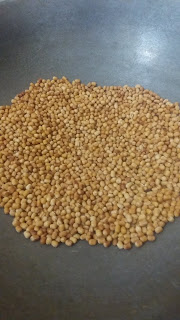 (dry roasted Urad dal)
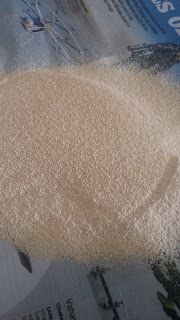 (taken during sieving of urad dal)
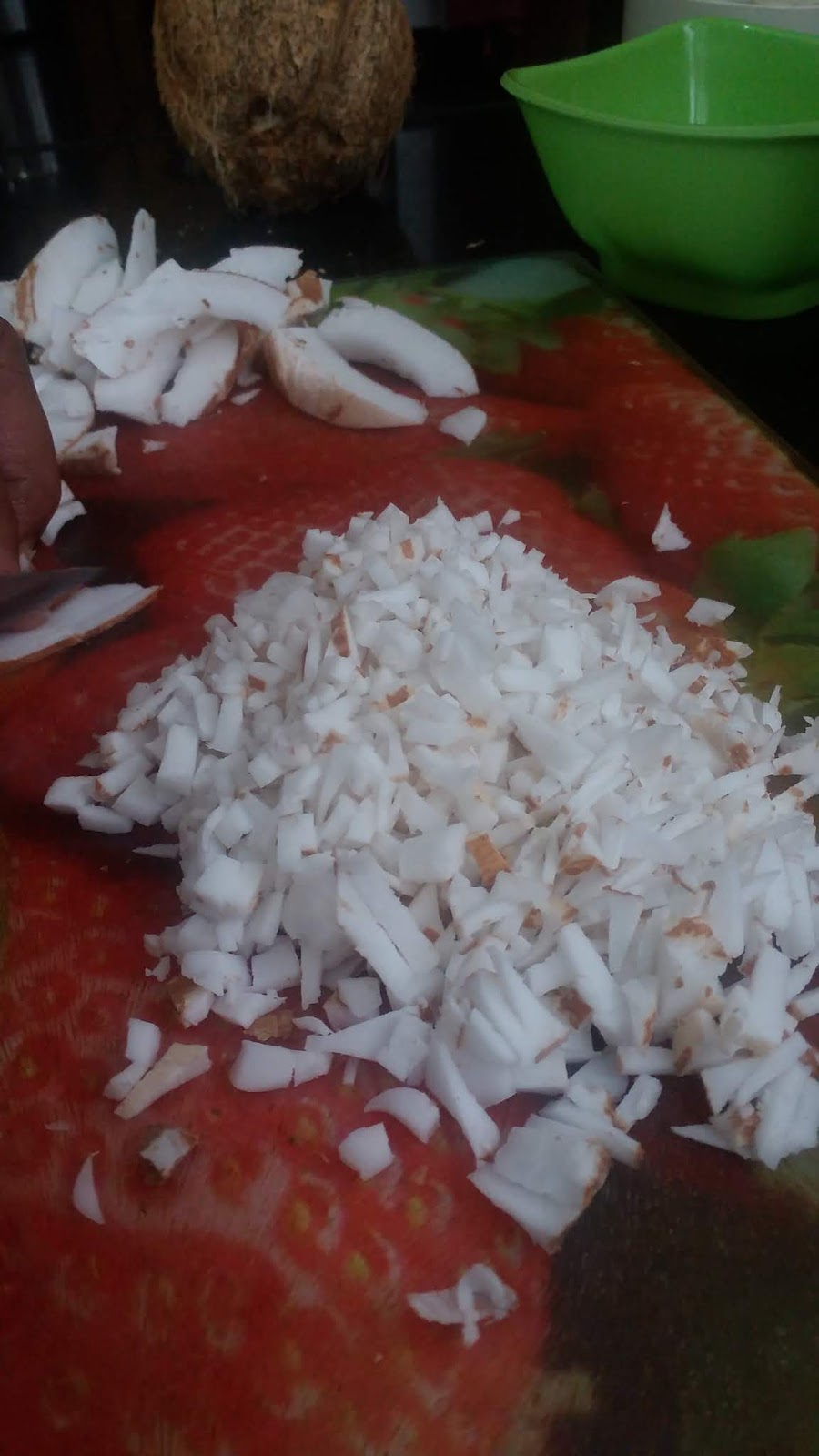
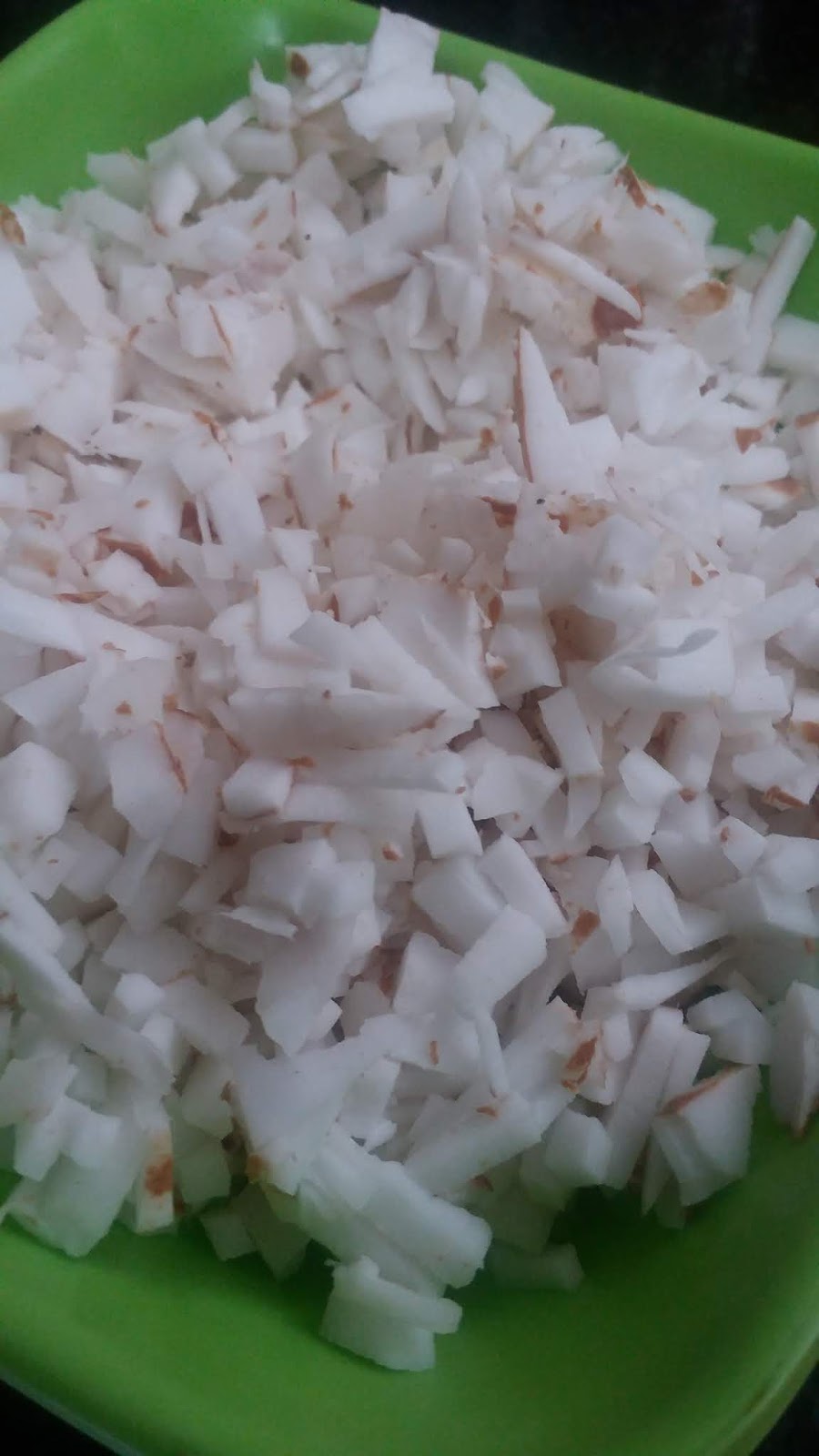
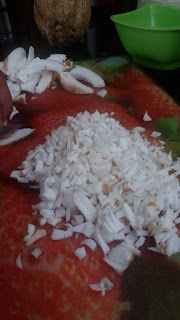 (chopping the coconut)
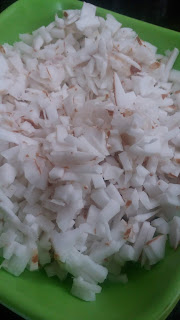 (chopped coconut)
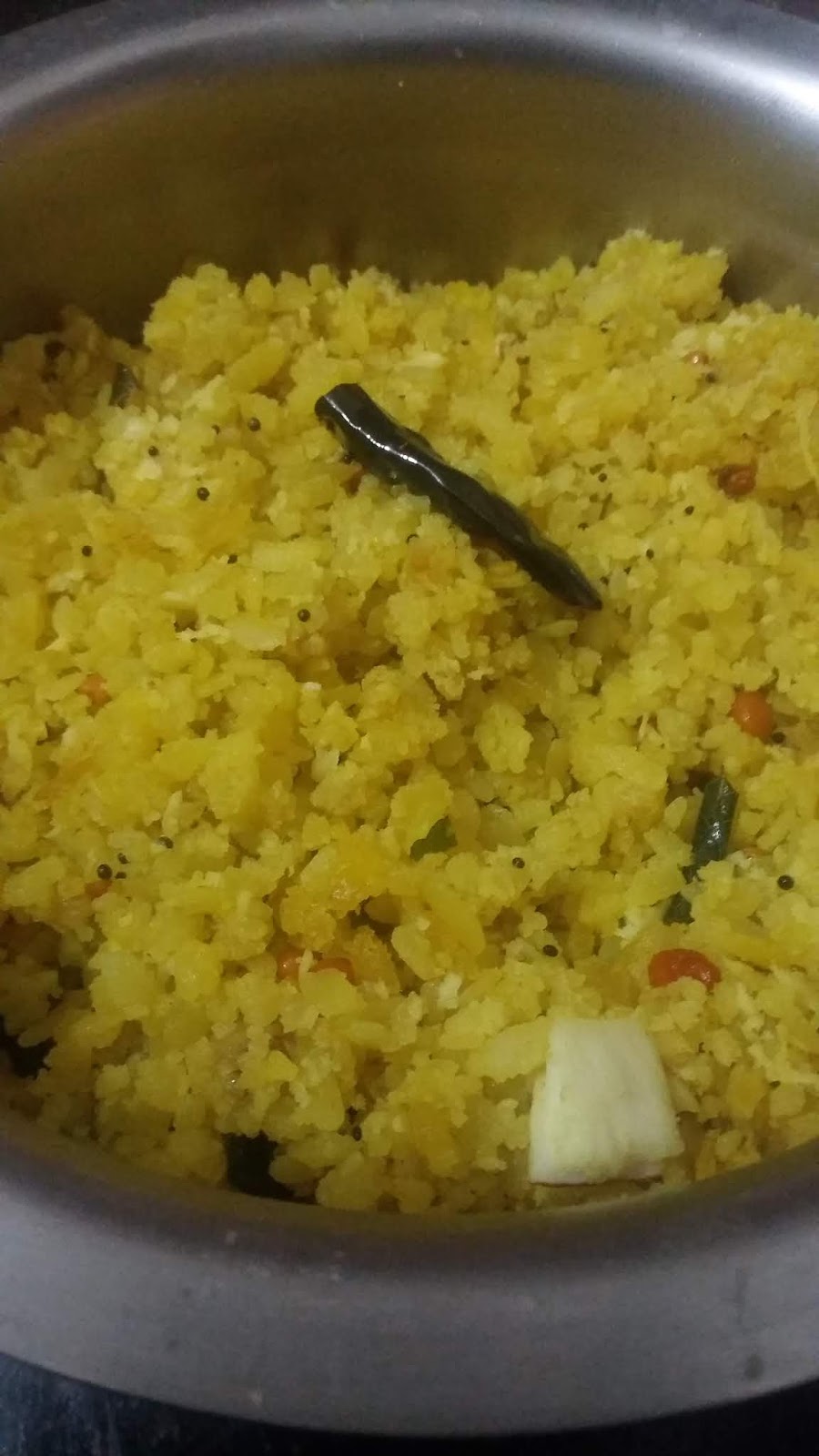
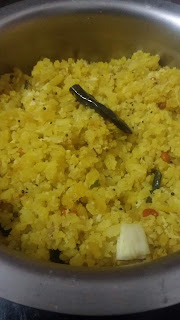 (aval Upma - with tamarind and coconut)
Note: The savouries are made of rice flour for Gokulashtami.
(aval Upma - with tamarind and coconut)
Note: The savouries are made of rice flour for Gokulashtami.
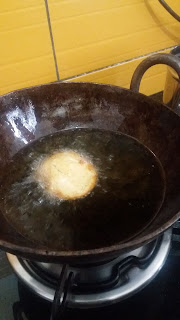
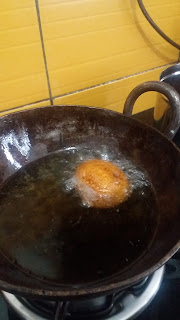
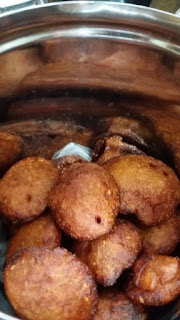
Add maida and urad dal powder into the batter and mix well. (this is for binding)
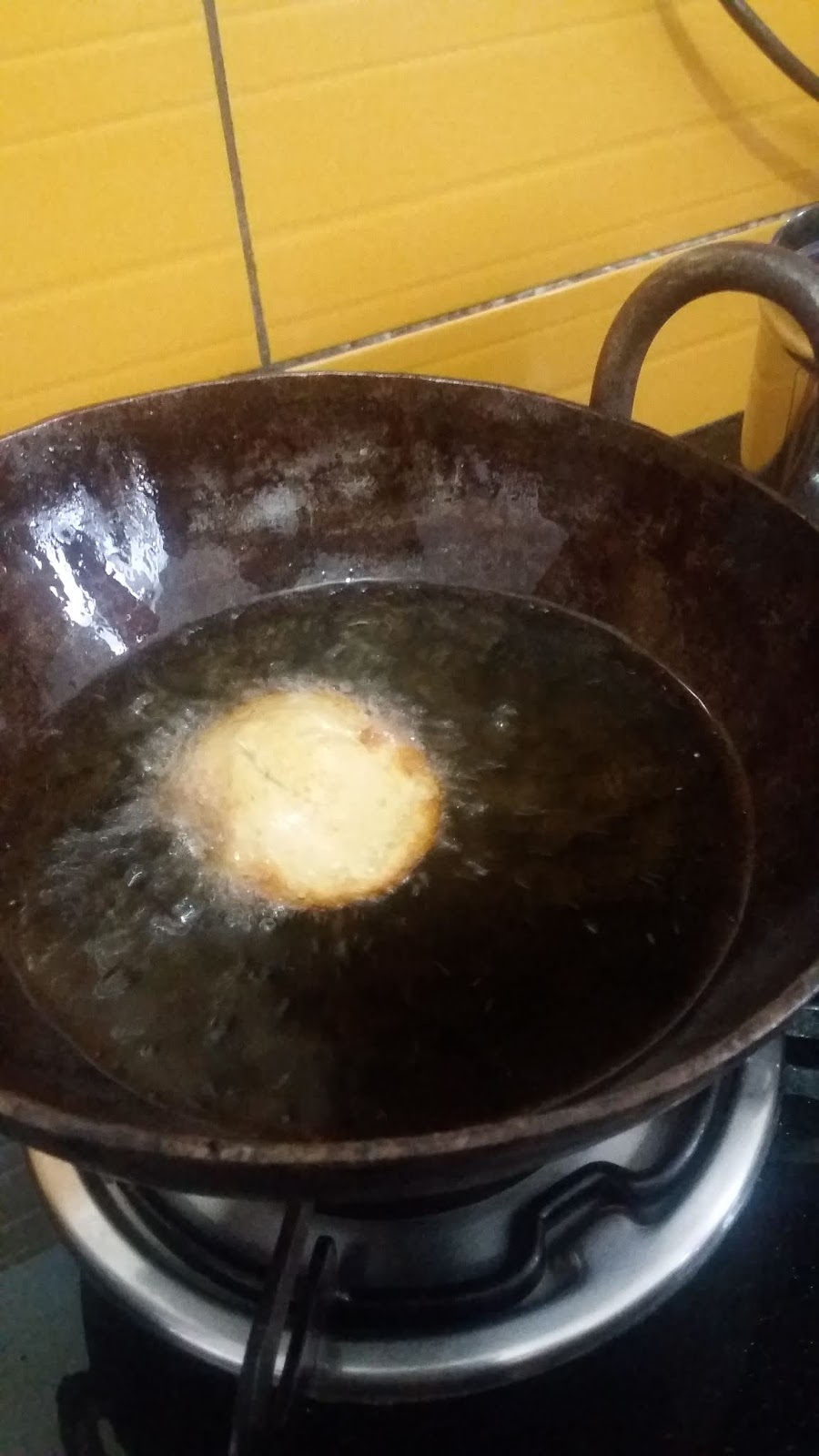
Heat oil in a pan for deep frying in a deep & thick bottom kadhai. When the oil is hot (but not too hot), take a small ladle of the batter and pour it right in the center of the kadhai. Initially the batter will stick to the bottom, but within a minute or so, it will come up. Turn it or flip it to the other side. Once it has turned golden brown evenly on both sides, remove it from the oil and place it on a plate or vessel with some tissue papers.
(note: transfer all appam into a container and close it only when appam cools down to room temperature)
Ganesh Chaturthi
Ganesh Chaturthi is celebrated all over India with equal spirit.
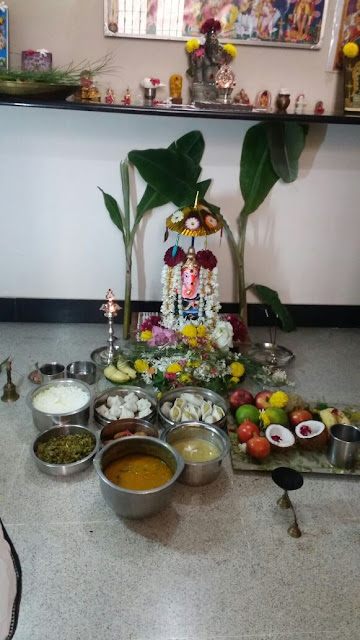
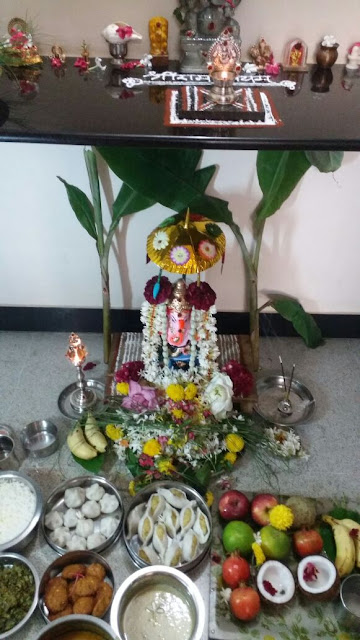
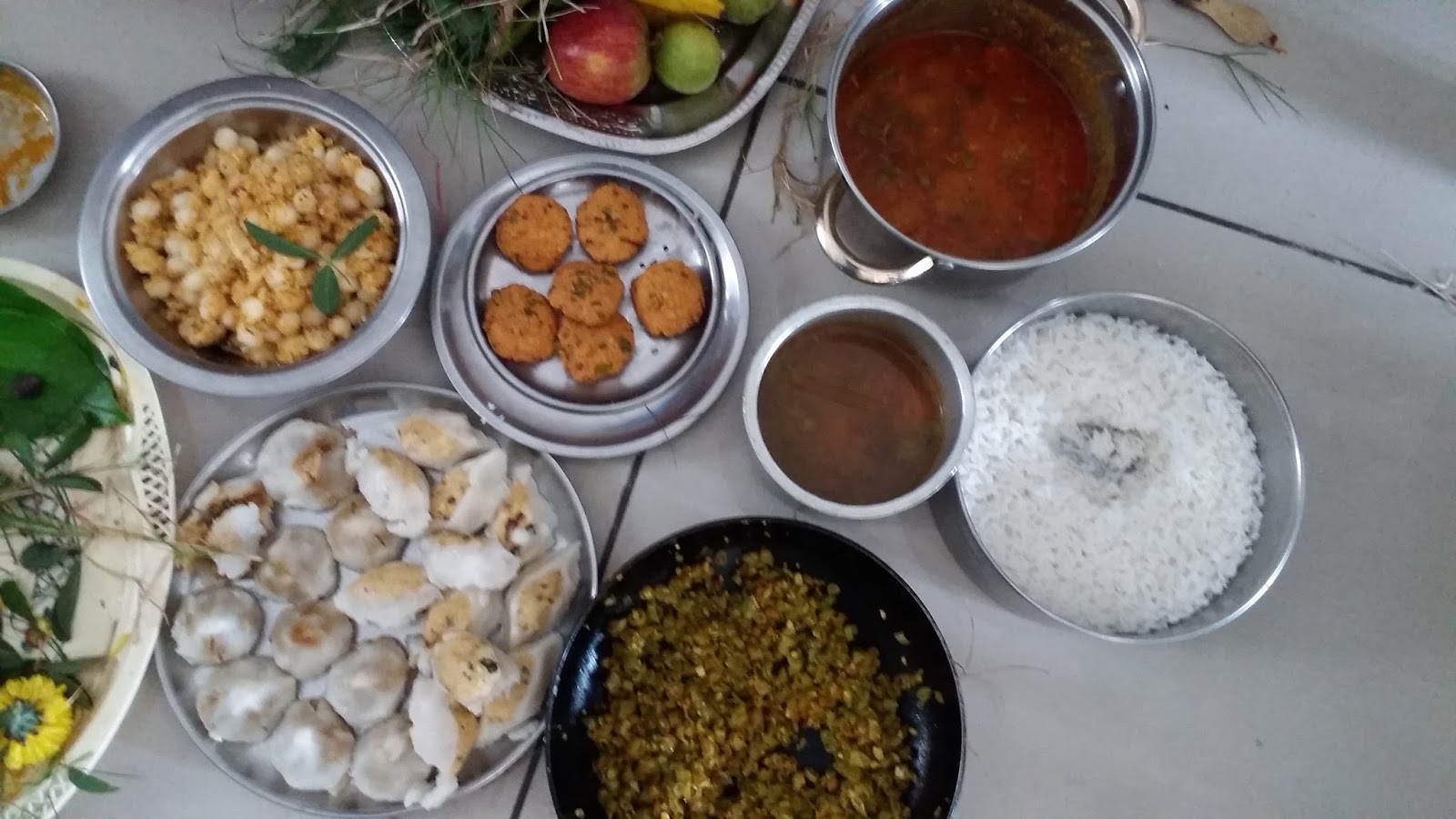
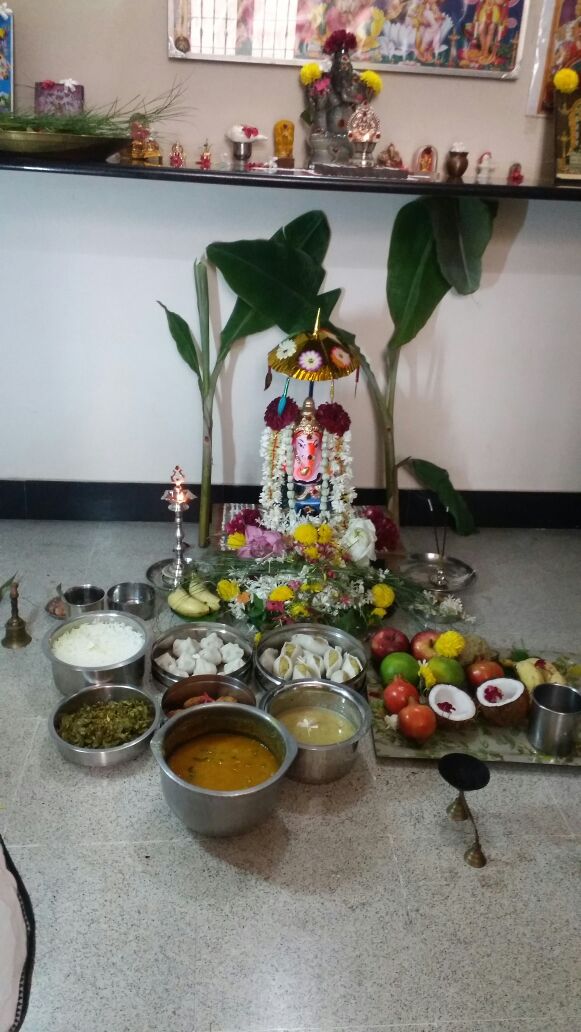
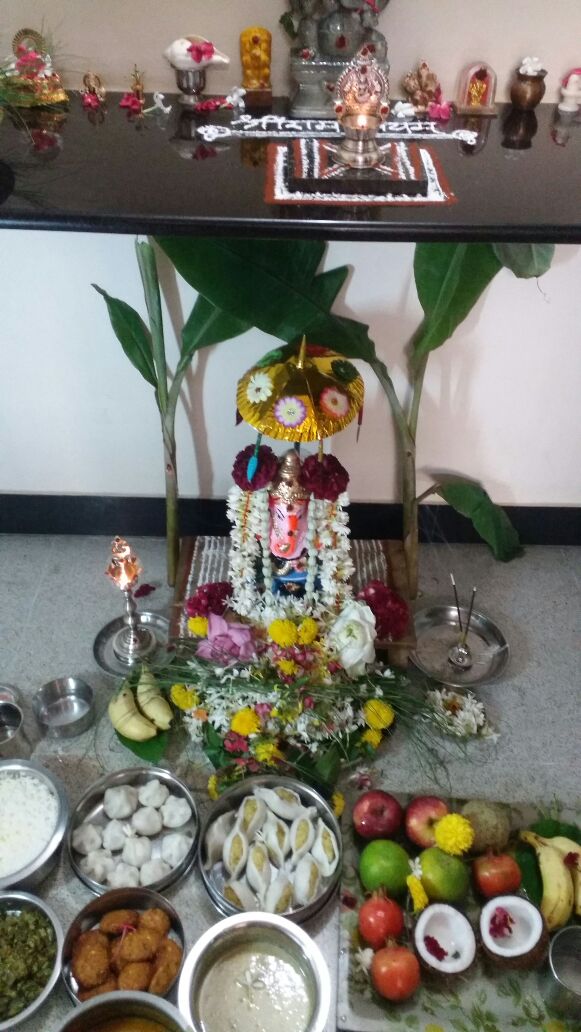
On this day, clean the house, draw rangoli, tie Ma ilai thoranam (mango leaves thoran). Buy kali mannu pillaiyar (Ganesh idol made of clay), apply chandan kumkum to the idol and decorate with flower garlands and a small decorative umbrella. Put poonal (janeu - the sacred thread), vastra malai (garland made of cotton beads with chandan kumkum applied). Buy a pair of vazha kannu (small banana plants) and keep it on the sides of idol. Buy different types of leaves and flowers, erukkam malai (crown flower) & arugam pullu (bermuda grass) is special for Ganesh.
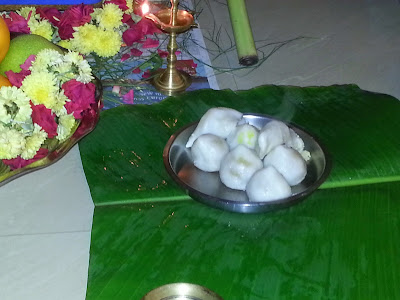
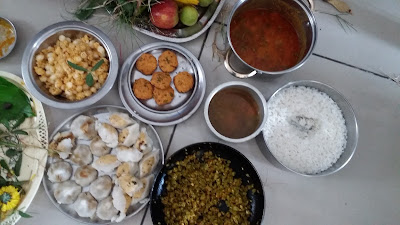
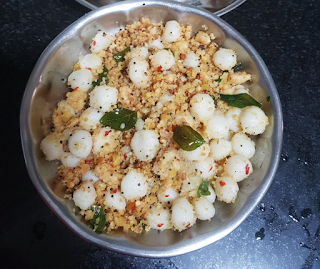
Prepare modak (sweet kuzhakattai, uppu kuzhakattai, mani kuzhakattai), paruppu vadai, kadala/arisi/moong payasam with coconut, sundal (karuppu kothu kadalai), appam (or unni appam), idli. Vella Aval (some call it aval kesari) can also be prepared.
Do pooja, aarti and offer the prepared dishes as neivedyam to the Lord.
Sing Bhakti songs, do thopkarnam (uthak baithak)as many times possible.
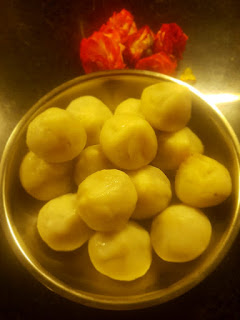
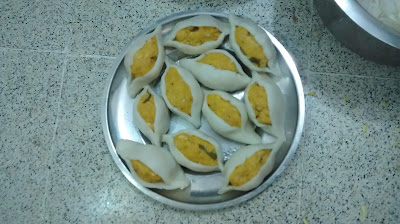
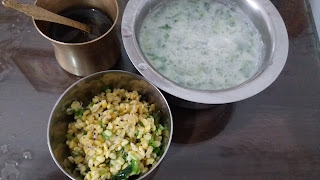
Generally people go to temple on this day and worship the deities. Ram-Seeta kalyanam is performed in temples and devotees are offered panakam, neer mor (thin buttermilk) and kosmalli (Moog dal with a touch of chillies and lemon.) You can also prepare them at home and offer it to the deity.
Panakam and neer mor helps cool your body. But in modern times we have replaced panakam with rasna.
Panakam
Ingredients:
Jaggery : 75g
Water : 2 cups apprx
Cardamom : 2
Ginger powder (sukku podi) : pinch
lemon : half
Method :
Mix jaggery (crushed/powdered/jaggery broken in small pieces) and water and give it sometime so that jaggery melts and blends with water. Filter it to remove impurities.
Add cardamom powder, ginger powder and squeeze half lemon to it. Mix well.
Kosmalli:
Ingredients
Moog dal (Paasi paruppu) : handful or 1/4 cup
Rai/Mustard : 1/4 tsp
Green chilli : 1-2
Lemon : half
Salt : 1/4 tsp
Curry leaves : few
Coriander leaves : few
Oil : for tempering
Method :
Soak the Moog dal in water for half an hour to 40 min.
For tempering, take 1 tsp oil in a pan, add mustard seeds, let it crackle, add chopped green chillies and curyy leaves, wait for 10-15 sec and switch off the flame.
Drain water from moog dal and add the tempering to it.
Add salt, few chopped coriander leaves and squeeze half lemon to it.
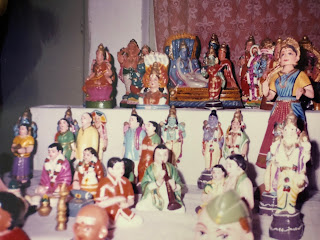
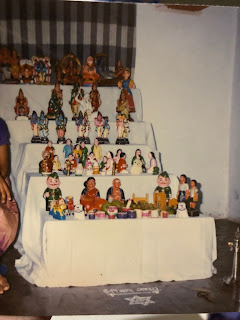
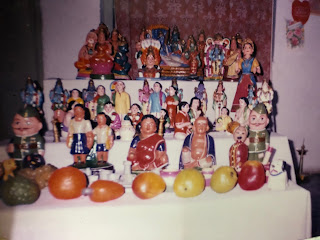
The colourful pattu pavadai ( silk dress worn by cute little girls), the numerous idols standing on the kolu steps, tasty sundal, bhakti songs, pooja - the 9 days of Navaratri is of absolute celebration. For kolu, the kalash and marapaachi bommai (a pair of dolls - one female and one male ) are the key ones. But if you place the kalash, then you should follows strict norms of pooja and be disciplined. Throughout the nine days, offer betel leaves & nuts by inviting married women at home (you should offer these items minimum : manjal/turmeric,kumkum, vethalai/betel leaves, paaku/betel nuts, fruits, blouse piece. But you can also offer any gifts like bangles, bindi, decorative items, any utensil, etc.).
Varieties of sundal are prepared throughout the nine days -
1. thatta payir - both white and brown (karamani/lobia)
2. mochakottai
3. pacha payir(green moong dal)
4. pattani sundal - green and white (mutter)
5. kadalaka (groundnut)
6. kothu kadalai -white & brown
7. Kollu sundal (kollu also comes in nava dhaaniyam list)
Also we can prepare pottu kadala podi.
On Tuesday and Friday, prepare payasam also (any variety of payasam).
Invite kanya kuzhandel (girl child who hasn't attained puberty) any of 10 days, but panchami (5th day) and durgashtami (8th day) is special. Invite any number of children except 3. You can offer them sweets like kesari(rava sheera) or payasam(kheer). Then offer turmeric,kumkum,betel leaves & betel nuts, fruits and any gift as per your wish like bangles/bindi/decorative box or anything.
On the ninth day we perform Saraswati pooja, and children eagerly await that day since it is advised not to study anything that day since studying will give headache to Saraswati. Clean musical instrments if any and apply kumkum turmeric to it and also to books. Tie maa illai thoran (mango leaves thoran), clean saraswati photo & apply turmeric-kumkum to it, put vastra mala, ravikai thuni (any blouse piece). Clean & decorate the pooja room with flowers. Perform pillaiyar pooja (ganesh pooja) first, then perform saraswati pooja. Prepare rice,paruppu (dal),vegetable curry,kootu,sambhar or more kuzhambu,rasam,payasam(kadala paruppu payasam),pachadi (always remember, if payasam is prepared, then pachadi also should be prepared) any vada, suiyam and offer it to God as neivedhiyam. If you are office goer and you have no time, then minimum offer rice,payasam,paruppu,ghee and do neivedhiyam. In the evening, prepare karuppu kothukadalai sundal and do nivedhiyam. Also some people perform ayudha poojai on this day, wherein all machines/equipments are cleaned, applied turmeric-kumkum and offered garlands.
On the tenth day, we celebrate Vijayadashami. (Goddess attained victory after nine days(or rather nights) of battle. Hence it is believed that victory will be definite for any work begun on this day. Mainly young parents with small kids perform Vidhyarambham on this day (hold the hand of the kid and write the first alphabet on a layer of rice, which means the kid has started to learn & gain knowledge on this auspicious day and hence will be victorious in knowledge attainment.) Read the books (few lines) and play the instruments for a little while which were kept for Saraswati pooja the previous day. Do aarti of dolls/idols kept in kolu and make them lay down since it is said that their legs will ache since they had been standing for 9 days together (anyone is enough - marapaachi bommai or murugan idol...). Vijayadashami is the day of victory, hence clean all the machines/equipments (like TV, fridge, washing machine) and vehicles, apply kumkum/chandan and offer flowers/garlands and take aarthi so that it works for long.(as said earlier, some perform this on ninth day itself)
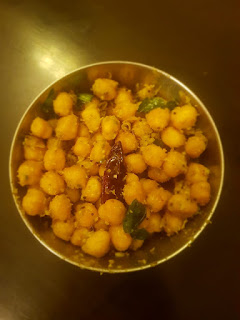
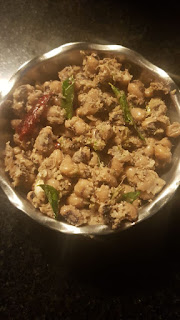
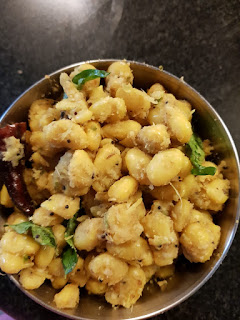
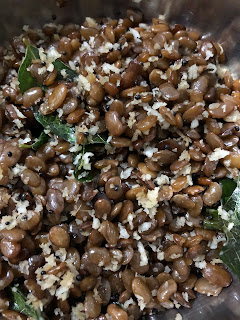
Kabuli chana Sundal (konda kadalai)
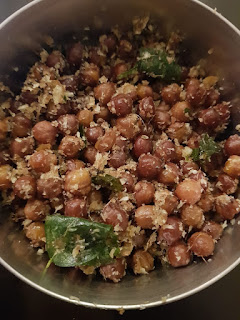
 Black chana Sundal (kothu kadalai)
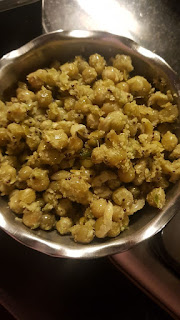
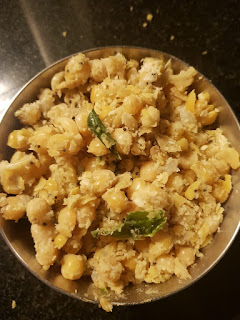
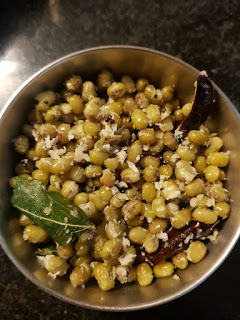
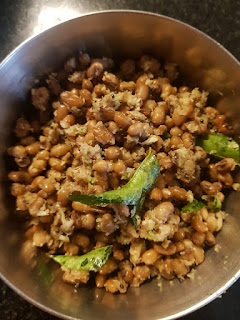
Sundal:
Ingredients:
sundal : 200g
Mustard/Rai : 1/2 tsp
Red chilli : 1 to 2
Curry leaves : few
ginger : 1/2 inch
green chilli : 1
[Note:Make coarsely mashed paste of ginger and green chilly]
hing : pinch
fresh coconut grated : 2 tbsp
oil : 1.5 tbsp
salt
Note:
For Thatta payir (karamani) or green moong dal sundal, u can dry saute them till they heat up well and then pressure cook it for 5-6 whistles.
For other varieties, soak the sundal for 2-3 hours and pressure cook it for 3-4 whistles
Method:
Heat oil, add mustard seeds, red chilli halved, curry leaves, ginger+green chilli paste.
Saute for few seconds, then add hing, add sundal (after draining the water well),some salt and saute for 2 min.
Add coconut and saute for 1 min. Switch off.
You can garnish with few fresh chopped coriander leaves if u like.
Item-wise Menu
Thiruvaadhirai Kootu
Thiruvadhirai Kali
Paruppu Payasam
Sakkarai Pongal/Sweet Pongal
Ven Pongal
Kaaradai (Uppu Kuzhakattai)
Velladai (Vellam Kuzhakattai)
Vella Cheedai
Appam
Plain Murukku
Mullu Murukku
Uppu Cheedai
Sweet Kozhukattai
Uppu Kozhukattai
Mani Kozhukattai
Panakam
Kosamalli
Sundal
Festival-wise Menu
Vaikunth Ekadasi
Aarudhra Dharisanam
Pongal
MahaShivaratri
Kaaradaiyaan Nombu
Rama Navami
Janmashtami/Gokulashtami
Ganesh Chaturthi
Navaratri
Vaikunth Ekadasi:
Elders would advise to take head bath (without oil). As per person's will power, fasting is observed either by fasting whole day or just eating once in a day. Some prefer eating idlis and some say idli is a form of rice, so some prefer chappathis. But both should be prepared without salt. For side dish, you can cook plain dhal without salt or can just have sugar. Or you can have just some fruits. It is completely as per the person's will power and bhakti.
The significance is that by oberving fasting on this day, we attain moksha and get place in the vaikuntham.
Thiruvaadhirai/Aarudhra Dharisanam
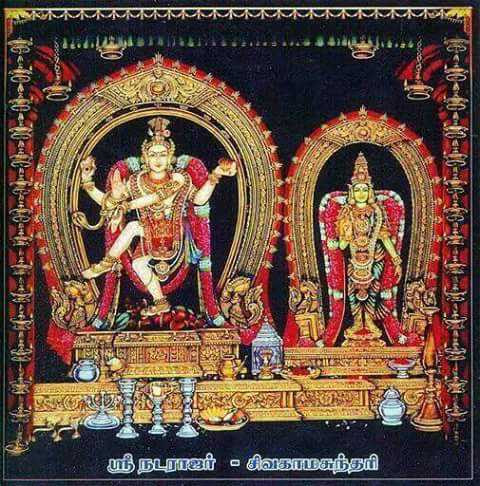
It is celebrated in the Tamil month of Margazhi and falls in December-January. The significance is celebration of Shiva's cosmic dance.
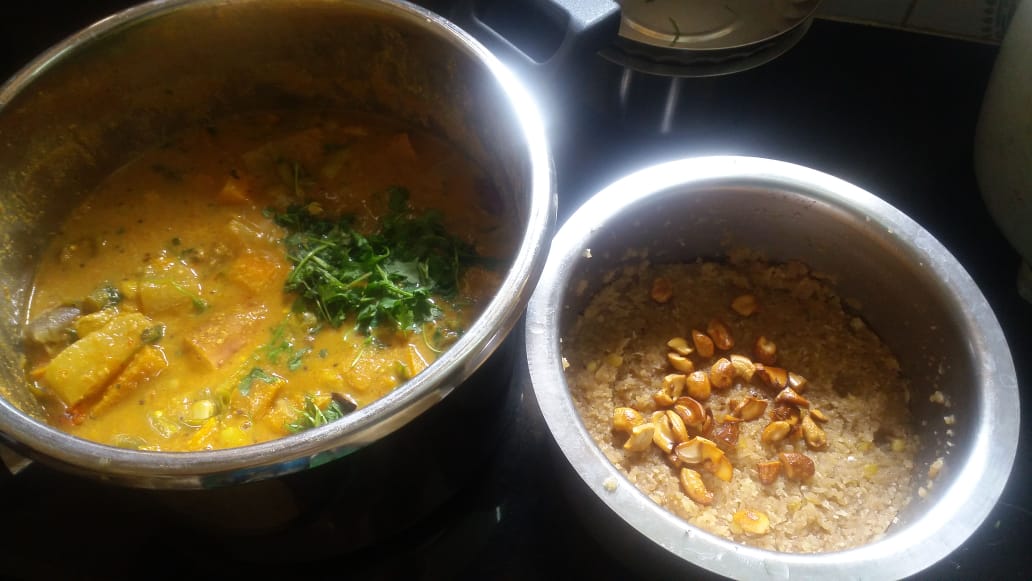
Thiruvaadhirai Kootu
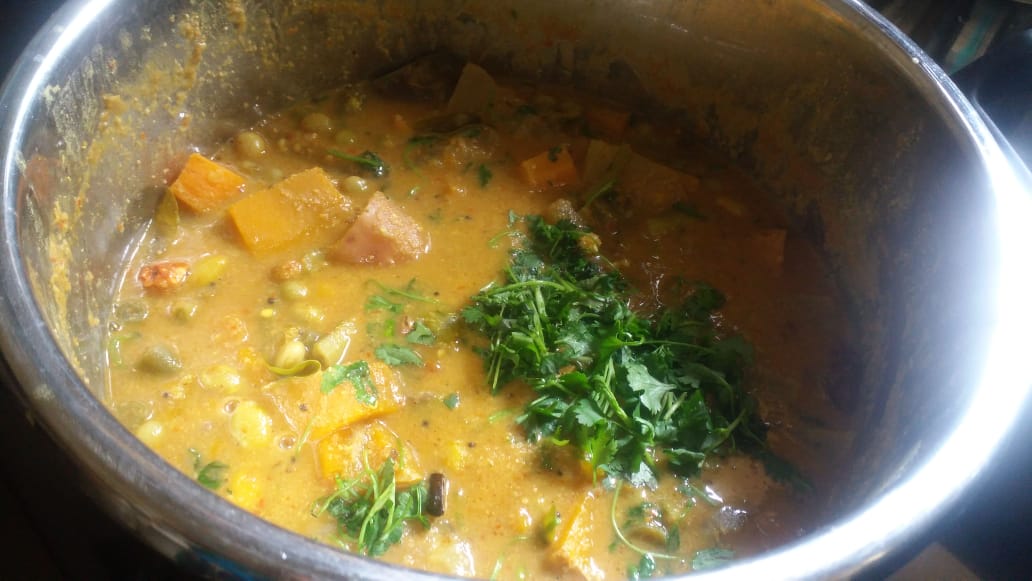
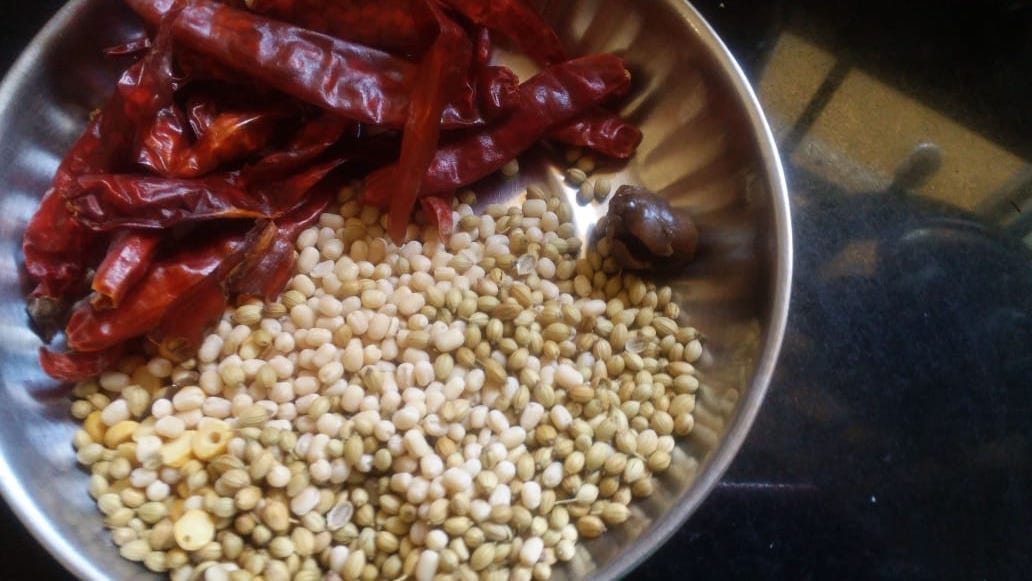
(spice ingredients for masala)
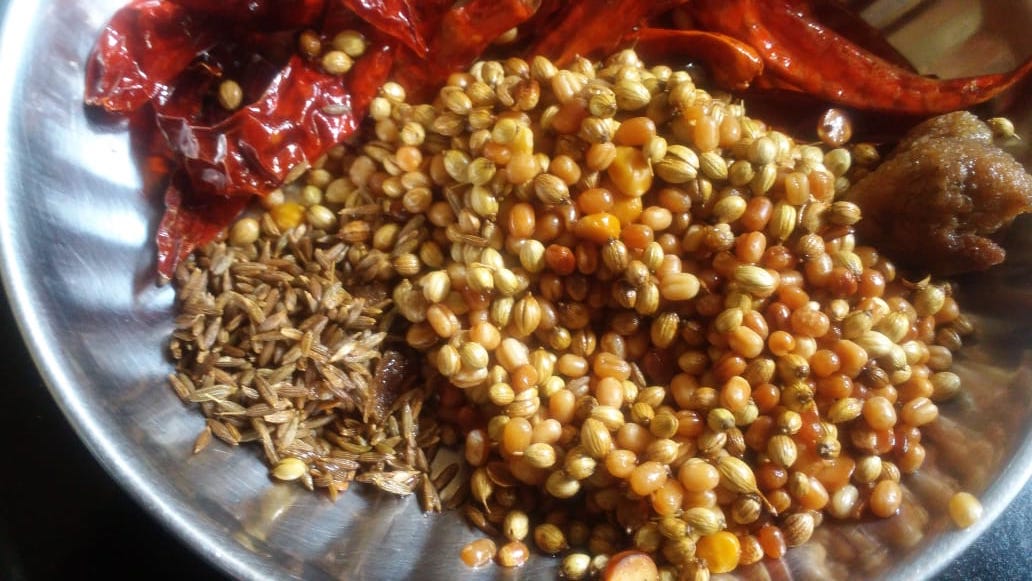
(roasted spices)
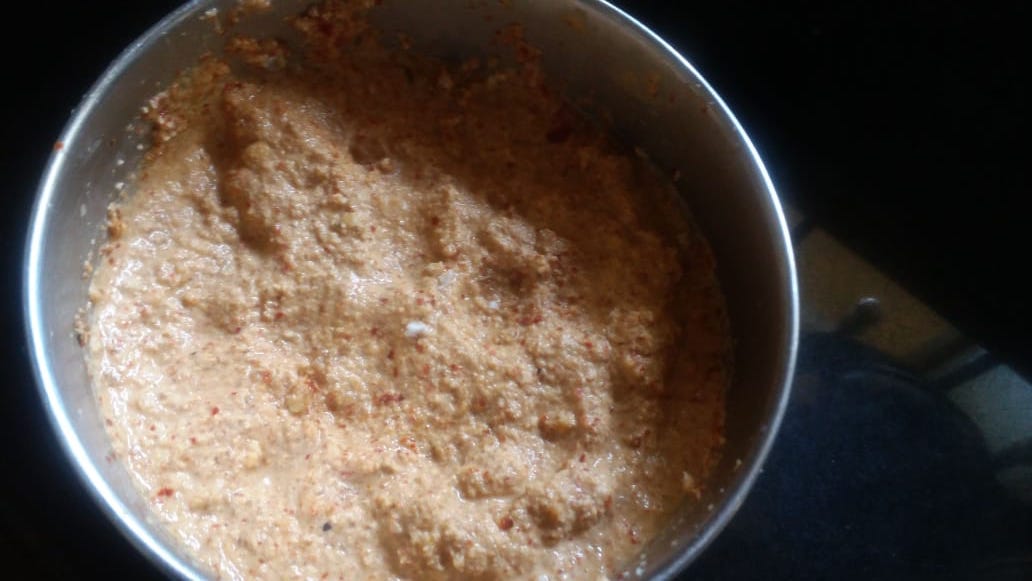
(ground masala paste)
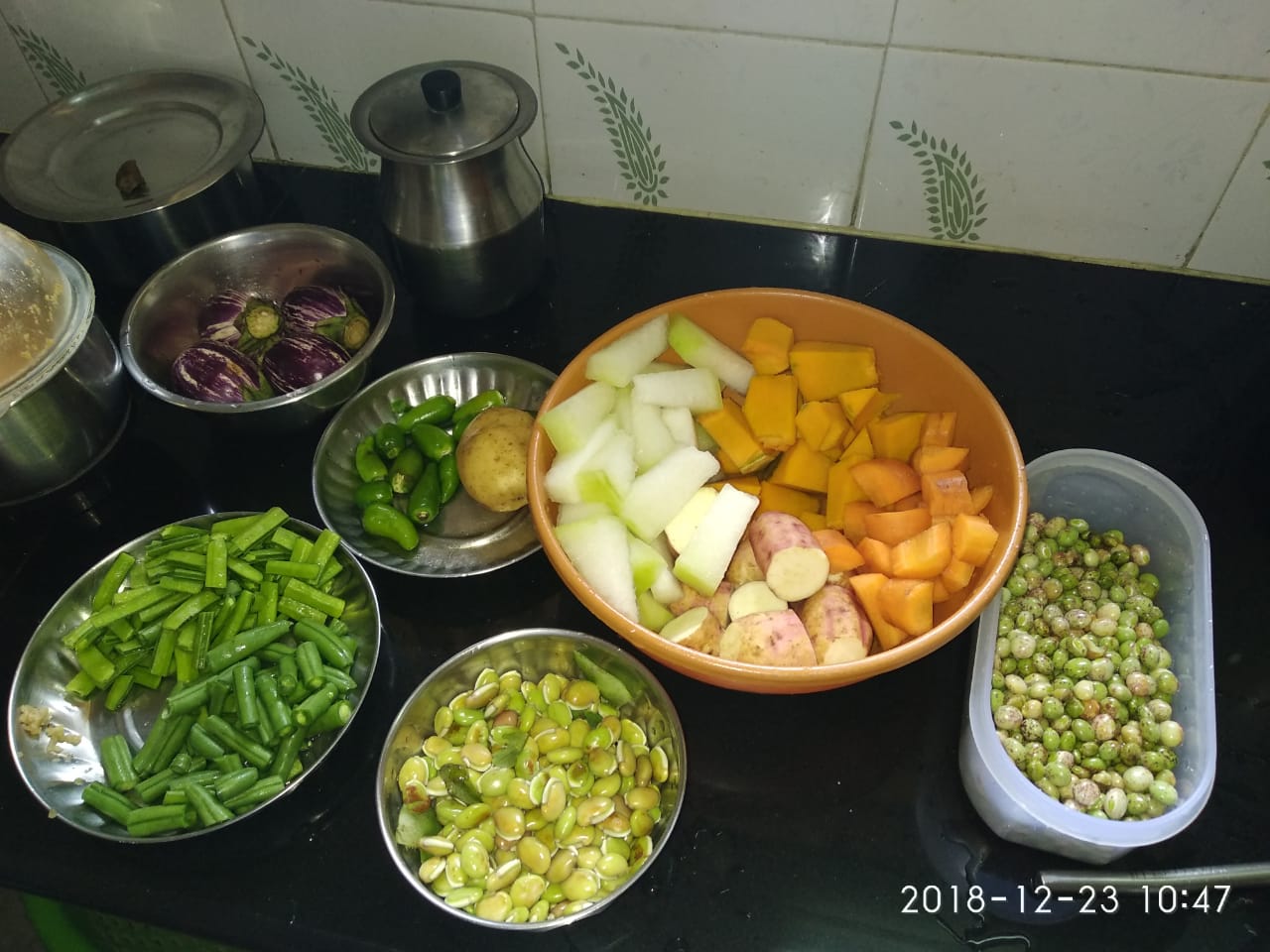
(fresh vegetables)
You need 7 variety of vegetables. That is why it is also named as yezhu-curry-kootu. (yezhu means 7 in Tamil, curry means vegetable). You can select any seven of these, or can also use all.
White pumpkin 250g
Yellow pumpkin 175g
sweet potato 2 (medium size)
avarakkai/flat beans : 15
kothavaranga/cluster beans: 20
katrika/brinjal : 5-6 medium size
Sena kazhangu/yam/suran: 150g
raw banana (optional) 1/2
You also need to add 1 cup lima beans ('moccha kottai' in tamil) along with the above. Chop above vegetables into big pieces.
Tamarind: Big lemon size (Make tamarind juice out of the raw tamarind.)
For masala paste:
urad dal : 2 tbsp (note: no kadala paruppu)
Dhaniya seeds : 2tbsp
Red chillies : 15-20
Jeera: 1/2 tspoon
Asafoetida/Perungayam: tamarind seed size
Fresh Grated coconut: 1 cup (or more as per quantity of vegetables)
green chillies : 6-7
curry leaves/cilantro leaves
Cooked Tuwar dal : 2 cups
1/4 tsp turmeric
salt 2 tsp
methi seeds 1/2 tsp
Method:
For masala:
Fry urad dal, red chilli,dhaniya seeds with 1tsp oil till golden brwon. Add jeera, saute for 10 sec, then add coconut and saute for 2 min in low flame. Switch off flame , let it cool , then grind it (neither coarse, nor fine). Add little water. But not too much. You need to make a thick masala paste.
For gravy:
1. Take a big thick bottom vessel. Add 1.5 to 2 tumbler water. Once it boils, Add these veggies in order as given: chopped white pumkin, sweet potato, avarakkai, kothavaranga,sena kazhanug.. Then on top add yellow pumpkin, katrika, mocha kottai, slit green chillies. salt, turmeric.
2. Let it boild for 5-7 min with closed lid.
3. If u r using metal spoon, pls reverse it and use the pointed side to mix the vegetables, so that vegetables dont get mashed. Mix well. Close it again and let it boil for 3 min with closed lid.
4. Once veggies are half cooked, add tamarind juice. Again close with lid and let it boil for 4-5 min.
5. Now once vegetables are cooked, add tuwar dal. Now let it boil on medium flame for 3 min without lid.
6. Now add ground masala paste. Stir well.Add water as per consistency.
7. Bring to boil for another 4-5 min and switch off flame.
8. Now in a small pan, heat oil, add mustard seeds, let it crackle..then add methi seeds,red chilli, curry leaves. Switch off flame. Add the tadka to the gravy.
Thiruvadhirai Kali:
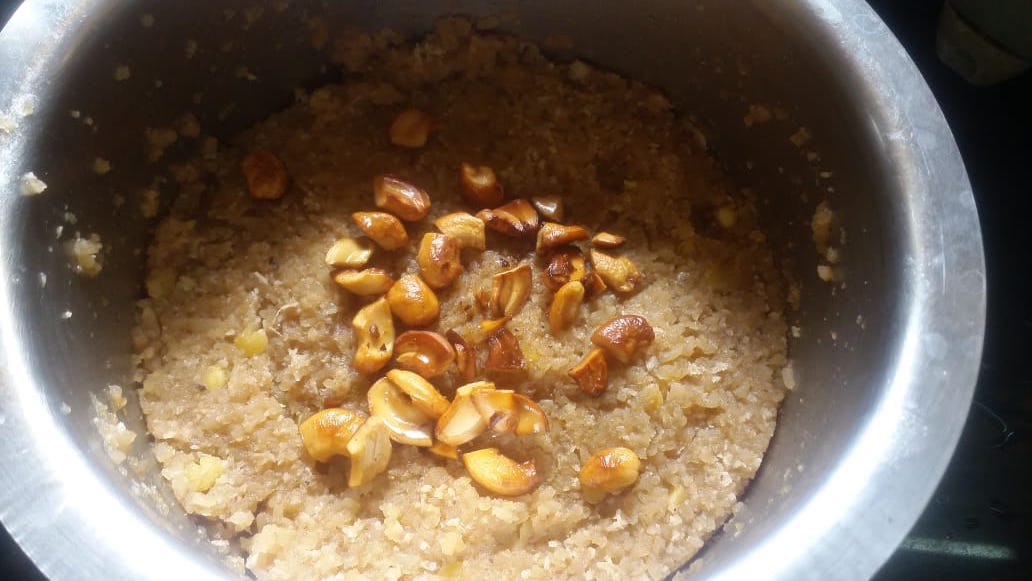
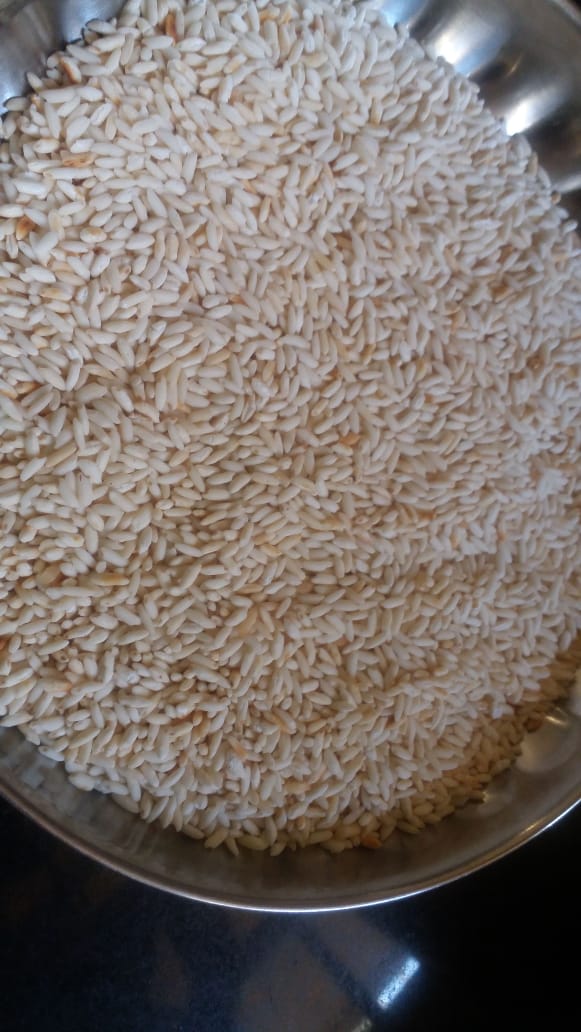
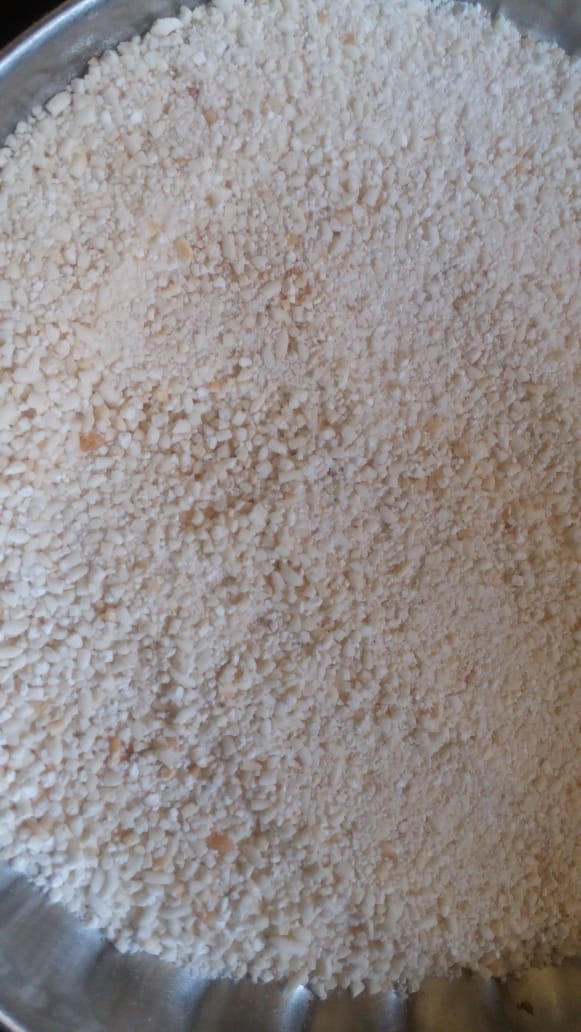
Ingredients:
1 tumbler raw rice
3/4 tumbler jaggery
Cardamom 4-5
ghee 4 tbsp
1.5 cup fresh grated coconut
Method:
Take kadhai and dry roast the raw rice till it becomes light reddish.
Once done, let it cool and grind it in mixer coarsely.
Take a pan, add 2 tbsp water and once it boils, put the broken jaggery. Jaggery will start melting and once done..let it cool and then using siever/filter, clean the melted jaggery. This is to be done since jaggery has sand and dirt particles.
Take 2-3 tumblers of water in a pan, once it boils, add grated coconut.
Add broken rice and stir well on low flame. Make sure that the rice doesnt get burnt.
Once rice is half cooked, add melted jaggery. Mix well.
While stirring, add few drops of ghee, mix well, again add few drops of ghee, mix well. Repeat this for 4 tbsp of ghee. Make sure that the rice doesnt get burnt.
Now add powdered cardomom, mix well. Switch off flame.
Pongal
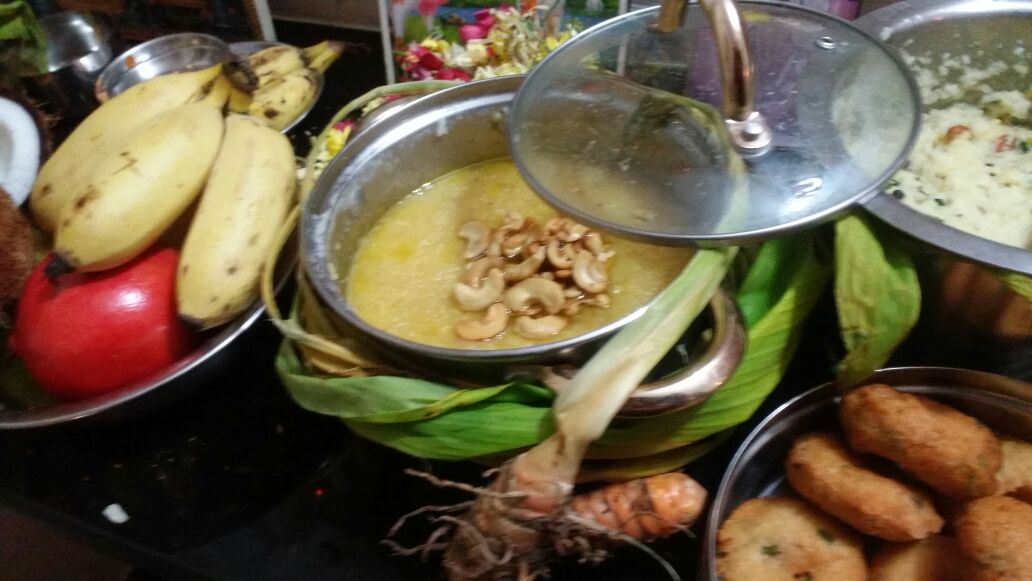
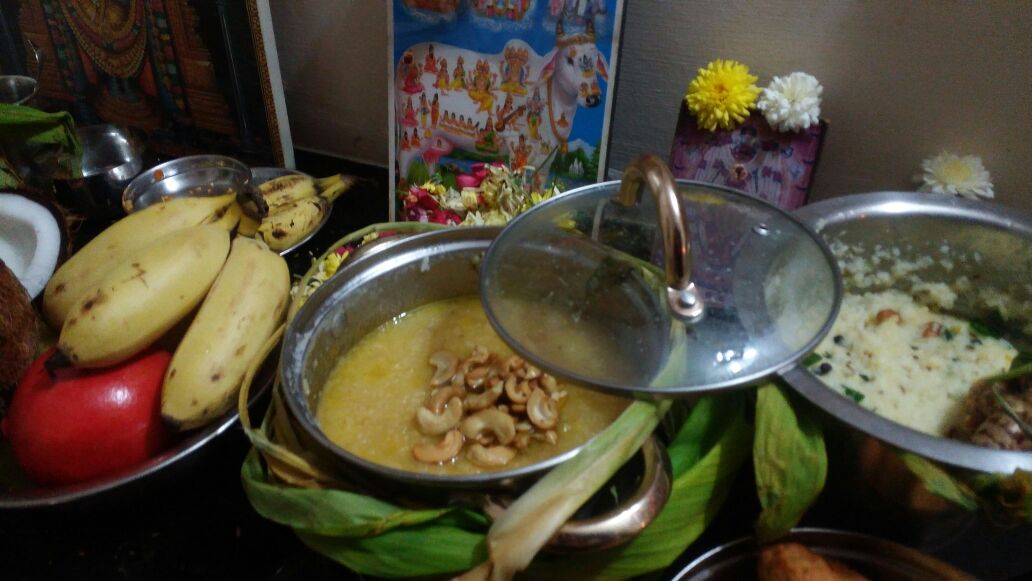

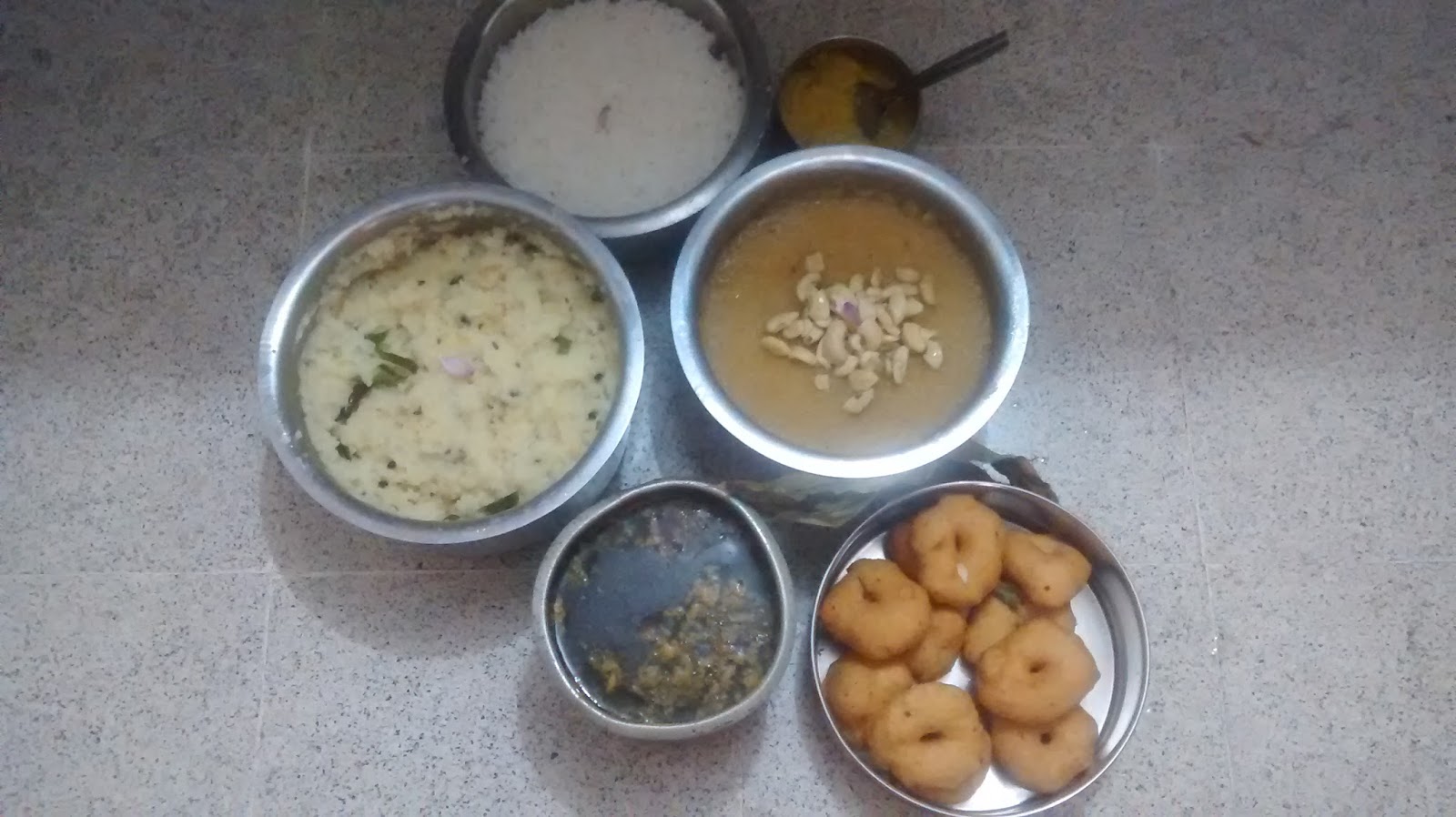
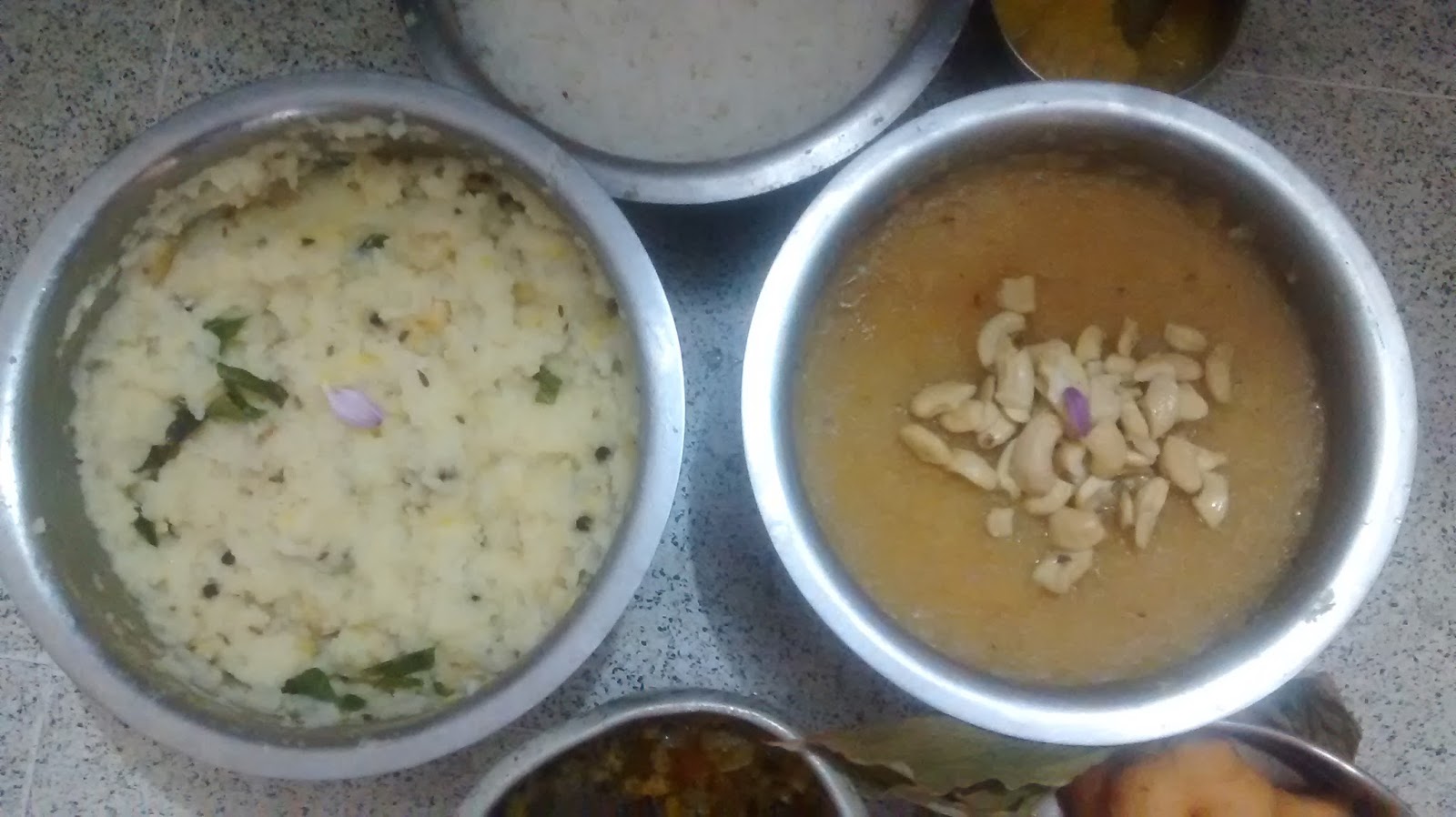
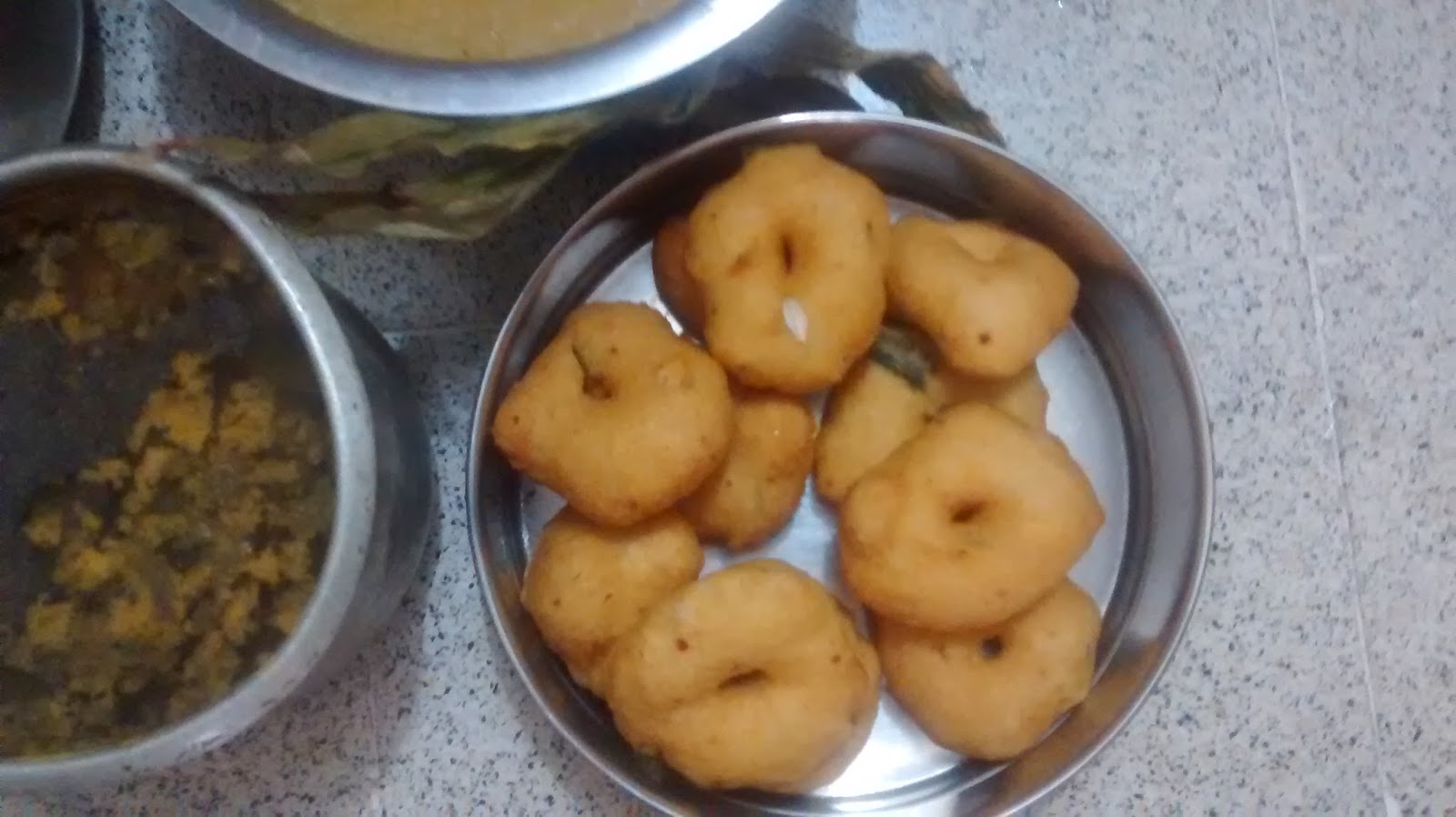
Pongal is festival of feast. Its a harvest festival which is a great celebration for farmers. Its a ThanksGiving to the Sun (nature) and the cattle which help us in agriculture and animal husbandry.
People in Tamilnadu celebrate it for four days as:
1. Bhogi Pongal
2. Surya Pongal
3. Maatu Pongal
4. Jallikattu (only in villages)
People make colourful rangolis, tie mango leaves thoran at the doors, clean house and decorate it.
Also kaapu kattu (bunch of pungam flowers and neem leaves) is tied at the doors/gate which stops negative power from entering the house.
Bhogi pongal feast:
Avial, Poriyal, Thuvaiyal, Paruppu Payasam (kadala paruppu), Pachadi, Sweet Pongal, Paruppu/Ulundu Vadai, Sambhar, Rasam, Appalam.
All the above items are first offered to God as neivedhiyam along with sugar canes.
Surya Pongal :
Take a new pot or used vengala pot (bell metal pot). Traditionally, we prepare pongal in vengala pots.
Take head bath in the morning (without oil). Surya Pongal is related to the Sun. We do not take oil bath on the days related to Sun. (That's why elders advise not to take oil bath on sundays too), wear new clothes. Its good to cook in open space under the sun.
Menu : Venpongal, Sakkarai Pongal, Vegetables Kootu, Vadai(ulundu vadai).
Tie turmeric along with its leaves around the pot. Draw surya and chandra pirai with chalk (sunnaambu). Prepare VenPongal and Sakkarai Pongal in those pots in open space under the Sun. While making Sweet pongal, when the milk boils, we have to joyfully shout 'pongal o pongal' which means 'wishing things to be in abundance'. 'Pongal' means 'overflow'. So we say it when the milk overflows. Offer the cooked items first to God as neivedhiyam (Do special offerings to SuryaDev and thank him for giving everything). Evening people go to temple with all family members.
Maatu pongal:
Its a thanks giving occasion to the cattle.
Villagers bathe the bulls, sharpen the horns and paint it with colours and decorate them. Bathe the cows, apply kumkum/turmeric to it, offer garlands. People take no work from cattle this day. Sweet pongal is prepared and fed to the bulls/cows/cattle.
Menu: Puli kootu with vegetables, Sweet coconut/tamarind/lemon rice.
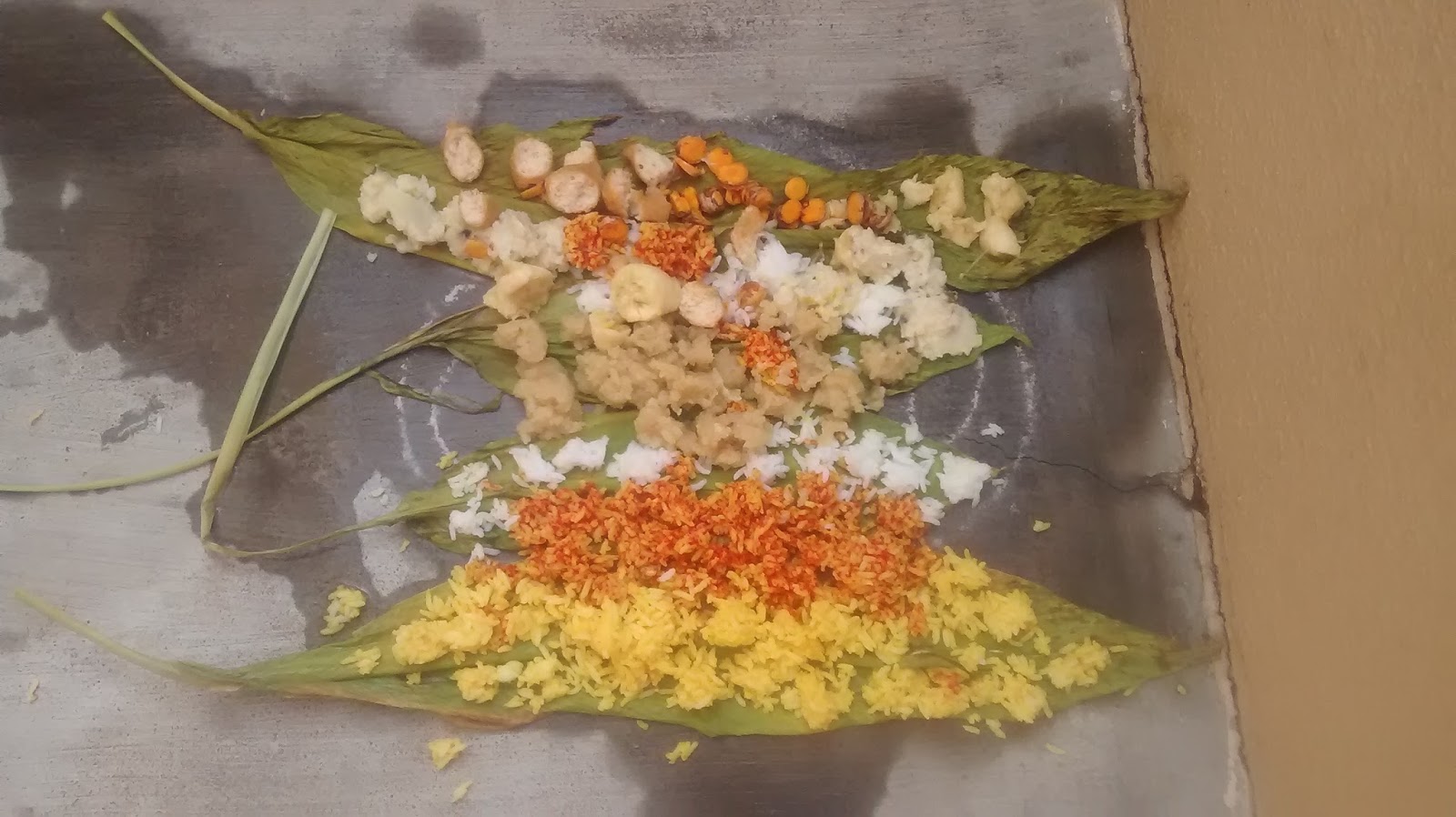
In brahmin family, we perform offering to the birds(crows). Wake up early morning and before taking bath, we perform this offering called 'kanu pidi'. This is considered to be performed for the well being of brothers and is performed by girls/ladies. Go to an open space/terrace, clean turmeric leaves, make rangoli and place the leaves over them and take handful of venpongal,sweet pongal, turmeric rice, kumkum rice and place them over the leaves. Also place banana, elandha pazham, turmeric. (all these are generally preserved from the previous day i.e. surya pongal). Do aarthi and say 'kaka pidi vechen, kanu pidi vechen, kakaellam kalyanam, kurvikellam kondaatam". Then younger ones(only for girls/ladies) go to elders and get some turmeric applied on the forehead by the elders, then take bath(without oil). Avoid touching things before taking bath.
Jallikattu: The last day of celebration wherein bull fight is held in villages and people show off bravery. Then they let those bulls mate with cows.
Now lets have a look at the Pongal recipes.
VenPongal:
Ingredients:
3/4 cup of rice, 1/4 cup moog dal, few curry leaves, ginger (1 inch), 1 pinch hing, salt 1 sp, 1 tsp pepper and 1 tsp cumin seeds. Ghee 2-3 tbsp
Method:
Take rice and moog dal , wash it and pressure cook it with salt for 5-6 whisteles with 1:4 water.
Take ghee in pan, add ginger, pepper, cumin seeds one by one turn off after they crackle.
Add hing and curry leaves and mix it with the pressure cooked rice-dal mixture. Add ghee on top as desired.
Sakkarai Pongal (Sweet Pongal)
Ingredients:
3/4 cup rice, 1/4 cup moog dal.
jaggery : 1 cup
elaichi :4-5
ghee : 5-6 tbsp
Method:
Saute rice and moog dal on a pan, dry without oil, just for 1-2 min.
Add 2.5 cup water and 0.5 cup milk, pressure cook it for 5-6 whistels ( or boil it in pot till milk boils and till rice/dal become soft)
Add 2tbsp water to jaggery and allow it to melt. Filter it to remove impurities if any and add it to rice dal mixture and mix it. Let the jaggery bind and blend well with the mixture.
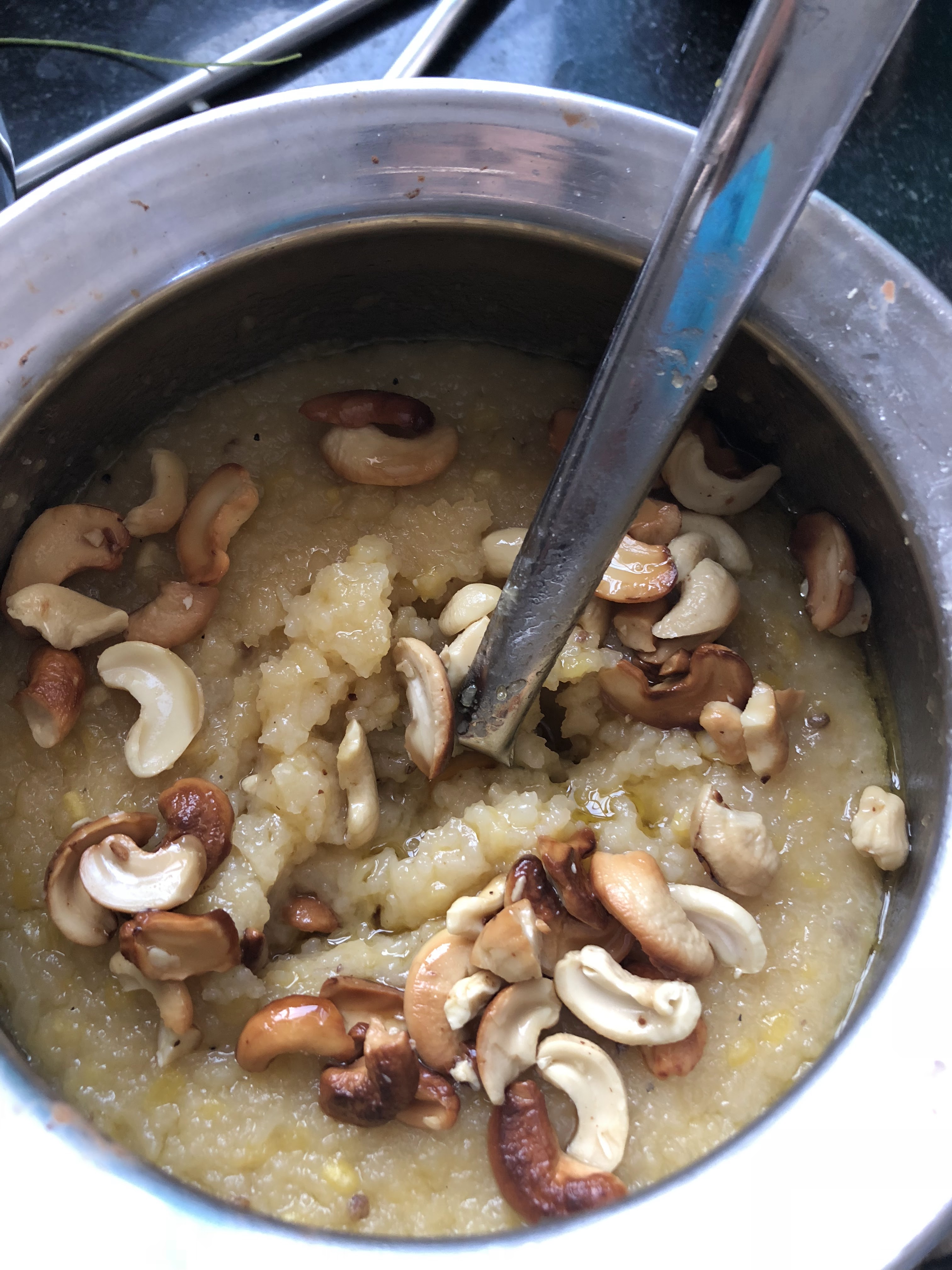
After 3-5 min, add ghee and stir well and allow it to boil for another 3-4 min till mixture reaches thick consistency. Add elaichi powder, Kaju & kishmish(roasted in ghee). Add more ghee if required/desired.
MahaShivaratri
paruppu payasam and boiled sweet potatoes
Paruppu Payasam
Moong dal : 1 small cup
Chana dal : 1 tbsp
Jaggery : 1 small cup
Milk : 1/2 tumbler
Elaichi : 4-5
Ghee : 2 tbsp
Kaju : 7-8
Method :
Take 1 cup moog dal, 1 tbsp chana dal. Dry roast lightly till colour slightly changes.
Boil it in enough water.
Melt 1 cup jaggery and filter it (to remove mipurities if any). Mix it with dal and allow it to boil till raw flavour goes off and consistency is little thick.
Add 1/2 tumbler boiled milk, add elaichi (4-5) powder
Add ghee as required and roast the kaju in it till golden brown. Add it to the payasam.
Kaaradaiyaan nombu
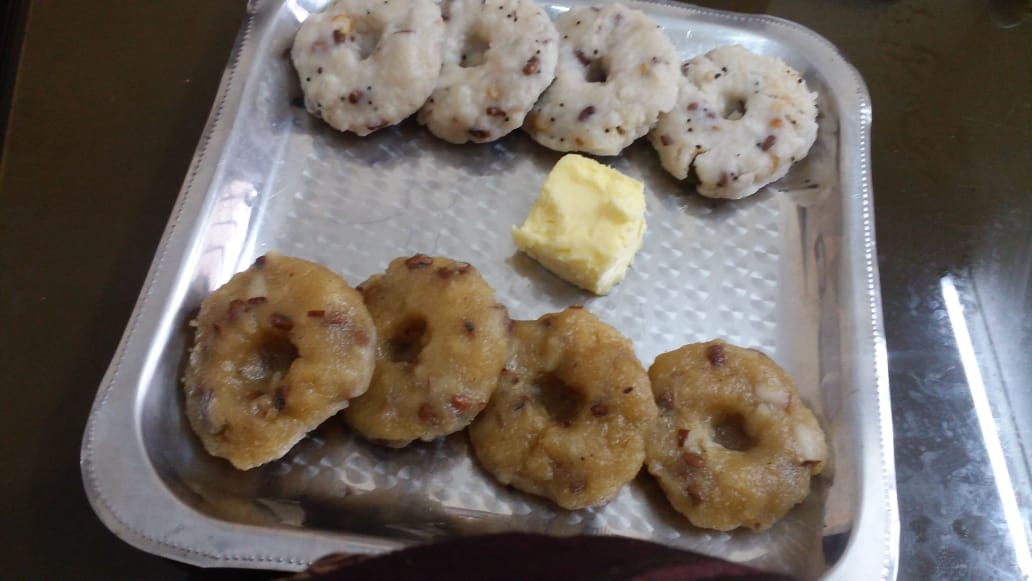
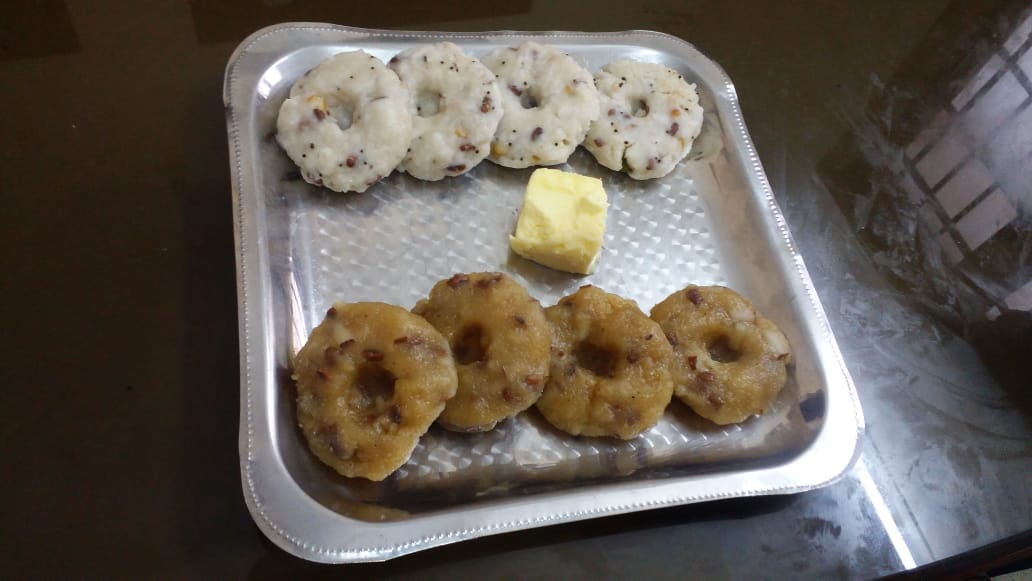
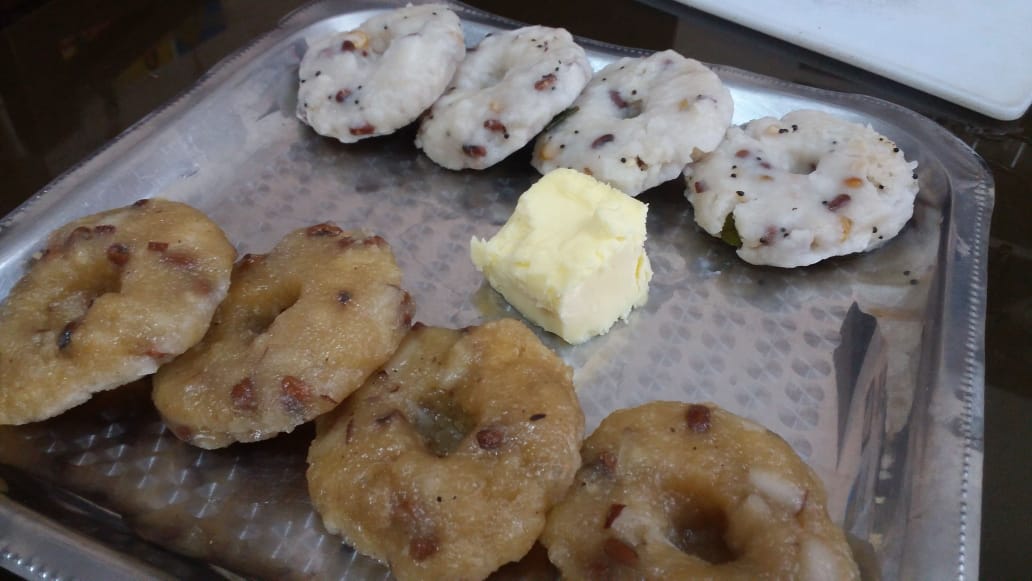
You might have heard the story of Satyavaan Saavitri. She brought back her husband from the clasps of Yamraj (Yamadharmar). Once Satyavaan was cutting woods in the forest that Yamraj comes to take him away as per his time rules. When Saavitri comes to know this, she pleads him to leave her husband. Since she keeps on following him, Yamraj tells her to ask for a boon, anything other than asking for her husband. She pleads that she needs hundred children through Satyavaan and in a hurry Yamraj says 'ok'. And on realizing what had happened, he is forced to leave Satyavaan and go. Hence we mark this day as 'Kaaradaiyan nombu' and ask for a boon of never getting separated from husband. As per our traditions, we don't worship or ask something from God without offering anything. Saavitri had prepared kuzhakattai/adai with sand(she could not get hold of anything but sand that time) and offered them to Yamraj for asking the boon. Hence to follow the same we prepare kuzhakattai and add karamani, chopped coconut to it to imitate the sand/stone particles.While praying and asking the boon, we tie 'saradu' - the sacred thread.
The time for tying the sacred thread (called 'saradu') is predicted before maasi month (in Tamil calendar) ends and before panguni month starts. If the predicted time falls in the morning, get up 3 hours before for the preparations. If the time falls in the evening, do the preparation in the morning itself.
(But if time is odd like 2 a.m., it is ok to get up at 4 or 5 a.m. and do the rituals.)
The rituals should be performed with empty stomach, hence pls do fasting that day. If the auspicious time falls in the evening, and if it is difficult to fast since morning due to health conditions, then try to finish lunch before 12 p.m. For lunch generally elders advise to eat 'pathu illa palagaaram' like aval upma or chappathi.
For Poojai, we need the below:
saradu (Buy nombu saradu from shop, else if not possible/not available, take a cotton thread and dip it once in turmeric water and take it out. )
flowers
banana leaf with corner/edge
vethalai, paaku (betel leaves & betel nuts)
fruits
coconut
malli poo or turmeric (manjal kazhangu).
(note : So always save fresh turmeric kazhangu which we get during pongal time. Pongal falls in month of Jan and this nombu falls in March).
The number of members participating in the Pooja should be even(i.e. 2 or 4) or can be 5 or more. If there are only 1 or 3 members participating, then add swami(God) as one member and make it 2 or 4 and put one banana leaf for swami too.
All should take bath and then only tie the saradu (if it is in the evening, take bath again before preparations), else if you are working professional and have no time after office, atleast clean your face,hands,legs and change clothes.
Clean the place for the members to sit and draw 'padi kolam' (rangoli) or simple star or square kolam with a center cross. (note : dont draw pulli kolam). Draw the rangoli for each member and place the banana leaf on every kolam/rangoli with leaf corner on the left hand side. Make sure that the sitting direction is east-west.
Tie malli poo(jasmine) or turmeric(small piece of manjal kazhangu) to the saradu.
Kongu region practice:
On a plate or tray, place vethalai(betel leaves 2 or 4 or >=5) ,two fruits (banana preferrably), manjal kazhangu (fresh turmeric),paaku (betel nuts),one whole coconut, saradu. Sprinkle water on banana leaf and clean it, place two sweet kuzhakattai on each leaf, 1 spoon of cooking butter (w/o salt). Now sit at the designated place, keep the prepared plate/tray in lap, first take the saradu and tie it round your neck. (if any elderly lady is there, they will offer the plate and tie the saradu for you, and also apply manjal(turmeric) kumkum to you). Pass the plate to others and each member will follow the same. After tying saradu, do namaskaaram to husband. Then come back, sit, take little water in hand and do neivedhiyam (move your hand circularly around the leaf and allow the water to drip simultaneously) and say
'urugaadha vennaiyum ore adaiyum naan tharen, oru naalum en kanavanai vittu piriyaadha irukkanum.'
(Meaning - Oh God, I'm offering you butter and adai, please grant me the boon of not getting separated from my husband even for a single day.)
Then keep aside one adai with some butter (for God) and then eat and enjoy the adai which you prepared with all hard work :) .
Thanjavur region practice:
Place vethalai (betel leaves 2 or 4 or >=5) ,two fruits (banana preferrably), manjal kazhangu (fresh turmeric), paaku (betel nuts) and saradu on the corner of the banana leaf. Then place two sweet kuzhakattai on each leaf, 1 spoon of cooking butter (w/o salt). Do neivedhiyam (move your hand circularly around the leaf and allow the water to drip simultaneously) and say
'urugaadha vennaiyum ore adaiyum naan tharen, oru naalum en kanavanai vittu piriyaadha irukkanum.'
(Meaning - Oh God, I'm offering you butter and adai, please grant me the boon of not getting separated from my husband even for a single day.)
Then take and tie the saradu, keep aside one adai with some butter and eat and enjoy the adai which you prepared with all hard work :) . Do namaskaaram to husband.
Do namaskaaram to elders.
This may be the only festival/pandigai wherein ladies eat first then serve to gents. :)
Next day give the adais (which were kept aside on the leaves) to cow.
In addition to sweet kuzhakattai (velladai), kaaradai (salted version) is also prepared, but that is for us to eat, neivedhiyam is not performed for the kaaradai.
Now let's see how to prepare the 'Adai's.
Vella Kuzhakattai (velladai)
(Velladai - the brown ones)
Rice : 1 tumbler (1 tumbler =~ 200ml)
Jagggery : 1/2 to 3/4 tumbler
Elaichi : 4
Coconut (chopped into baby milk teeth size) : 1/4 coconut
Thatta payir (karamani/lobia): 1 handful (one pidi)
Method:
Dry saute the karamani without oil and then pressure cook for 5-6 whistles.
Soak rice in water for min 1/2 hr.
Drain the water well. Rice can be light wet but no water should remain. So strain well.
Grind the rice nicely and sieve it.(Dont use rava salladai, use maavu salladai - the one with the most minute pores.)
Now dry saute the ground rice flour till rose colour i.e. colour change. check if u can draw straight line (rangoli) without gaps.
Again sieve the roasted rice flour. Whatever remains in siever can be ground and added again.
Now take 1:2 water (here 2 tumblers) and boil it. Add vellam(jaggery). Filter it to remove impurities.
Again add vellam water and add chopped coconut,drain the water from thatta payir (karamani) and add 2-3 tbsp of it. Add powdered elaichi.
When jaggery mixture starts boiling, add rice flour slowly. Keep flame to sim and mix well. It will become thick paste like (like kali). Switch off the flame.
Now take a small portion of it, flatten it like vada/patty and make one thumb impression in centre (do not make hole) and steam it like idlis in idli cooker for 8-10 min.
Uppu kuzhakattai (kaaradai)
(Kaaradai - the white ones)
Ingredients:
Rice : 1 tumbler (1 tumbler =~ 200ml)
Rai/Mustard : 1/2 tsp
Urad dal : 1.5 tsp
Kadala Paruppu (chana dal): 1.5 tsp
Thatta payir (karamani/lobia): 1 handful (one pidi)
Green chilly : 2 chopped
Red chilly : 1
Coconut (chopped into baby milk teeth size) : 1/4 coconut or 2 tbsp apprx
Oil : 2 tbsp
Asafoetida : pinch
ginger
curry leaves : few
Salt : 1 tsp or as per taste
(Note: Kaaradai is not for neivedhiyam. It is only for us to eat)
Method:
Dry saute the karamani without oil and then pressure cook for 5-6 whistles.
Soak rice in water for min 1/2 hr.
Drain the water well. Rice can be light wet but no water should remain. So strain well.
Grind the rice nicely and sieve it.(Dont use rava salladai, use maavu salladai - the one with the most minute pores.)
Note : No need to roast the ground rice flour.
Heat oil in a pan, add rai, red chilly halved, urad dal, kadala paruppu (chana dal), curry leaves, green chilly, saute for a min, add 1:2 water, salt and bring it to boil. Drain the water from thatta payir (karamani) and add 2 tbsp of it.,chopped coconut, pinch hing. Once boiling, add rice maavu, mix well, it will become thick dough absorbing all water. switch off and close with lid for 10min. Knead it well with hands and again take ball, flatten like vadai, make finger impression in centre and steam it like dilis for 8-10 min in idli cooker.
Janmashtami/Gokulashtami
Janmashtami is celebrated across India, rejoicing the birth of Lard Krishna. If we see or hear stories of Krishna, we can note that Krishna also is a foodie. So we celebrate preparing varieties of dishes specially made of rice flour. Clean the house, draw the big traditional rangoli (maav padi kolam as shown in photo), draw cute little legs in the center of rangoli and draw them till pooja room (it's to be like little Krishna is walking into our house), prepare the special varities of dishes and offer them along with curd, milk, cooking butter, paitham paruppu payasam (moong dal kheer), vada, aval upma (poha/rice flakes upma), vella aval (made of rice flakes & jaggery, method similar to poornam for modakam, instead of rice flour, aval is added), fruits (especially jamun) to Lord Krishna.

Vella Cheedai
Ingredients:
Rice flour : 1 tumbler (1 tumbler = 200ml apprx)
Jaggery : 3/4 tumbler
Elaichi : 3-4
Urad dal powder : 2-3 tsp (the urad dal should be dry sauted till golden brown before powdering)
coconut : 2 tbsp chopped
til/seasame : 1 tsp
Ghee : 1 tsp
Oil for deep frying
Method:
Take 1 tumbler rice flour. Heat a pan and saute the flour (dry) over medium flame. Stir continuously else the flour will get over heated underneath. Check if you are able to draw a rangoli line with the flour. The line be neat without gaps, else cheedai will not come out properly. It may break and mix with oil during preparation. Also it is important for the crispness. Switch off the flame and keep the flour aside.
Heat a pan, add jaggery to it, add little hot water and stir well. The jaggery will melt. Filter it to remove the sand/impurities.
Again saute the jaggery on low to medium flame, add elaichi powder, saute till we get one string consistency. Then put one drop of jaggery in one cup water, you should be able to take it with your fingers and roll it into a ball which looks soft like jelly. Once you achieve this, switch off the flame.
Saute the chopped coconut in ghee for 2 minutes.
Now mix the jaggery with rice flour and knead it into a thick dough(like we do for roti). Also add the coconut and til during this step.
Add urad dal powder to the dough and knead it again. (This is for binding). Allow the dough to cool down completely and allow it to rest for 5-6 hrs.
Now divide the dough into small round balls and deep fry them in oil till they turn golden brown.
(note: transfer all cheedai into a container and close it only when cheedai cools down to room temperature)
Appam
Ingredients:
Rice flour : 1 tumbler
Jaggery : 3/4 tumbler
Elaichi : 3-4
Maida : 2-3 tsp
Urad dal powder : 2-3 tsp (the urad dal should be dry sauted till golden brown before powdering)
coconut chopped : 2 tbsp
til : 1 tsp
ghee : 1 tsp
Oil for deep frying
Method:
Heat
a pan, add jaggery to it, add little hot water and stir well. The
jaggery will melt. Filter it to remove the sand/impurities.
Again
saute the jaggery on low to medium flame till we get one string consistency. Add elaichi powder in between during stirring.
Now mix the jaggery with rice flour. Add little water if required and knead it into idli batter consistency.Add maida and urad dal powder into the batter and mix well. (this is for binding)
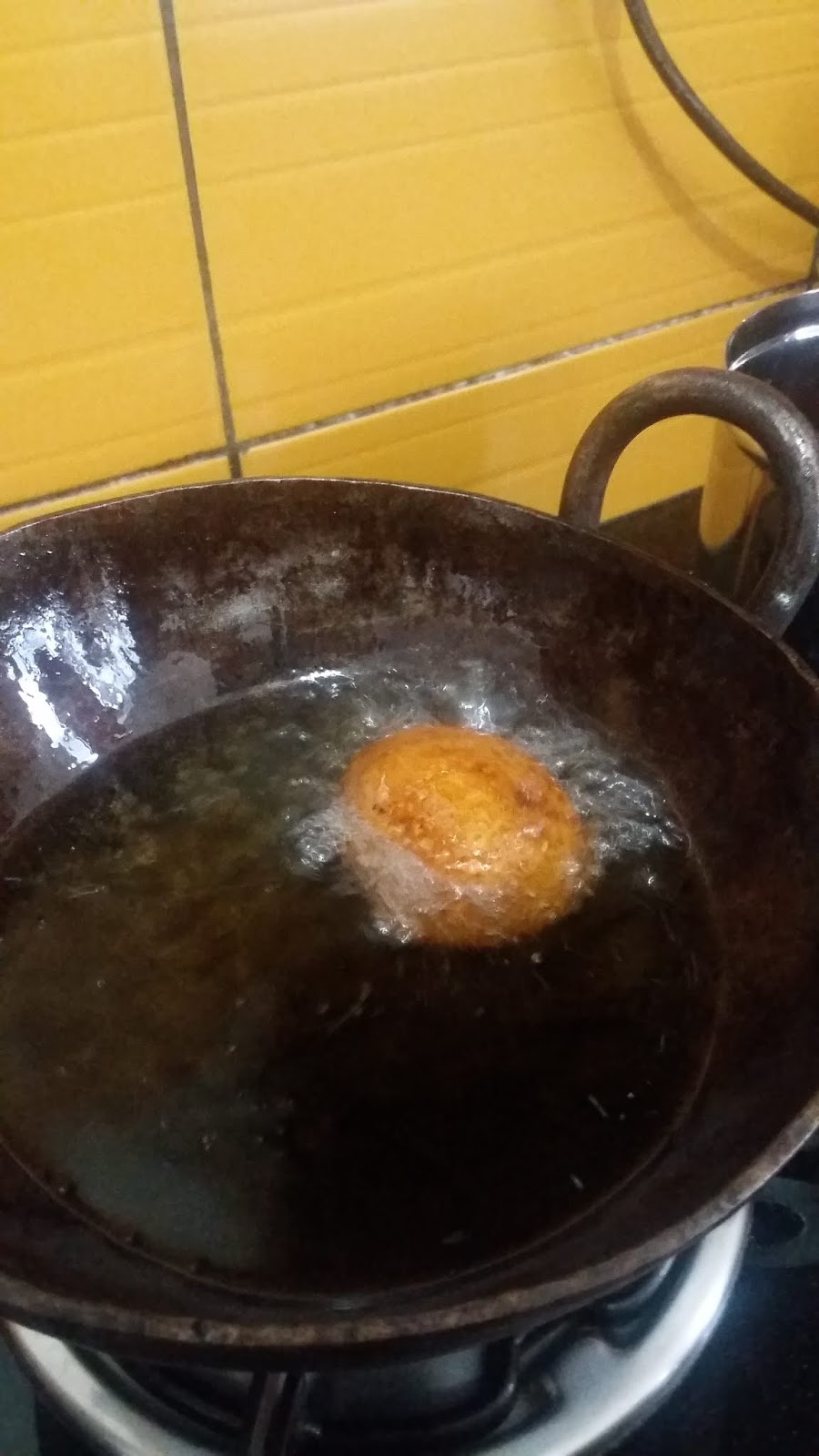
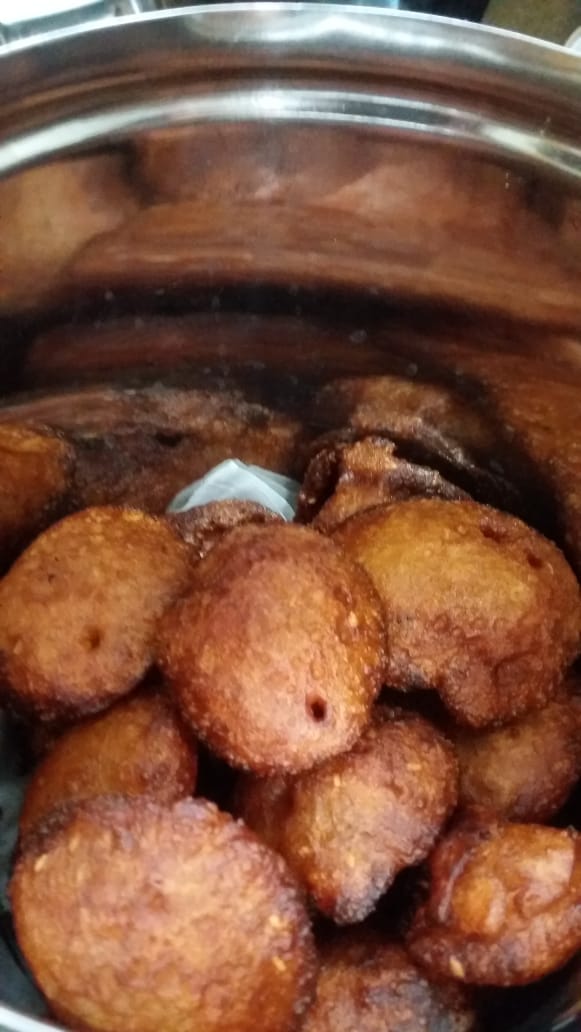
Heat oil in a pan for deep frying in a deep & thick bottom kadhai. When the oil is hot (but not too hot), take a small ladle of the batter and pour it right in the center of the kadhai. Initially the batter will stick to the bottom, but within a minute or so, it will come up. Turn it or flip it to the other side. Once it has turned golden brown evenly on both sides, remove it from the oil and place it on a plate or vessel with some tissue papers.
(note: transfer all appam into a container and close it only when appam cools down to room temperature)
Plain Murukku
Ingredients
Rice: 4 tumbler
Urad dal : 1 tumbler (i.e. urad to rice ratio should be 1:4.)
Asafoetida/hing : 1/2 tsp
Cooking butter : 100g
Salt : 2-3 tsp
Jeera : 2 tsp
Til/seasame: 2 tsp
Oil for deep frying
Method:
Dry saute the urad dal till it becomes hot. Then let it cool down and mix it with rice. And grind it into nice powder by giving it to some flour machine shop. Then wait for it to come down to room temperature. Then sieve it once or twice. This is important, else if rice or dal particles are present, then it will burst during deep frying which may cause burns.
Add asafoetida, cooking butter, salt, jeera,til. Mix well.
Add some water and knead it as a dough which doesnt stick to your palm. (but do it in portions else if you make dough with all the flour at a time, then first few murukkus will come out well, and other murukkus will come out reddish.)
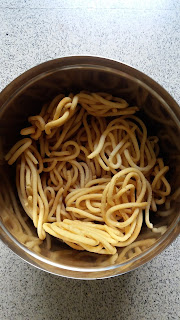
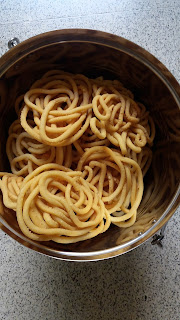
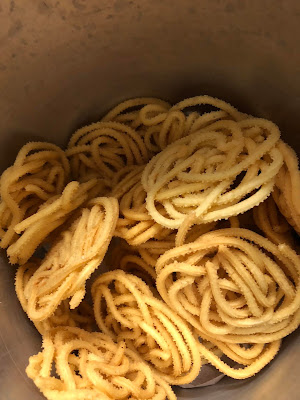
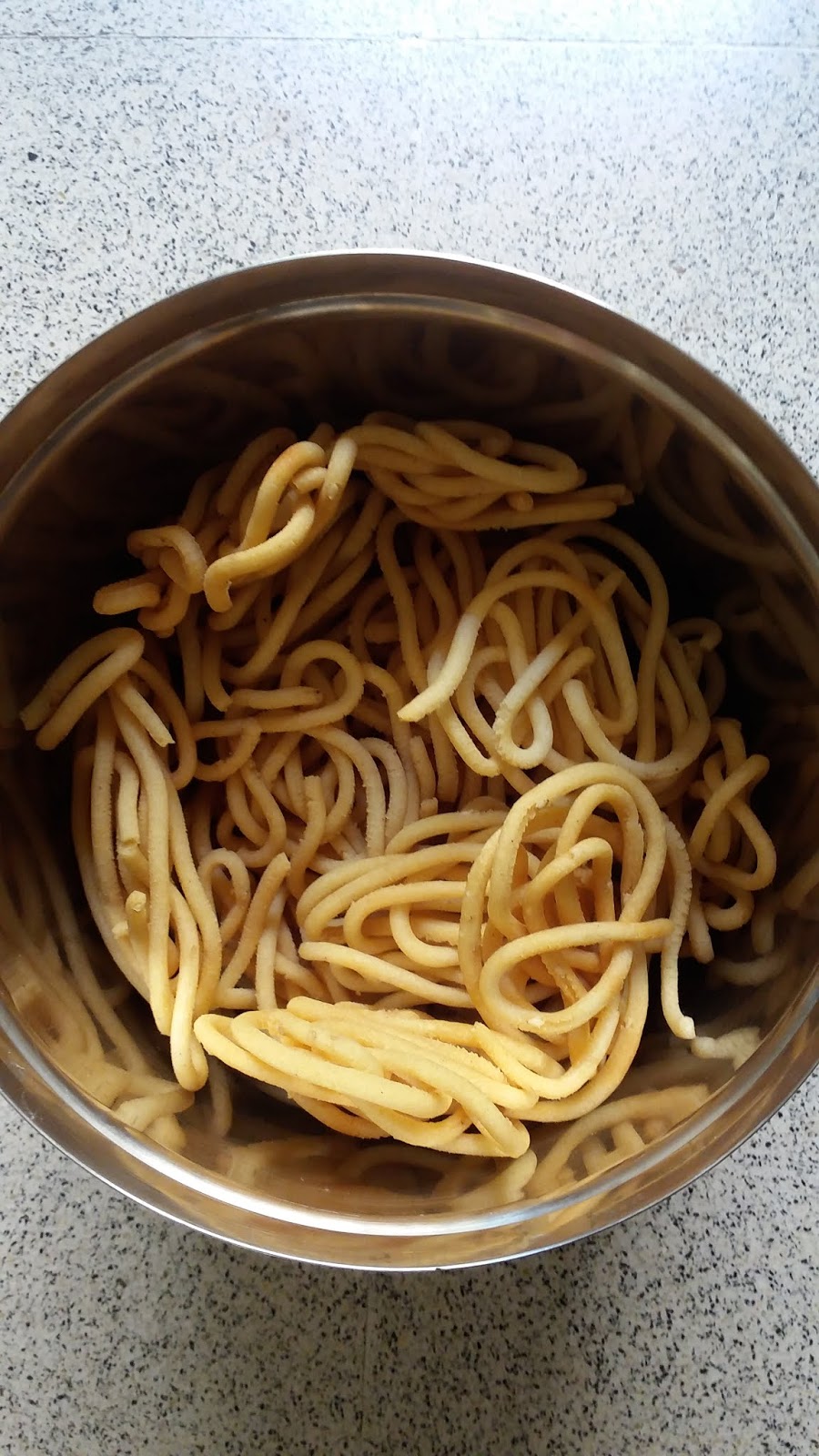
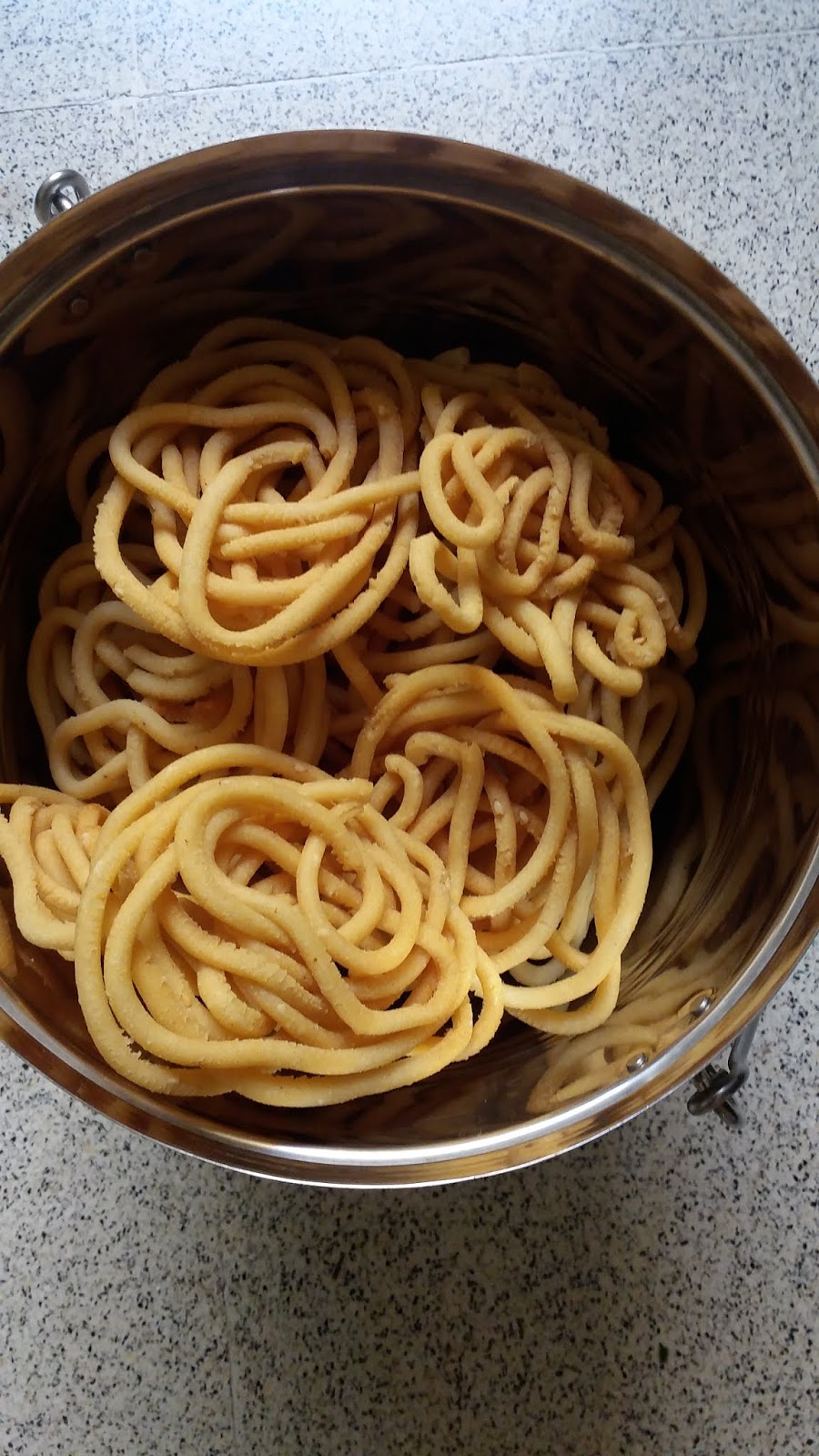
With the help of a muruku maker (handy squeezing machine with different attachments for different shapes- choose the attachment with plain circle), squeeze them into small spirals and deep fry them.
Mullu Murukku
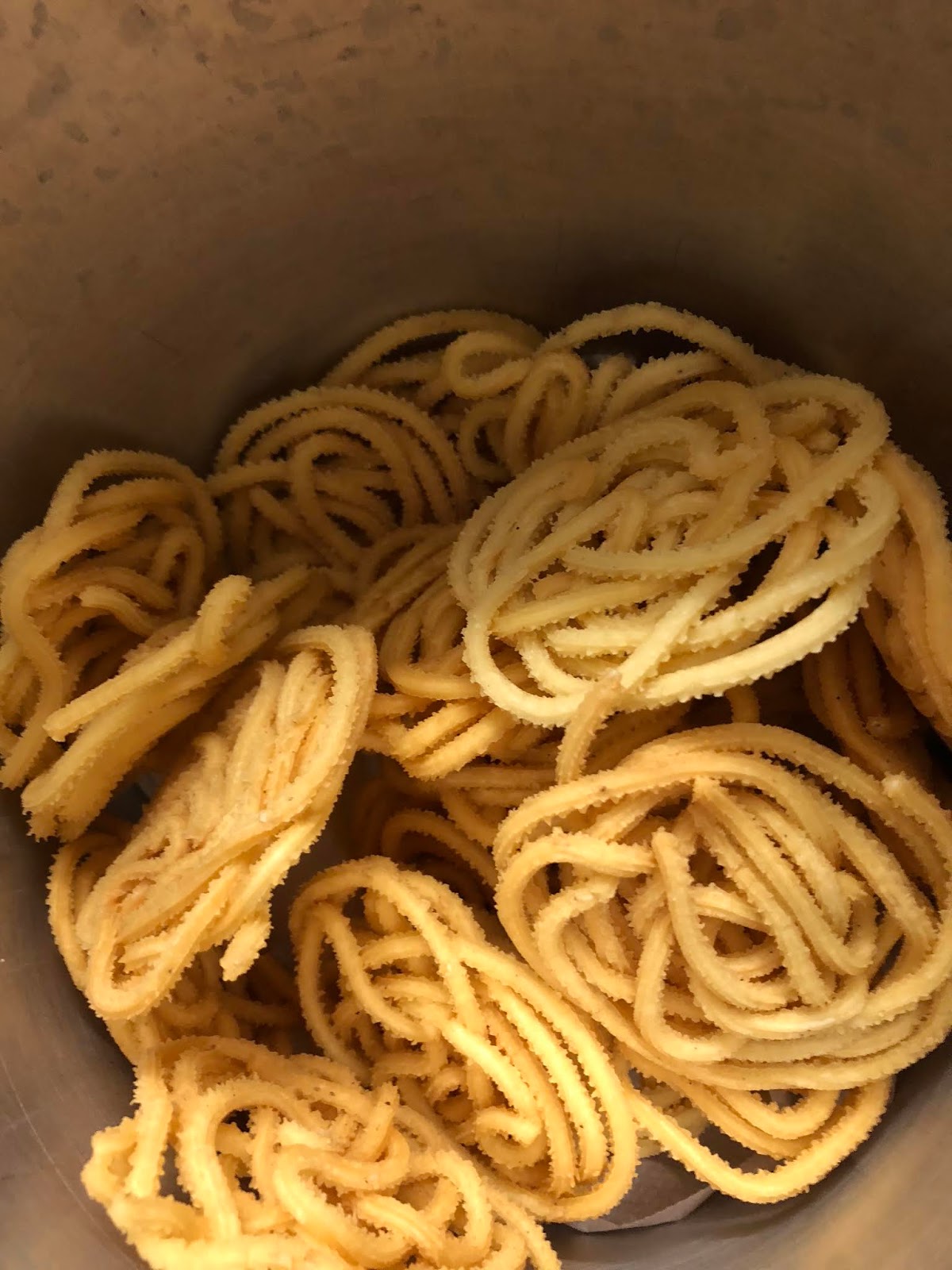
Ingredients:
Rice: 2.5 tumbler
Kadala paruppu (chana dal) : 3/4 tumbler
Pasi paruppu (moong dal): 1/2 tumbler
Til : 2 tsp
Salt : 2.5 tsp
Elaichi : 3
Cooking butter : 50g
Method:
Dry saute the urad dal and moong dal till it becomes hot. Then let it cool down and mix it with rice. And grind it into nice powder by giving it to some flour machine shop. Then wait for it to come down to room temperature. Then sieve it once or twice. This is important, else if rice or dal particles are present, then it will burst during deep frying which may cause burns.
Add cooking butter, salt,til,elaichi powder. Mix very well.
Add some water and knead it as a dough which doesnt stick to your palm. (but do it in portions else if you make dough with all the flour at a time, then first few murukkus will come out well, and other murukkus will come out reddish.)
With the help of a muruku maker (handy squeezing machine with different attachments for different shapes- choose the attachment with spiky circle), squeeze them into small spirals and deep fry them.
Uppu Cheedai
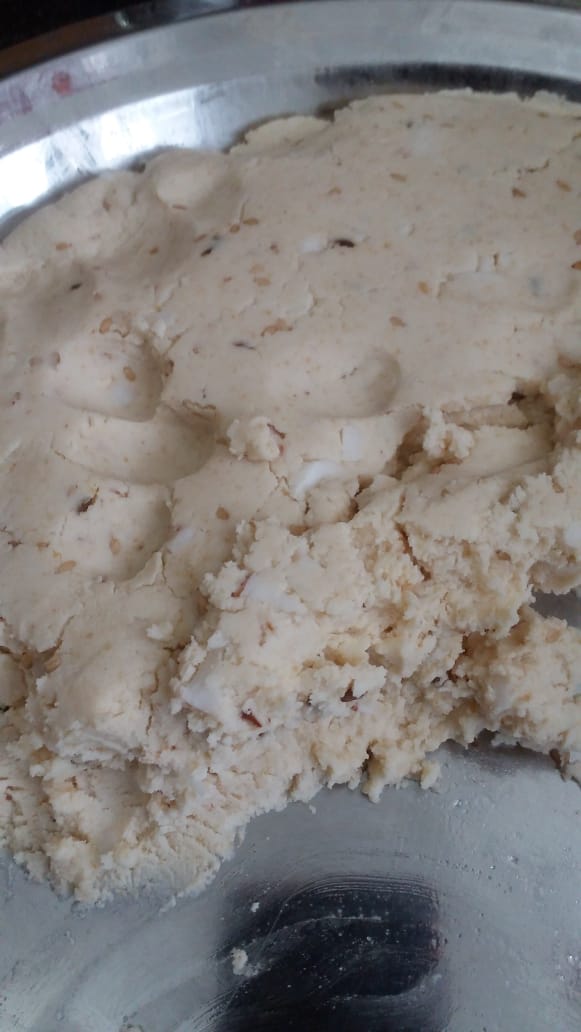
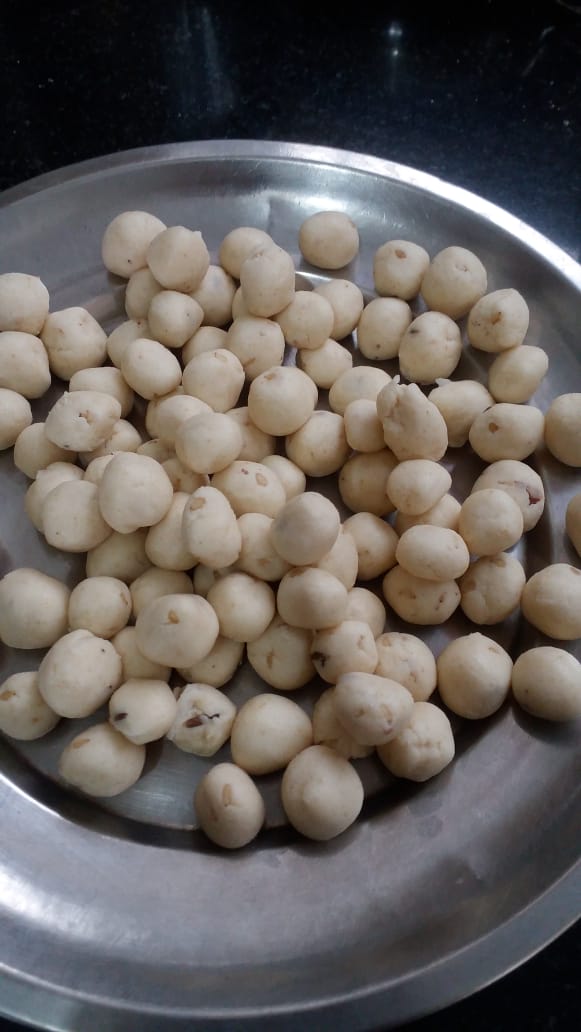
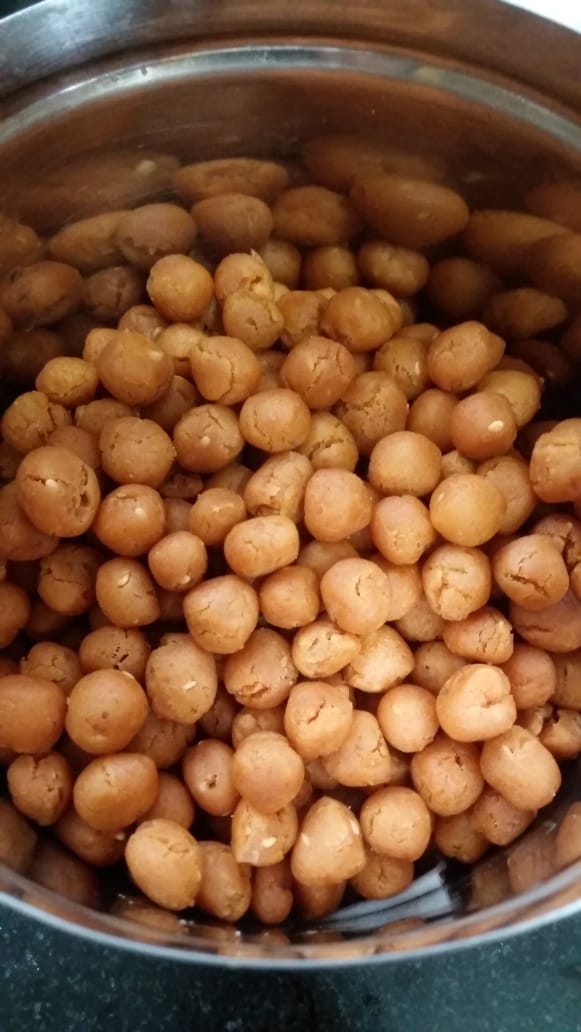
Rice flour : 2 tumbler
Urad dal powder (dry roasted till golden brown before powdering it and sieved) : 2 tbsp
Salt : 2 tsp
Finely Chopped coconut (like baby milk teeth) : 3 tbsp
Asafoetida : 1/2 tsp
Jeera : 1.5 tsp
Til (seasame) : 1 tsp
Cooking butter : 3 tbsp
Method :
Sieve rice flour and Urad dal powder once or twice. Then mix the rice flour,urad dal powder. Add cooking butter, salt, coconut, asafoetida, jeera, seasame(til). Mix very well.
Add some water and knead it as a dough which doesnt stick to your palm. Divide the dough into very small balls (like tamarind seed size, roughly roll it into ball shape. Dont roll them into perfect balls/spheres which will burst during deep frying). Deep fry these balls till bubbles fade away and they turn golden brown.)
Ganesh Chaturthi
Ganesh Chaturthi is celebrated all over India with equal spirit.
On this day, clean the house, draw rangoli, tie Ma ilai thoranam (mango leaves thoran). Buy kali mannu pillaiyar (Ganesh idol made of clay), apply chandan kumkum to the idol and decorate with flower garlands and a small decorative umbrella. Put poonal (janeu - the sacred thread), vastra malai (garland made of cotton beads with chandan kumkum applied). Buy a pair of vazha kannu (small banana plants) and keep it on the sides of idol. Buy different types of leaves and flowers, erukkam malai (crown flower) & arugam pullu (bermuda grass) is special for Ganesh.
Prepare modak (sweet kuzhakattai, uppu kuzhakattai, mani kuzhakattai), paruppu vadai, kadala/arisi/moong payasam with coconut, sundal (karuppu kothu kadalai), appam (or unni appam), idli. Vella Aval (some call it aval kesari) can also be prepared.
Do pooja, aarti and offer the prepared dishes as neivedyam to the Lord.
Sing Bhakti songs, do thopkarnam (uthak baithak)as many times possible.

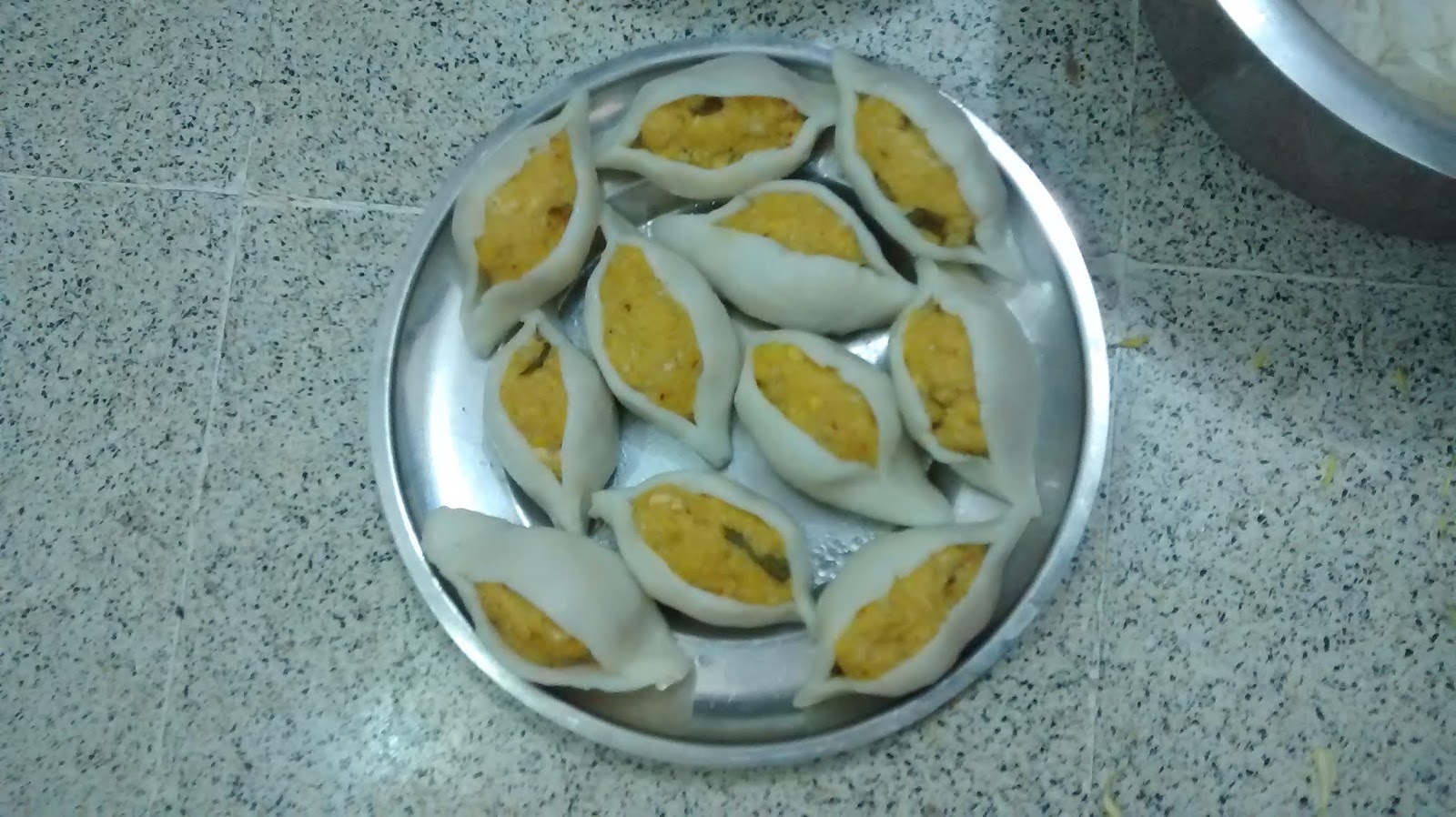
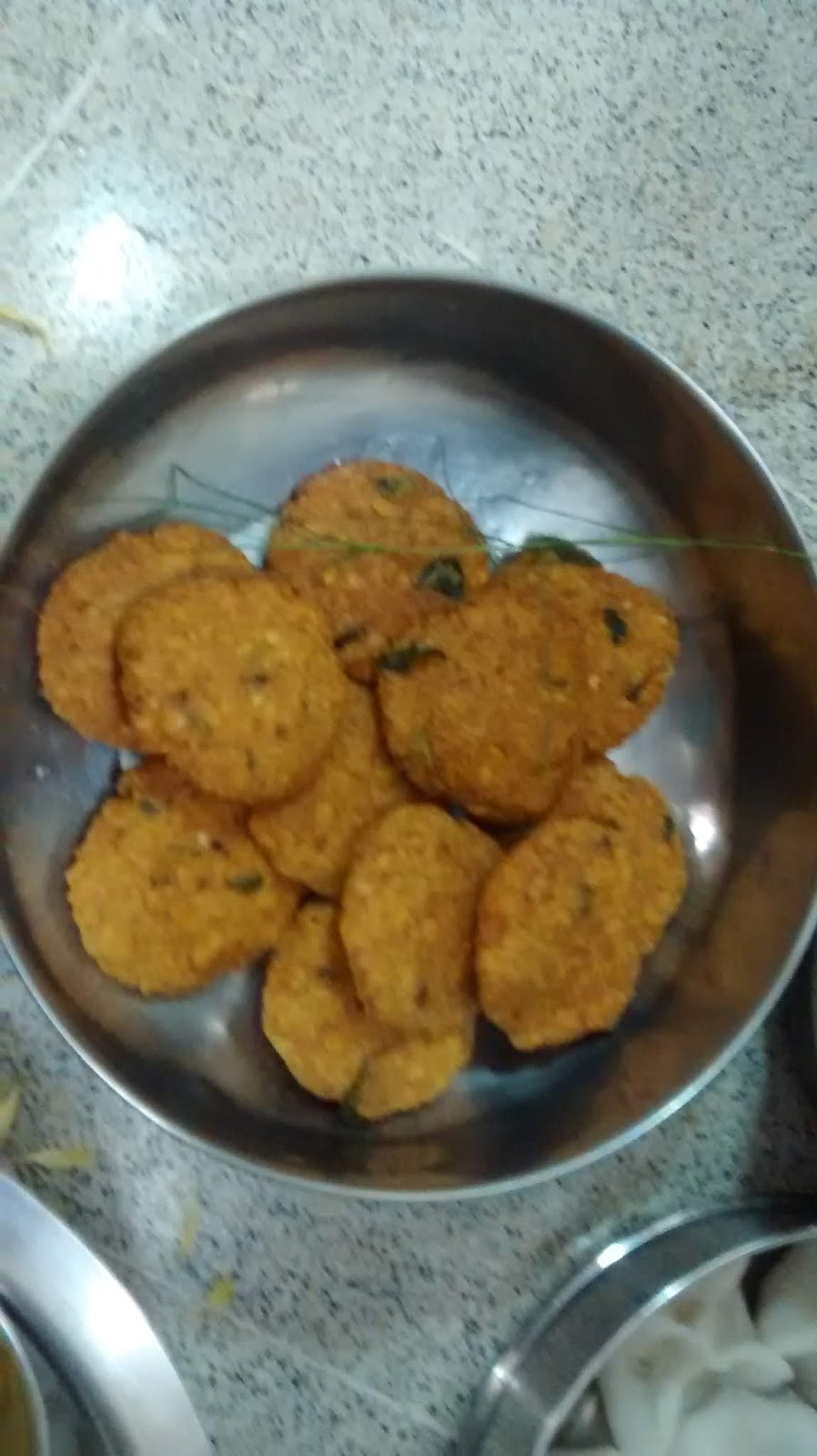
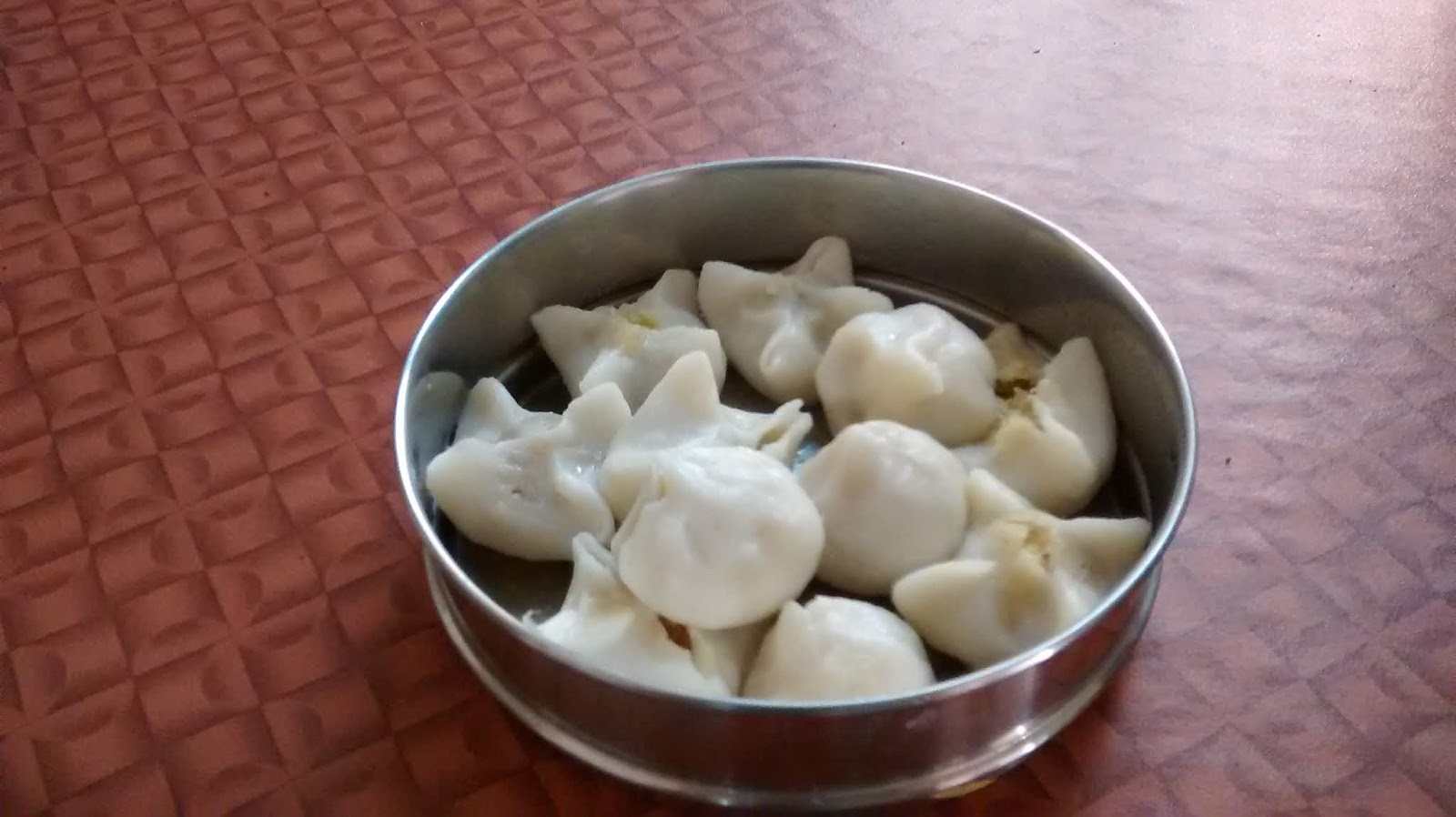
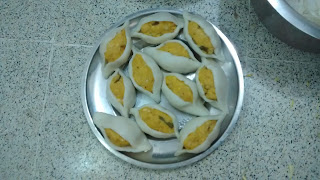
Sweet kozhukattai (Modak)
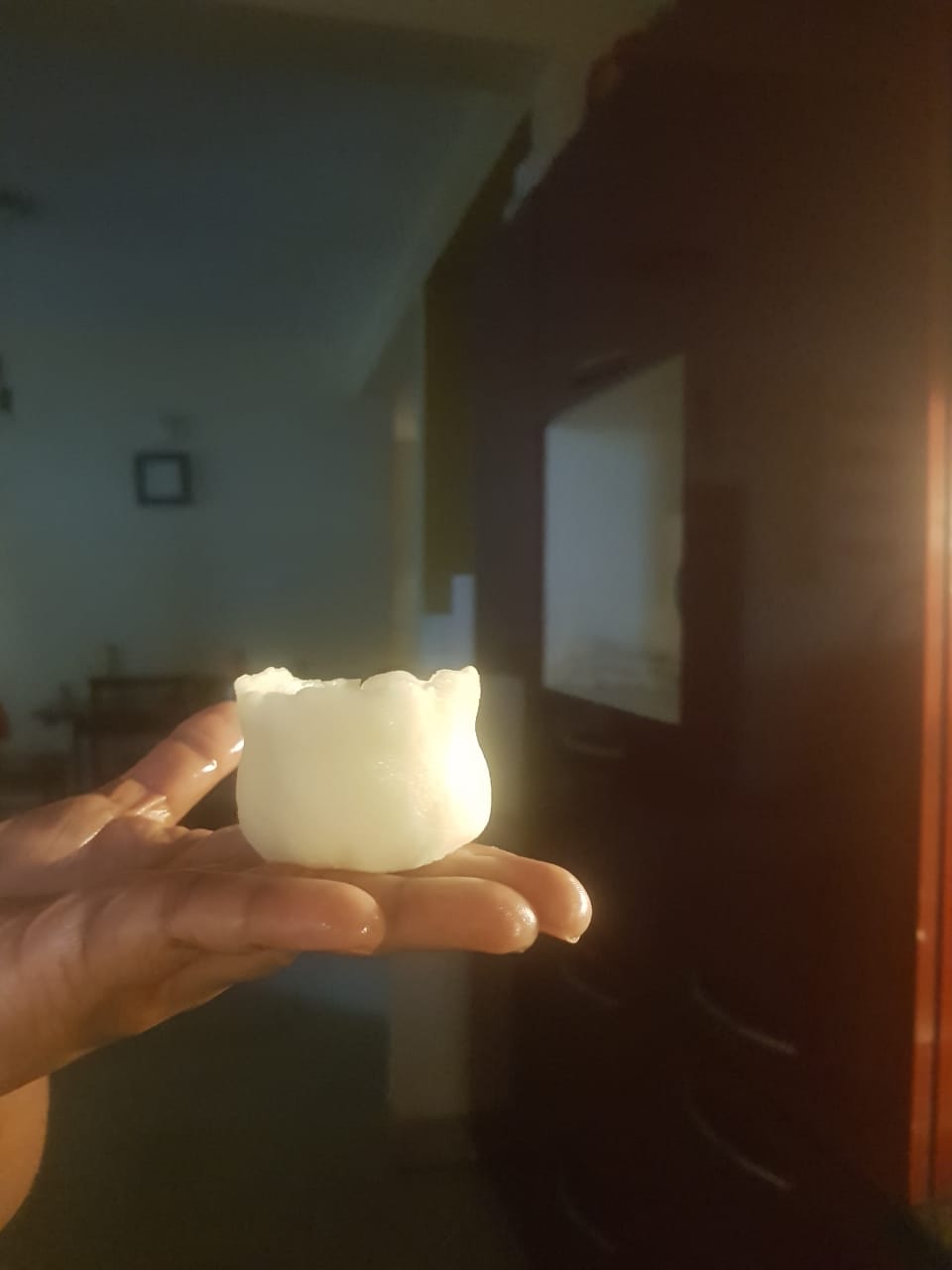
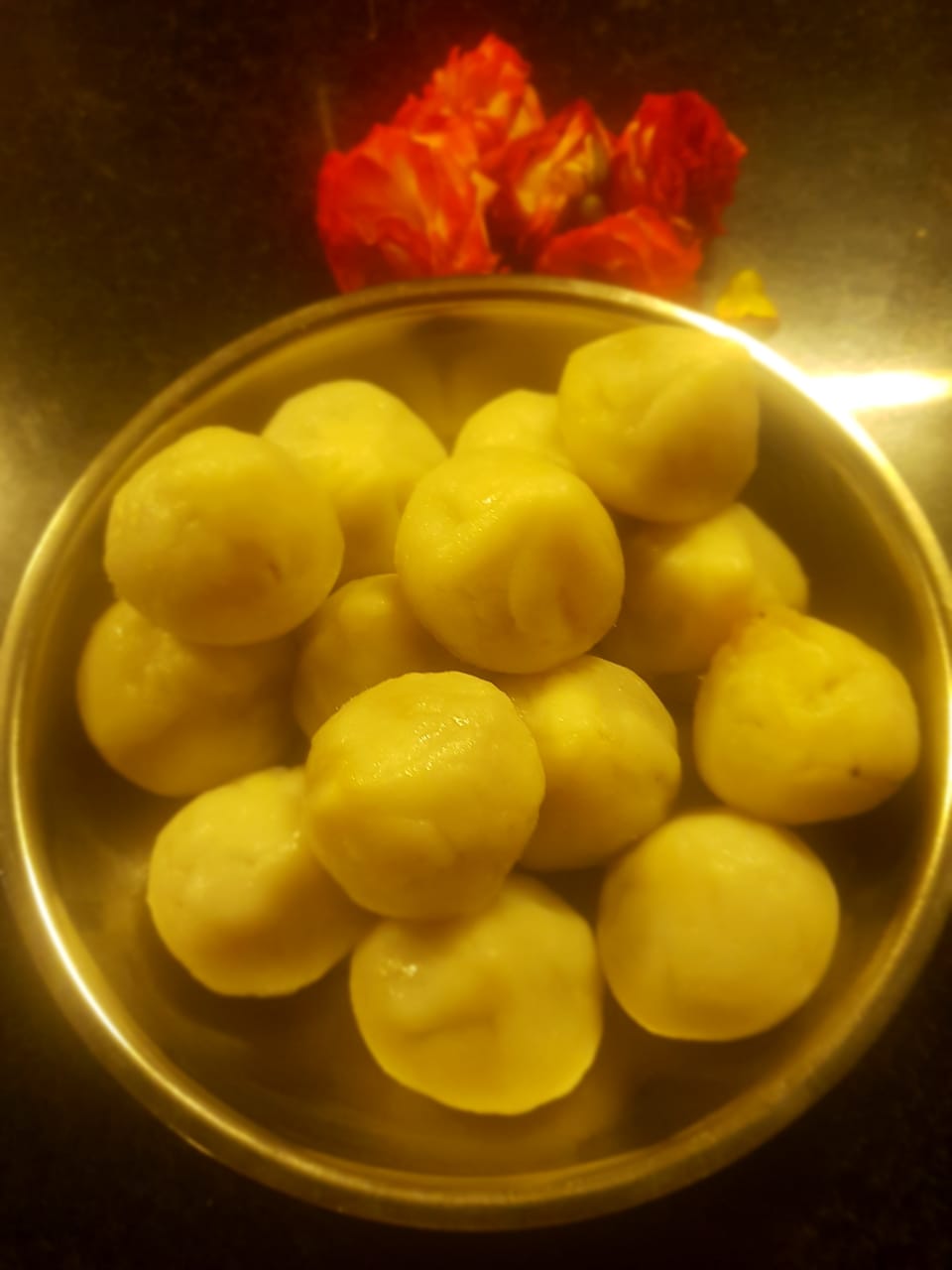
Ingredients:
Fresh grated coconut: 1 cup
Jaggery : 3/4 cup
Elaichi : 3-4
Rice flour : 1 cup
Salt :pinch
Ghee/Gingeley oil : 1/2 tsp
Note: Buy the rice flour which is specially packaged for preparing kozhukattai. e.g. 'Anil' brand Kozhukattai Rice flour.
Method:
Heat a pan, add little water, once water becomes hot, add jaggery. Keep stirring, you will see that jaggery will melt down. Now strain this melted jaggery to remove sand/impuruties.
Again heat the jaggery and once it starts boiling, add coconut and elaichi powder. Mix well. Stir till jaggery and coconut bind well with each other like halwa. (This is for pooran, used for stuffing) Switch off the flame.
Boil water which is in between 3/4th cup to 1 cup, add salt and ghee/gingelly oil. Slowly add the flour and mix well simulatenously. Make sure no lumps are formed. Switch off the flame when all the water is absorbed. Close it with a lid or wet muslin cloth. After 15-20 minutes, grease your hands with oil/ghee and knead it well into a dough.
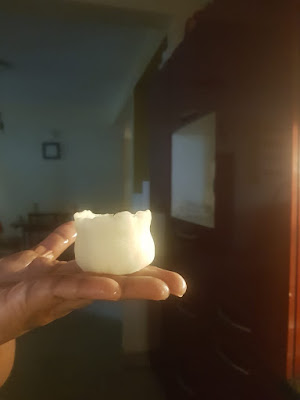
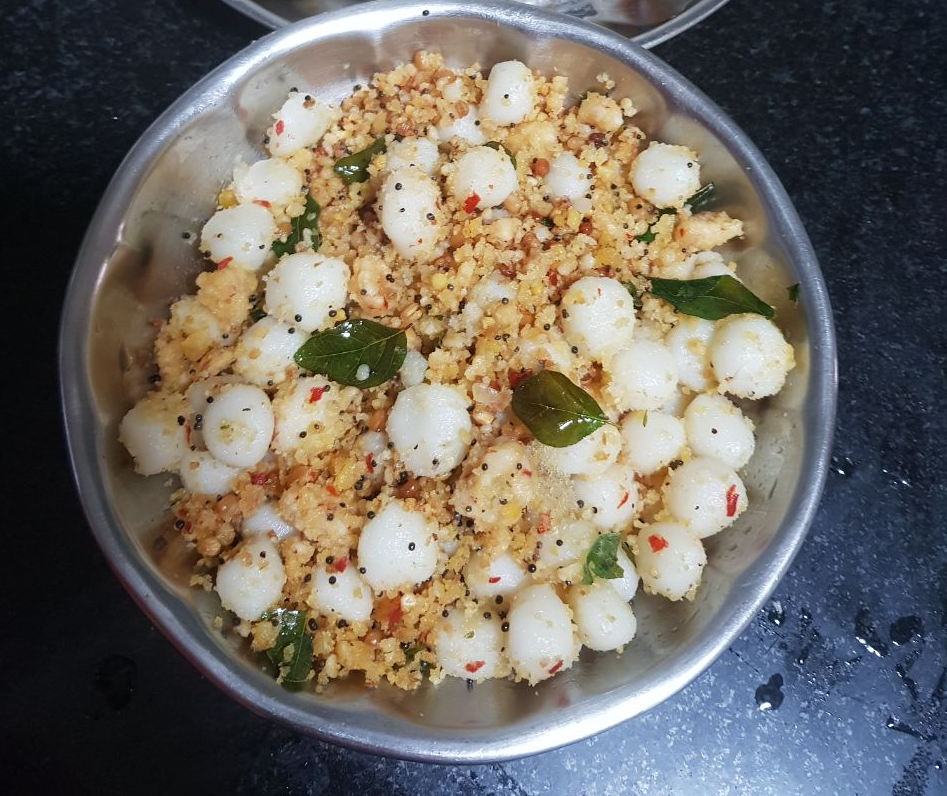
Grease your fingers with some oil, take some rice dough (amla size), roll it between your palms and form a ball. Mould it into cup like shape, use the coconut-jaggery mixture for center stuffing and thus form dumplings.
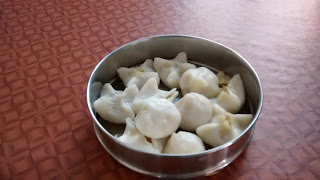
Steam these dumplings for 8-10 min in idli cooker or normal cooker (don't put weight onto the cooker).
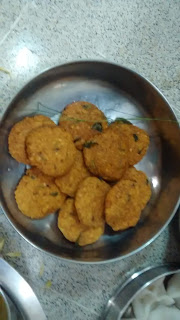
Uppu Kozhukattai
Ingredients:
Rice flour : 1 cup
Chana dal (kadala paruppu) : 1/2 cup
Tuwar dal : 1/4 cup
Chana dal (kadala paruppu) : 1/2 cup
Tuwar dal : 1/4 cup
Urad dal : 1/4 cup
Salt : 3/4 to 1 tsp
Green chillies :1
Red chllies : 3
Asafoetida : pinch
Ghee/Gingeley oil : 1/2 tsp
Mustard : 1/2 tsp
Refined/groundnut oil : 1 tbsp
Curry leaves : few
Fresh coriander leaves : few
Mustard : 1/2 tsp
Refined/groundnut oil : 1 tbsp
Curry leaves : few
Fresh coriander leaves : few
Note: Buy the rice flour which
is specially packaged for preparing kozhukattai. e.g. 'Anil'
brand
Kozhukattai Rice flour.
Method:
Soak tuwar dal, chana dal and Urad dal in water for 1 hour.
Drain the excess water, transfer the dals into a mixi jar, add salt, green chillies, 2 red chillies and asafoetida and grind it coarsely without water. Heat 1 tbsp refined/groundnut oil in a pan, add 1/2 tsp mustard, 1 red chilly, curry leaves, saute for few seconds and add the ground dal mixture and saute 1-2 mins. Add chopped coriander leaves and switch off the flame. Let it cool.
Boil water which is in between 3/4th
cup to 1 cup, add ghee/gingelly oil and pinch of salt. Slowly add the flour and mix well
simultaneously. Make sure no lumps are formed. Switch off the flame when all the water is absorbed.
Close it with a lid or wet muslin cloth. After 15-20 minutes, grease your hands with oil/ghee and knead it well
into a dough.
Grease
your fingers with some oil, take some rice dough(amla size),
roll it between your palms and form a ball. Mould it into cup like shape, use the dal
mixture for centre stuffing and thus form dumplings. (the dumplings should not be fully closed. Let it be 3/4th closed for the dal to get cooked properly.)
Steam these dumplings for 8-10 min in idli cooker or normal cooker (don't put weight onto the cooker).
Mani Kozhukattai
Rice flour : 1 cup
Urad dal : 1/2 cup
Chana dal (kadala paruppu) : 1.5 tbsp
Tuwar dal : 1 tbsp
Urad dal : 1/2 cup
Chana dal (kadala paruppu) : 1.5 tbsp
Tuwar dal : 1 tbsp
Salt : 3/4 to 1 tsp
Green chillies :1
Red chllies : 2
Asafoetida : pinch
Ghee/Gingeley oil : 1/2 tsp
Fresh coriander leaves : few
Fresh grated coconut : 1 tbsp
For tempering:
Mustard : 1/2 tsp
Urad dal : 1/2 tsp
Refined/groundnut oil : 1 tbsp
Curry leaves : few
Red chilly : 1
Fresh coriander leaves : few
Fresh grated coconut : 1 tbsp
For tempering:
Mustard : 1/2 tsp
Urad dal : 1/2 tsp
Refined/groundnut oil : 1 tbsp
Curry leaves : few
Red chilly : 1
Note: Buy the rice flour which is specially packaged for preparing kozhukattai. e.g. 'Anil'
brand Kozhukattai Rice flour.
Method:
Soak tuwar dal, chana dal and Urad dal in water for 1 hours.
Drain
the excess water, transfer the dals into a mixi jar, add salt, green
chillies, 2 red chillies and asafoetida and grind it coarsely without
water.
Divide them into small patties and steam them in a cooker (don't put weight) for 8-10 min.
Boil 1 cup water, add 0.5 tsp oil/ghee and pinch of salt. Slowly add the flour and mix well
simulatenously. Make sure no lumps are formed. Switch off the flame when all the water is absorbed.
Close it with a lid or wet muslin cloth. After 5-7 minutes, grease your hands with ghee/oil and knead it well
into a dough.
Grease
your fingers with some oil, take rice dough (black grapes size),
roll it between your palms and form ball like shapes. Repeat and use all the dough to make such balls.
Place these balls into a idli plate and steam it in the cooker for 8-10 min.
Heat 1 tbsp oil in a pan, add mustard seeds and let it crackle, add urad dal, 1 red chilly halved, curry leaves, saute for a min.
Add the steamed dal mixture (crumble them), mix well and saute for 8-10 min apprx.
Add the steamed rice balls, mix well and saute for 1-2 min. Add 1 tbsp coconut (optional), mix well, add chopped fresh coriander leaves and switch off the flame.
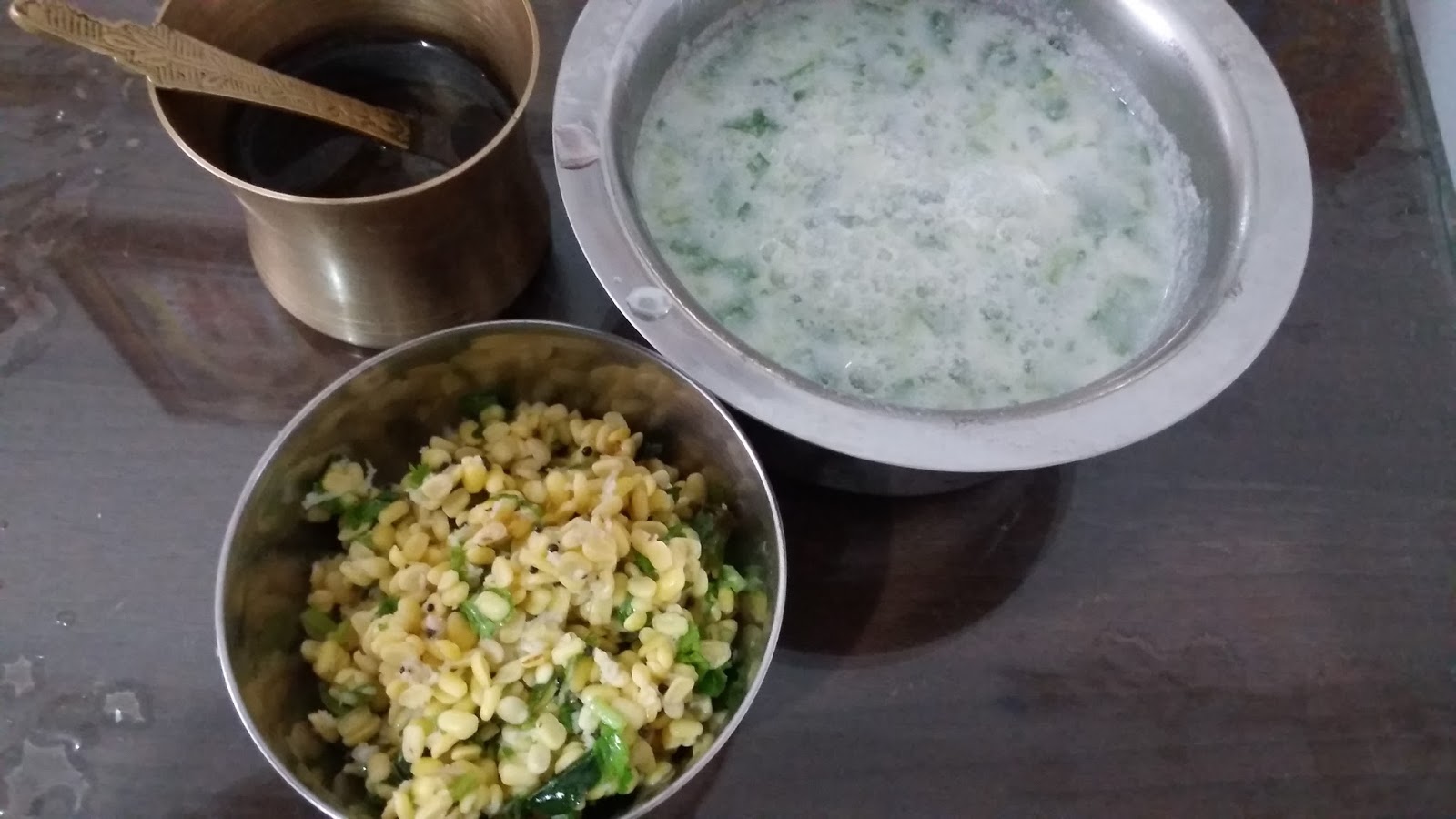
Generally people go to temple on this day and worship the deities. Ram-Seeta kalyanam is performed in temples and devotees are offered panakam, neer mor (thin buttermilk) and kosmalli (Moog dal with a touch of chillies and lemon.) You can also prepare them at home and offer it to the deity.
Panakam and neer mor helps cool your body. But in modern times we have replaced panakam with rasna.
Panakam
Ingredients:
Jaggery : 75g
Water : 2 cups apprx
Cardamom : 2
Ginger powder (sukku podi) : pinch
lemon : half
Method :
Mix jaggery (crushed/powdered/jaggery broken in small pieces) and water and give it sometime so that jaggery melts and blends with water. Filter it to remove impurities.
Add cardamom powder, ginger powder and squeeze half lemon to it. Mix well.
Kosmalli:
Ingredients
Moog dal (Paasi paruppu) : handful or 1/4 cup
Rai/Mustard : 1/4 tsp
Green chilli : 1-2
Lemon : half
Salt : 1/4 tsp
Curry leaves : few
Coriander leaves : few
Oil : for tempering
Method :
Soak the Moog dal in water for half an hour to 40 min.
For tempering, take 1 tsp oil in a pan, add mustard seeds, let it crackle, add chopped green chillies and curyy leaves, wait for 10-15 sec and switch off the flame.
Drain water from moog dal and add the tempering to it.
Add salt, few chopped coriander leaves and squeeze half lemon to it.
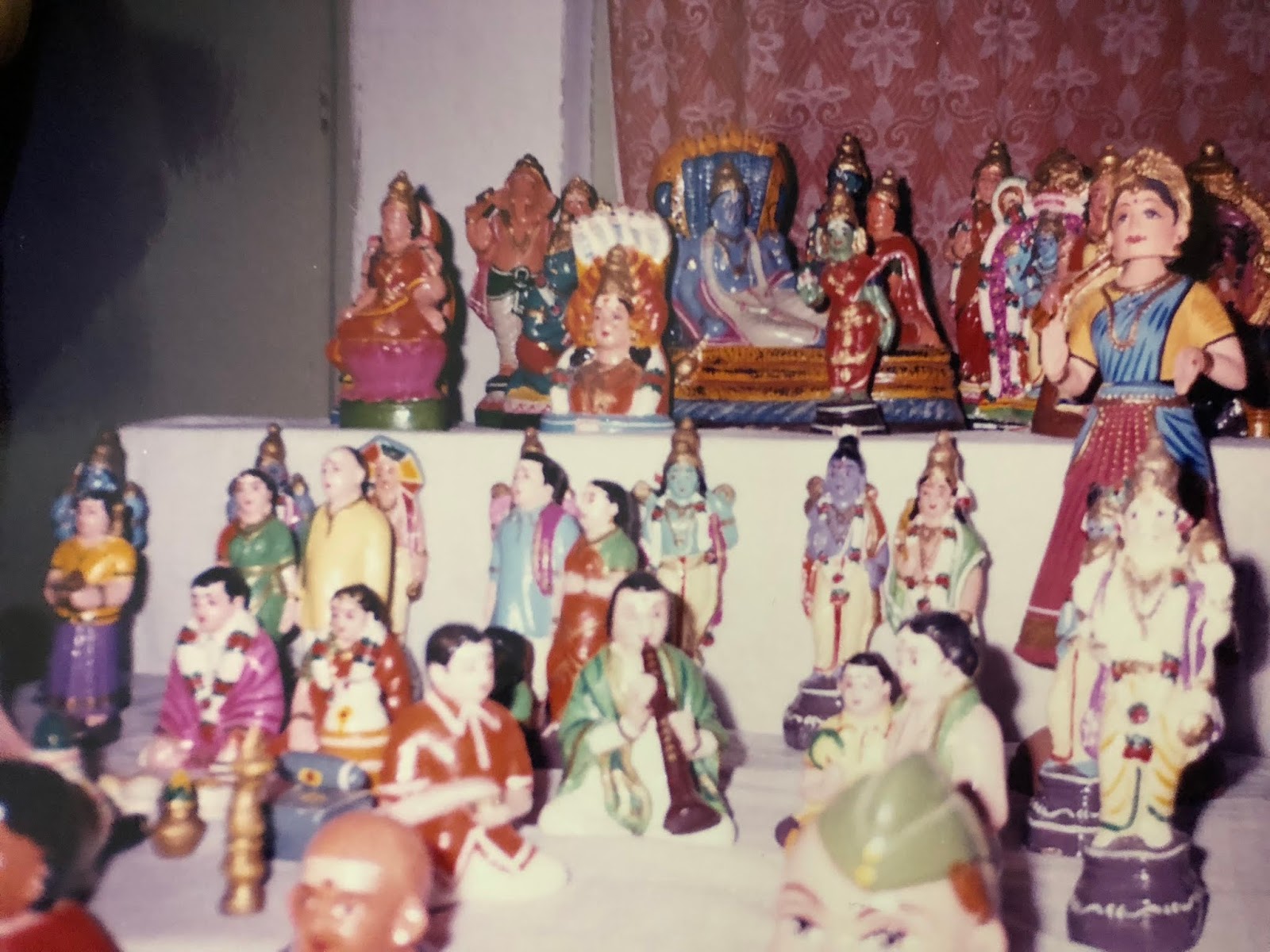
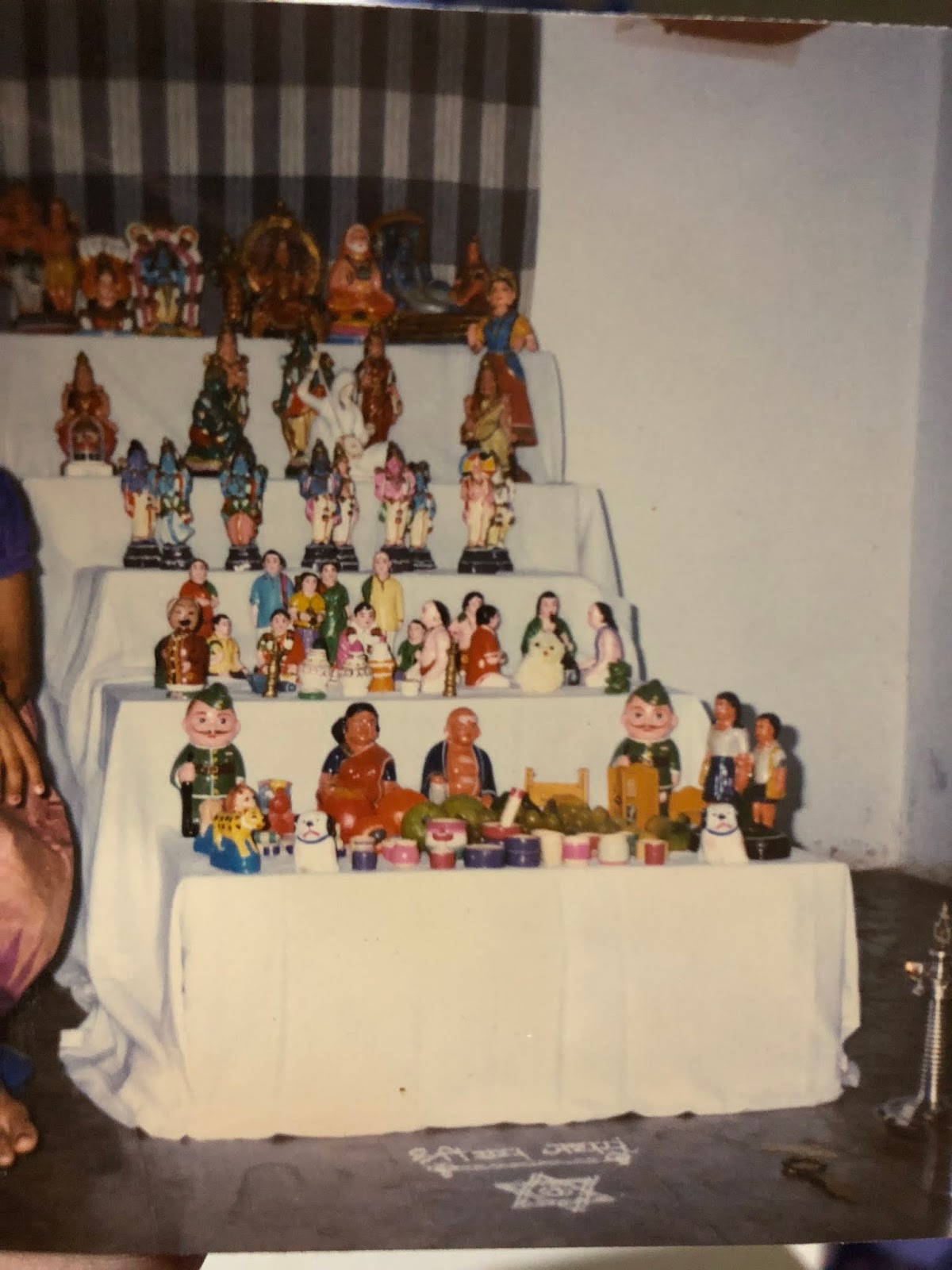
The colourful pattu pavadai ( silk dress worn by cute little girls), the numerous idols standing on the kolu steps, tasty sundal, bhakti songs, pooja - the 9 days of Navaratri is of absolute celebration. For kolu, the kalash and marapaachi bommai (a pair of dolls - one female and one male ) are the key ones. But if you place the kalash, then you should follows strict norms of pooja and be disciplined. Throughout the nine days, offer betel leaves & nuts by inviting married women at home (you should offer these items minimum : manjal/turmeric,kumkum, vethalai/betel leaves, paaku/betel nuts, fruits, blouse piece. But you can also offer any gifts like bangles, bindi, decorative items, any utensil, etc.).
Varieties of sundal are prepared throughout the nine days -
1. thatta payir - both white and brown (karamani/lobia)
2. mochakottai
3. pacha payir(green moong dal)
4. pattani sundal - green and white (mutter)
5. kadalaka (groundnut)
6. kothu kadalai -white & brown
7. Kollu sundal (kollu also comes in nava dhaaniyam list)
Also we can prepare pottu kadala podi.
On Tuesday and Friday, prepare payasam also (any variety of payasam).
Invite kanya kuzhandel (girl child who hasn't attained puberty) any of 10 days, but panchami (5th day) and durgashtami (8th day) is special. Invite any number of children except 3. You can offer them sweets like kesari(rava sheera) or payasam(kheer). Then offer turmeric,kumkum,betel leaves & betel nuts, fruits and any gift as per your wish like bangles/bindi/decorative box or anything.
On the ninth day we perform Saraswati pooja, and children eagerly await that day since it is advised not to study anything that day since studying will give headache to Saraswati. Clean musical instrments if any and apply kumkum turmeric to it and also to books. Tie maa illai thoran (mango leaves thoran), clean saraswati photo & apply turmeric-kumkum to it, put vastra mala, ravikai thuni (any blouse piece). Clean & decorate the pooja room with flowers. Perform pillaiyar pooja (ganesh pooja) first, then perform saraswati pooja. Prepare rice,paruppu (dal),vegetable curry,kootu,sambhar or more kuzhambu,rasam,payasam(kadala paruppu payasam),pachadi (always remember, if payasam is prepared, then pachadi also should be prepared) any vada, suiyam and offer it to God as neivedhiyam. If you are office goer and you have no time, then minimum offer rice,payasam,paruppu,ghee and do neivedhiyam. In the evening, prepare karuppu kothukadalai sundal and do nivedhiyam. Also some people perform ayudha poojai on this day, wherein all machines/equipments are cleaned, applied turmeric-kumkum and offered garlands.
On the tenth day, we celebrate Vijayadashami. (Goddess attained victory after nine days(or rather nights) of battle. Hence it is believed that victory will be definite for any work begun on this day. Mainly young parents with small kids perform Vidhyarambham on this day (hold the hand of the kid and write the first alphabet on a layer of rice, which means the kid has started to learn & gain knowledge on this auspicious day and hence will be victorious in knowledge attainment.) Read the books (few lines) and play the instruments for a little while which were kept for Saraswati pooja the previous day. Do aarti of dolls/idols kept in kolu and make them lay down since it is said that their legs will ache since they had been standing for 9 days together (anyone is enough - marapaachi bommai or murugan idol...). Vijayadashami is the day of victory, hence clean all the machines/equipments (like TV, fridge, washing machine) and vehicles, apply kumkum/chandan and offer flowers/garlands and take aarthi so that it works for long.(as said earlier, some perform this on ninth day itself)
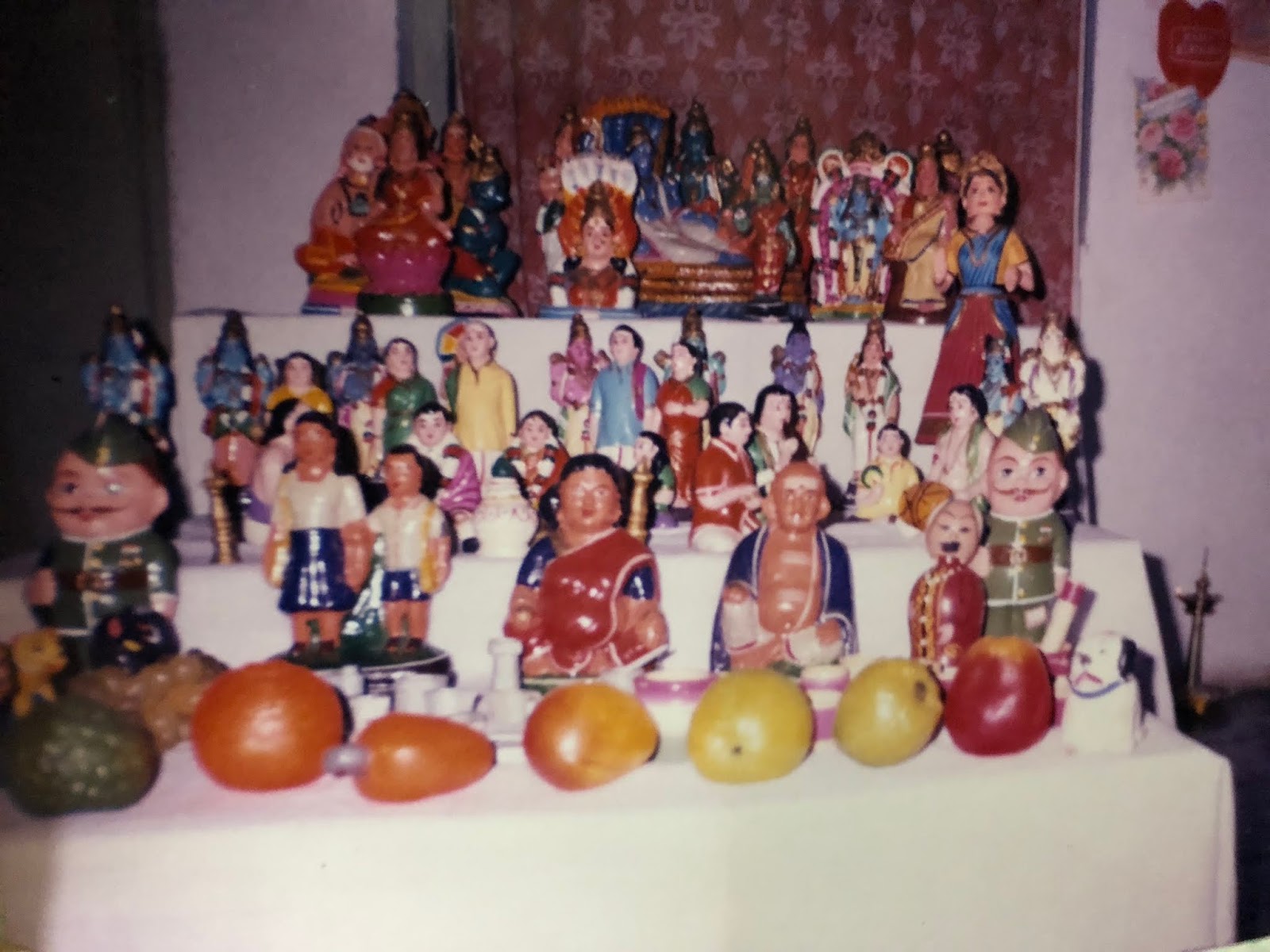
Kabuli chana Sundal (konda kadalai)
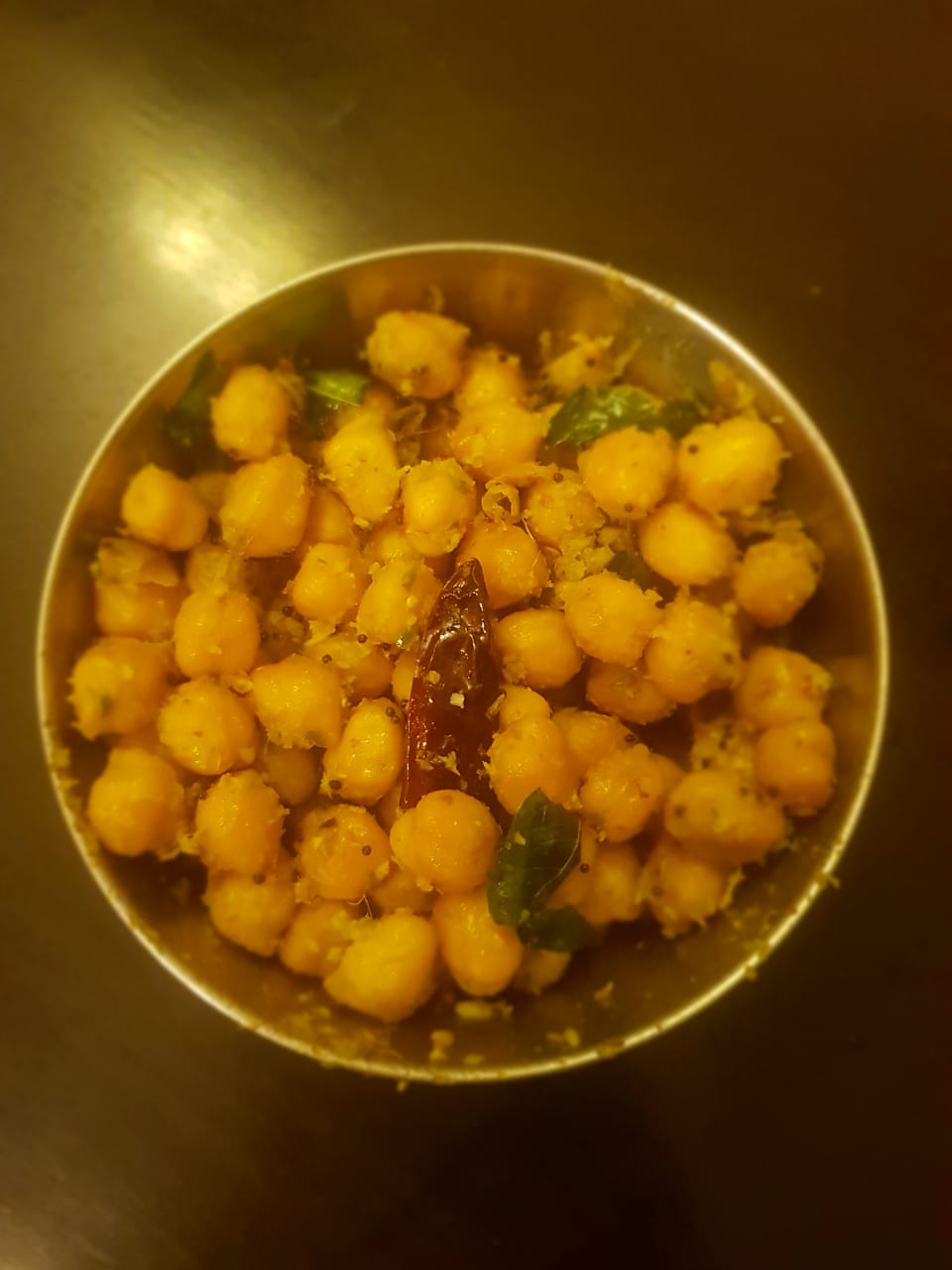
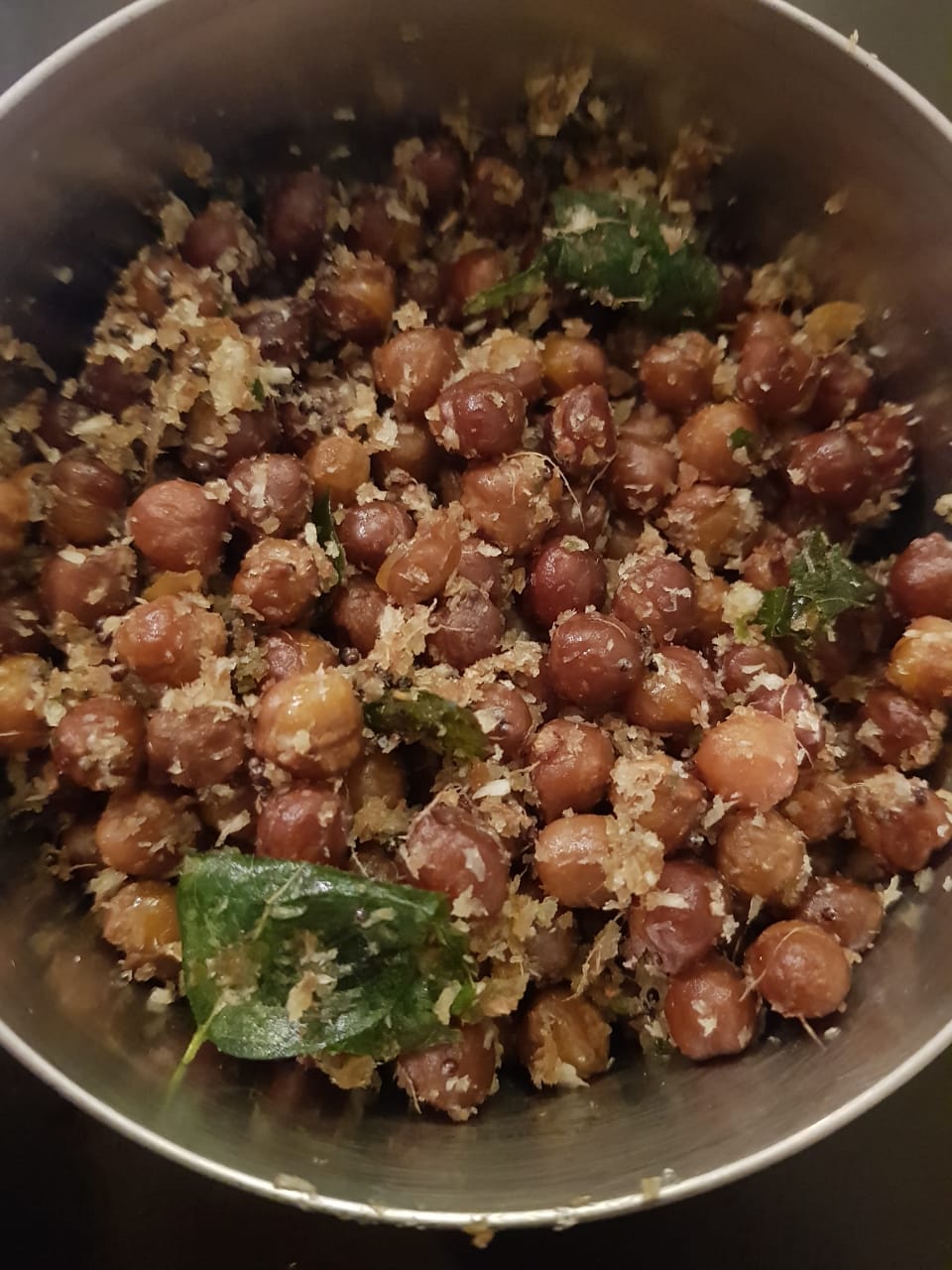
Green Mutter Sundal
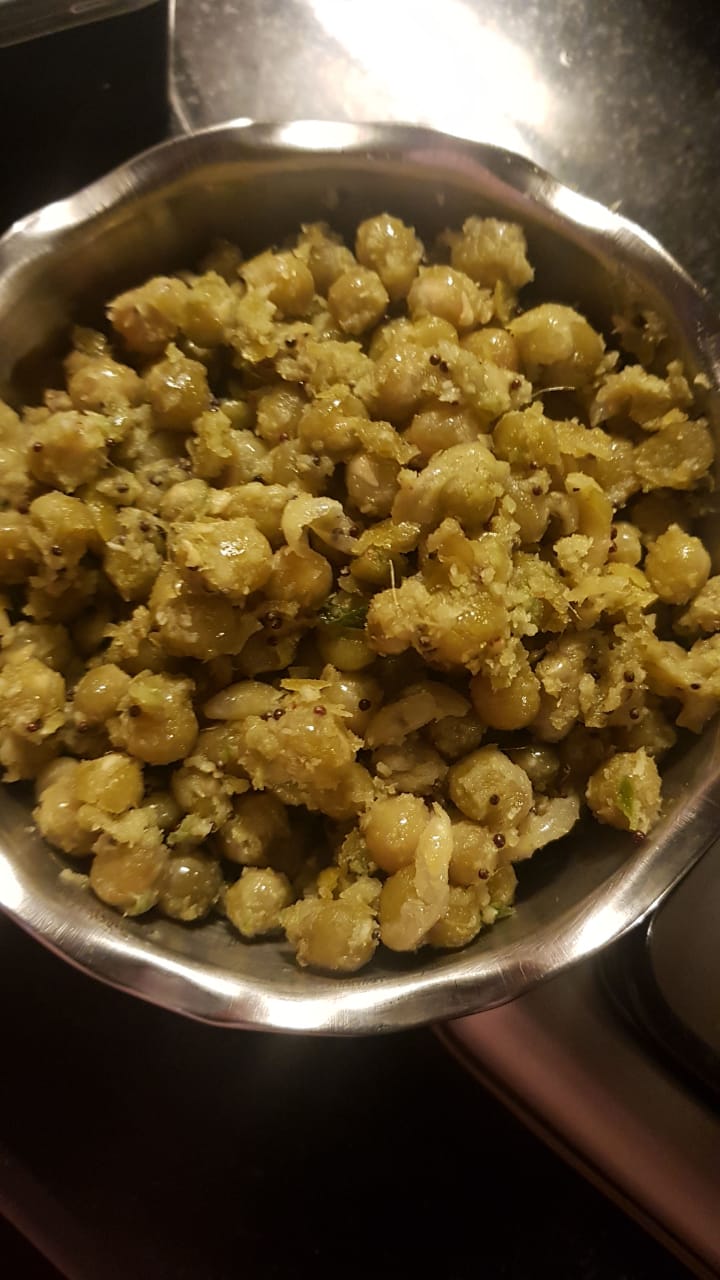
White mutter Sundal
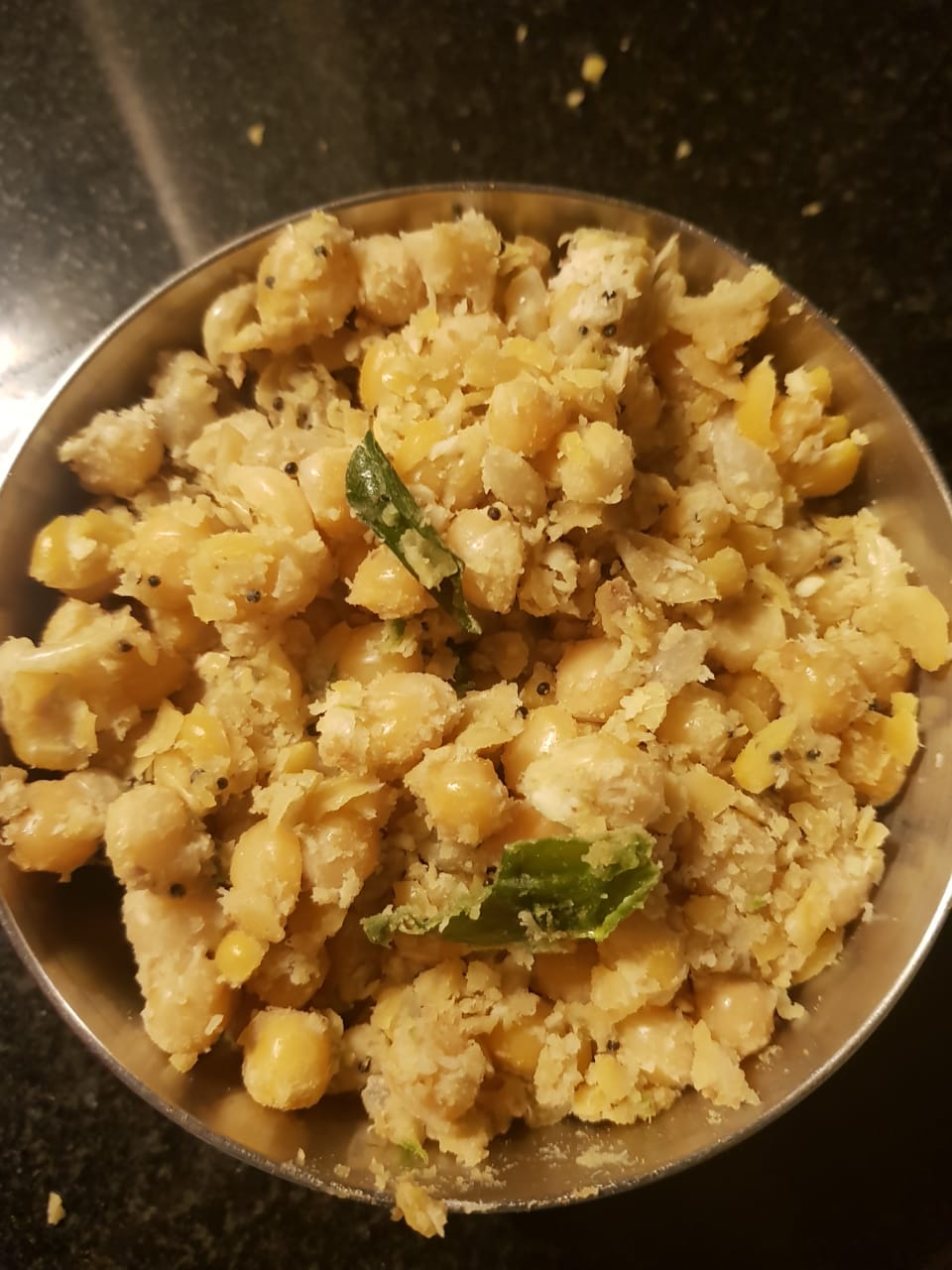
Green Moong Sundal (pachha payir)
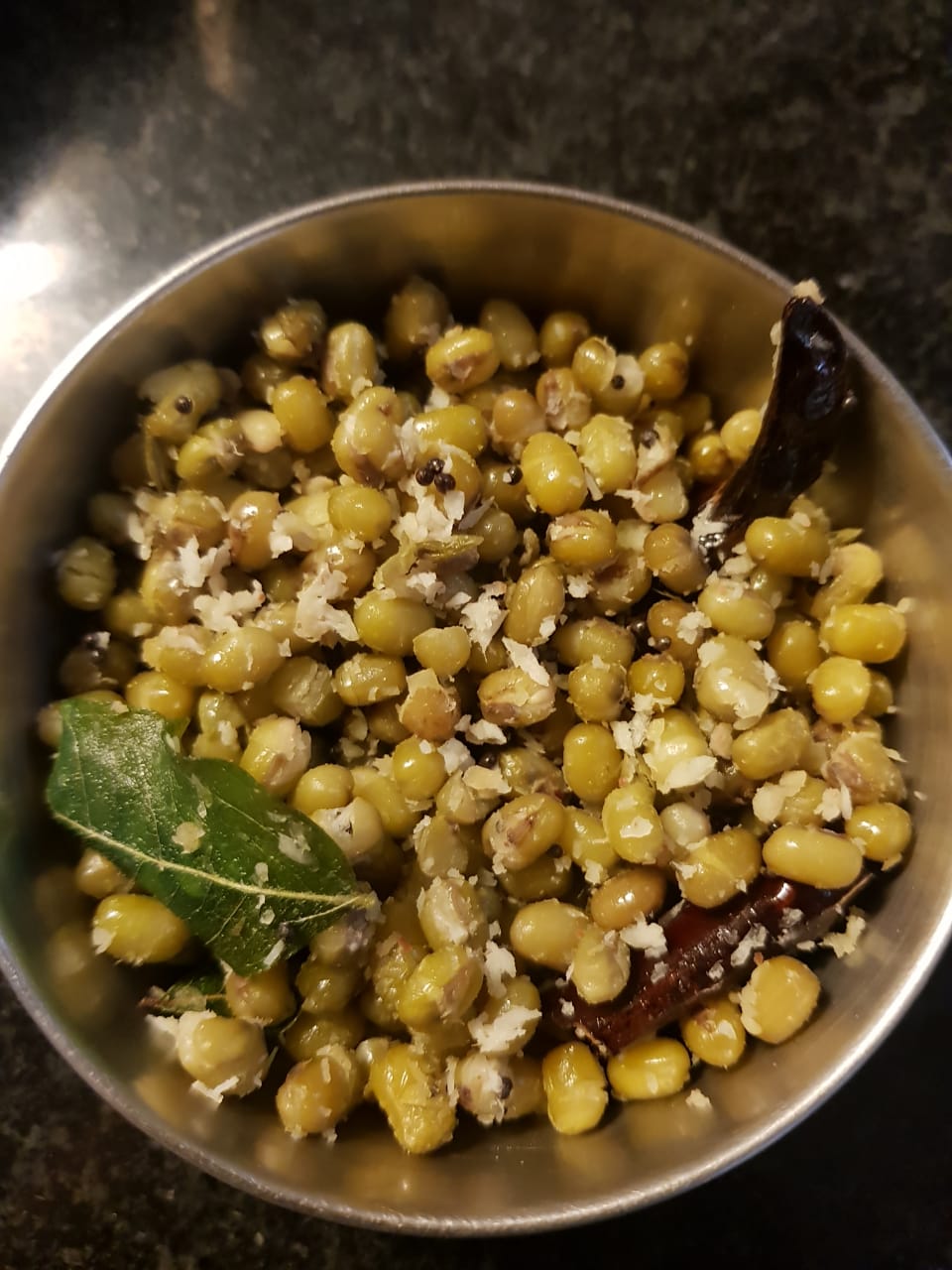
Karamani Sundal
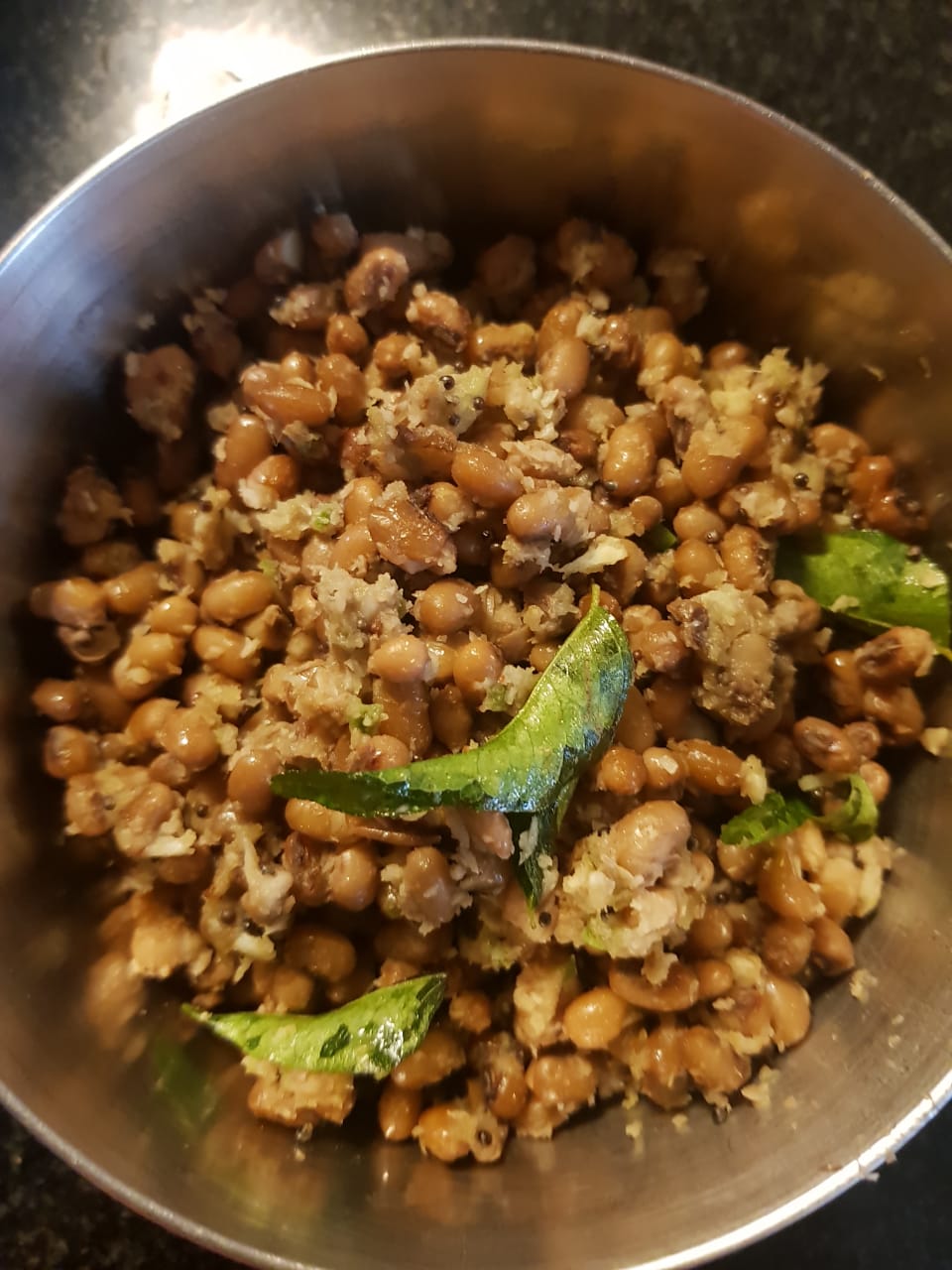
White Karamani Sundal
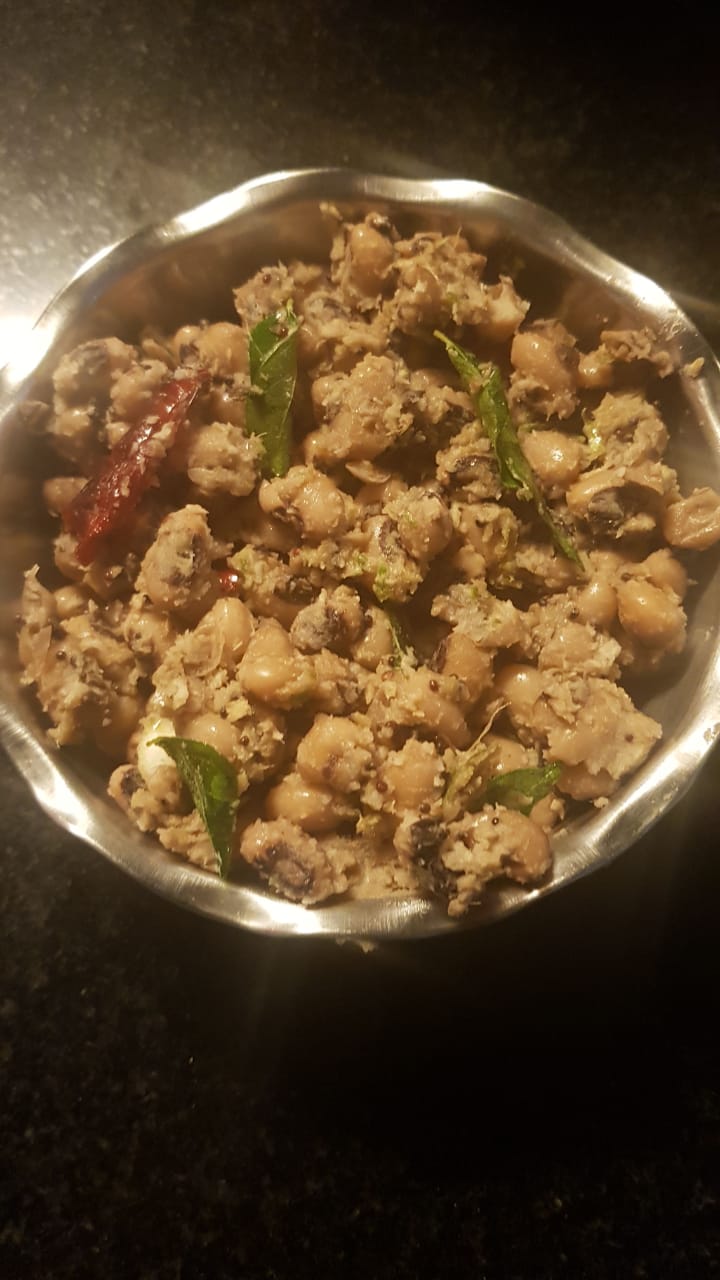
Mochai Sundal
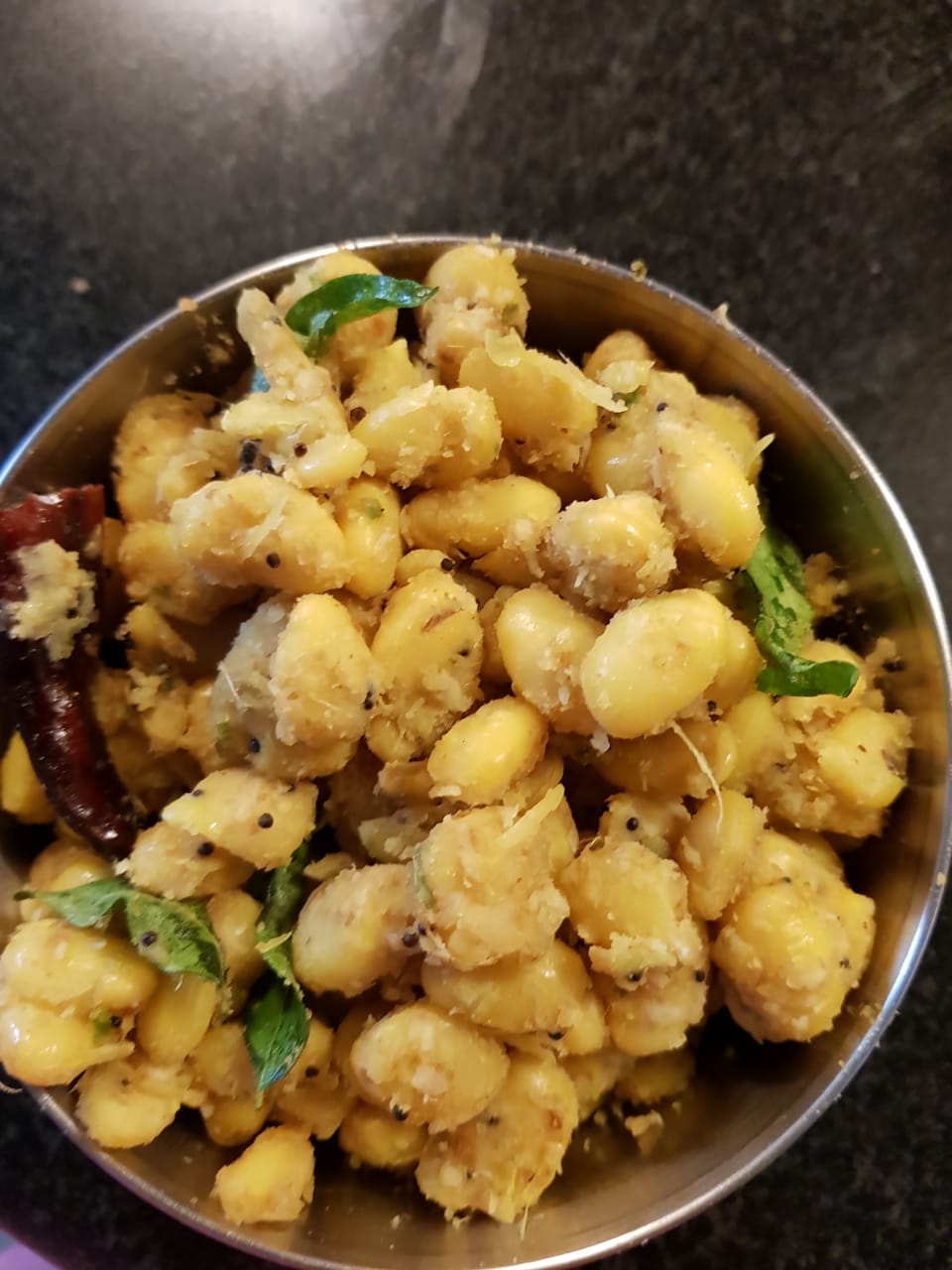
Kollu Sundal
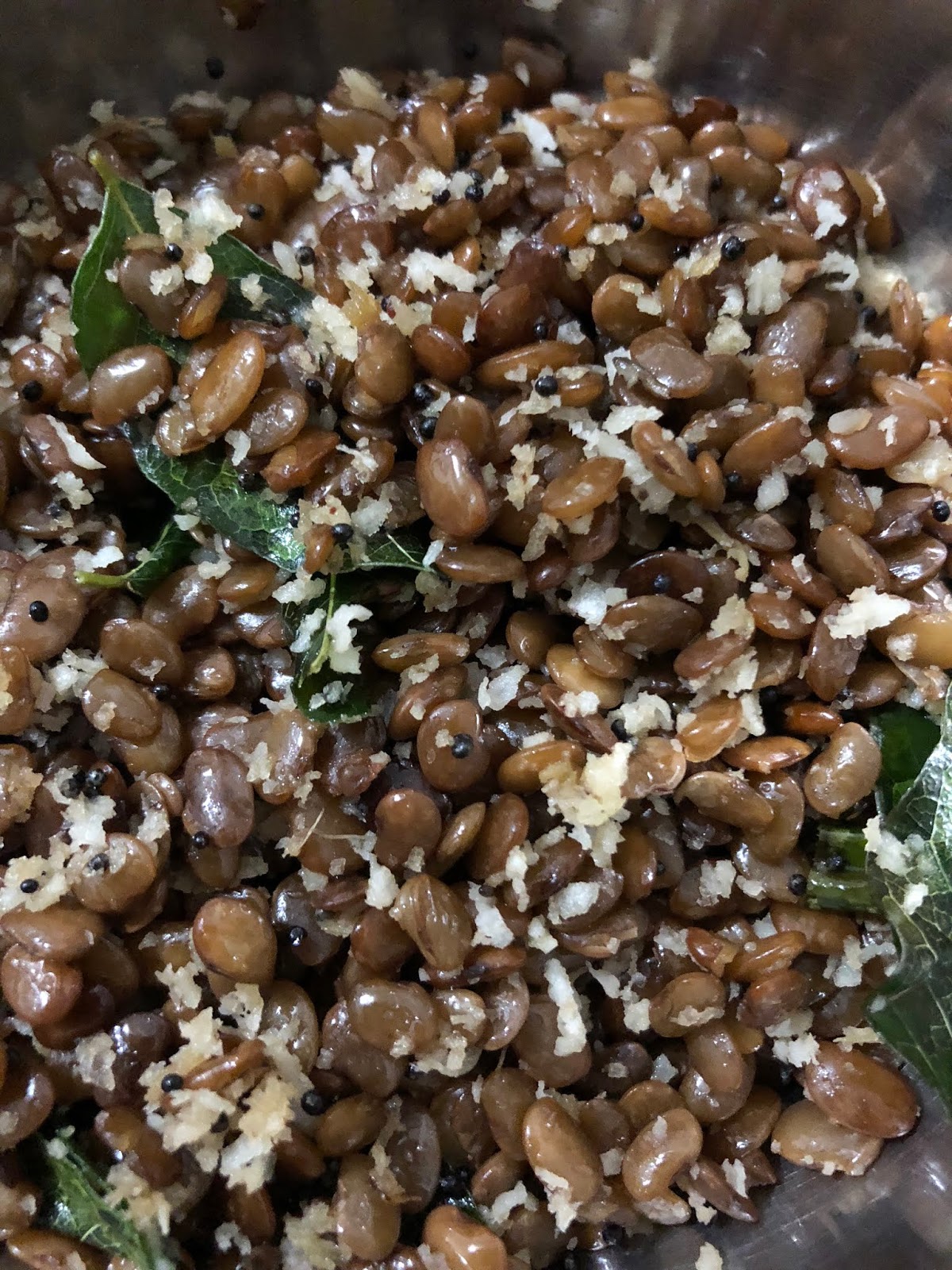
Sundal:
Ingredients:
sundal : 200g
Mustard/Rai : 1/2 tsp
Red chilli : 1 to 2
Curry leaves : few
ginger : 1/2 inch
green chilli : 1
[Note:Make coarsely mashed paste of ginger and green chilly]
hing : pinch
fresh coconut grated : 2 tbsp
oil : 1.5 tbsp
salt
Note:
For Thatta payir (karamani) or green moong dal sundal, u can dry saute them till they heat up well and then pressure cook it for 5-6 whistles.
For other varieties, soak the sundal for 2-3 hours and pressure cook it for 3-4 whistles
Method:
Heat oil, add mustard seeds, red chilli halved, curry leaves, ginger+green chilli paste.
Saute for few seconds, then add hing, add sundal (after draining the water well),some salt and saute for 2 min.
Add coconut and saute for 1 min. Switch off.
You can garnish with few fresh chopped coriander leaves if u like.
Great recipe, thanks for sharing.
ReplyDeletetuvar dal online
toor dal online india
buy dal online